Category Archives: Atoms for Peace

“The weekend at the college didn’t turn out like you planned” … and neither did this week

(Title from Steely Dan’s “Reeling in the Years”)

Before we get to the week, let’s get back to Con-Gregate. Winston-Salem is less than 90 minutes away, it was a smooth drive and I found a spot in the parking garage very close to the entrance to the hotel. On the downside, parking cost around $40 for the weekend; it may be a good thing if they switch hotels next year.
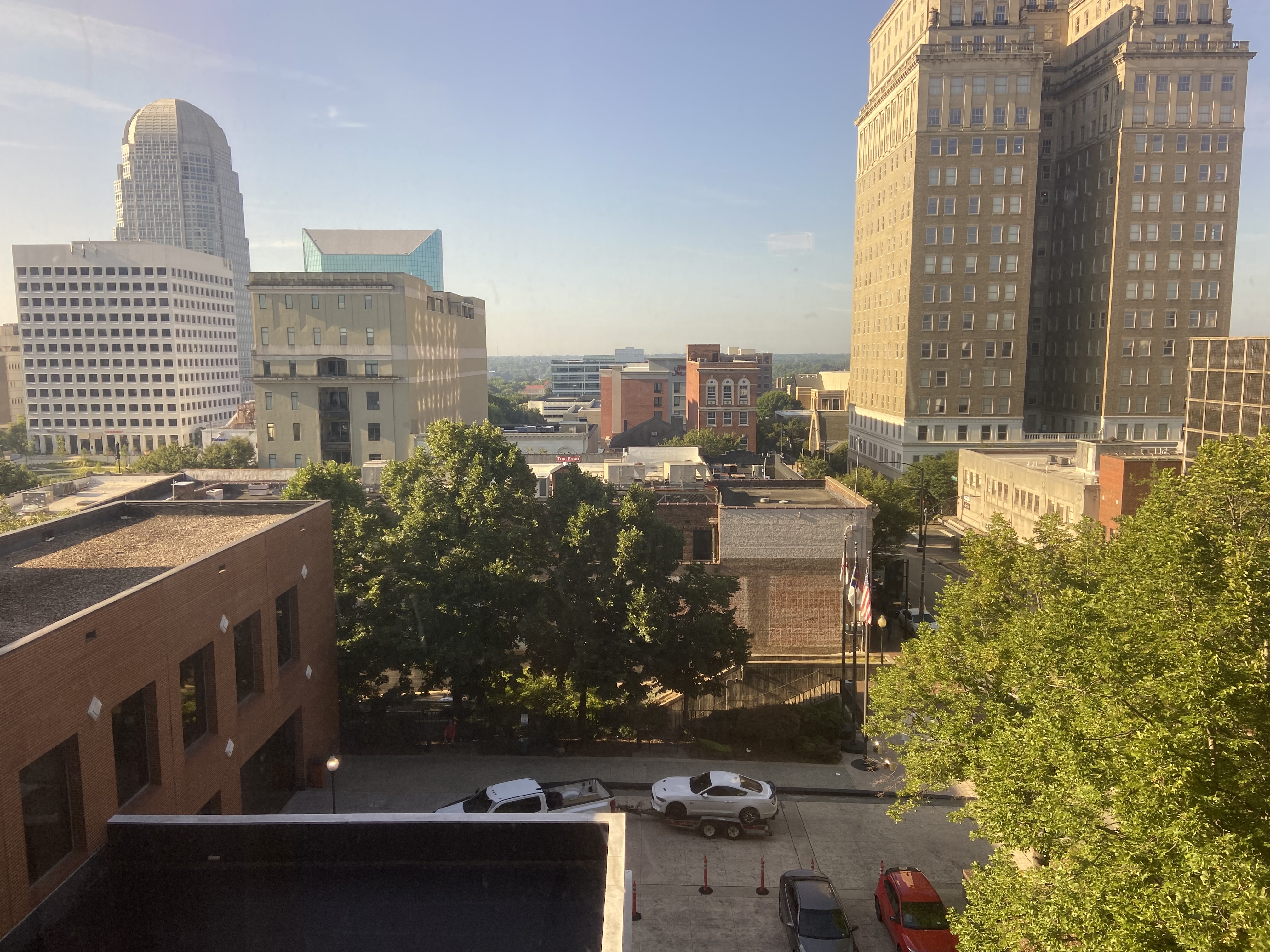
(The view from my hotel room)

Because the “author’s alley” tables for selling books were all bought up, I had to settle for a table in the dealer’s room. That was less than ideal as they cost more and have shorter hours. I did, however, want to sell more than I was able to at Ravencon, and that wasn’t going to happen without some sort of table. So … and it paid off, covering the cost of the space and a little more.

I’m always fascinated by how some books click at different cons more than others. There’s no pattern to it I can see, unless it’s something in the way I display them. This time I sold five copies of Atlas Shagged. One of them because one of the audience at my reading Sunday liked Dark Satanic Mills so much. That’s very flattering.

I also sold three copies of Questionable Minds, three of Undead Sexist Cliches, and two each of Atoms for Peace, Ceaseless Way and Sex for Dinner, Death for Breakfast. Links available at my Behold the Book page. This time I was professional and figured in sales tax ahead of time — otherwise I’d be going “Oh, I’ll eat the tax, don’t worry about it” rather than figuring it out.

I only had three panels: one on fashion in fiction, one on fae in fantasy (I plugged Southern Discomfort mightily) and one on mad science in movies (I brought up some Dr. Jekyll, of course). The rest of the time, I sat at my table. Which was fine except I kept worrying when I left to get food or tea that I’d miss another sale — and yes, I’m small-fry enough that every sale matters. As guesting comes with a free second membership I’m thinking about inviting someone along to help — though they’d still be stuck paying for hotel rooms (I really value having a room to myself and I can’t afford two). Food for thought.

I still managed to chat with several friends and bought $60 of tea from Moments in Tea, a dealer who’s found cons supplement their online business well (I’ve bought from them before so I knew they were worth it). Then a smooth drive home.

Then the week. I took Monday off to recover but rather than rest it was the third type of day off — attending to assorted tasks that had accumulated. A couple of issues with my insurance (resolved), one with pet insurance (still up in the air), various other odds and ends. Necessary, and glad they’re out the way, but not relaxing.

Tuesday I spent mostly working on Local Reporter update articles on Tropical Depression Chantal. One about the impact on local businesses, one about ways to donate to help. Then, Tuesday evening TYG was running a quick errand and wound up with a staple in the right rear tire. The big heavy kind, not the paperwork kind. Fortunately she got home safe on the donut, once AAA changed it for us, but I spent Wednesday afternoon at the tire place getting a replacement. And that after a Wednesday morning spent at a doctor’s office, one of those routine “let’s check that possible problem to make sure it’s not a problem” appointments. That chopped up the working day to the point I got zippo done.

Yesterday? Cleaners came in, which didn’t use to be a big deal. Now I spend a couple of hours upstairs with Snowdrop and Wisp – we lock them in so they don’t panic and rush out with strangers in the house. This is surprisingly brain deadening so I budget it into my time … but as the cleaners came first thing in the morning, that meant most of the day deadened. Probably worse because I think I have a low level of “con crud” — nothing disabling, just a general sense of dragginess. This morning I overslept by about two hours which is way abnormal for me. If that’s the worst it gets, though, I’ll consider myself lucky.

So a little bit of work on Savage Adventures, a little bit on Jekyll and Hyde. Nothing else. And this weekend we take Snowdrop to the vet for his annual physical. Pray for us.

All rights to images remain with current holders.

Leave a comment

Filed under Atlas Shagged, Atoms for Peace, Nonfiction, Personal, Sex for Dinner, Death for Breakfast, Short Stories, Southern Discomfort, Time management and goals, Undead Sexist Cliches: The Book, Writing

I am not as miserable as I thought I’d be today

I’m still horrified by Wednesday’s catastrophe. And I have moments of stomach-clenching dread about what happens next. Worried for myself and TYG because even though we’re a white, heterosexual couple in a blue area, this will affect us in lots of ways (a massive increase in inflation from Trump’s proposed tariffs, for instance). Horrified for what’s going to happen to gay people, immigrants, women as Republicans try to restore the white man’s absolute supremacy in America. Pissed off that while multiple countries have elected women to lead them in my lifetime, America can’t do it.

And yet, I’m much more functional than I expected to be. Much more than in 2016. Partly because I had deadlines to meet. Partly because having listened to Trump and the rabid dogs of his party on media and social media for the past eight years, listening to them crow about the evil they’ll do — well, it’s not like I shrug it off but it’s not shocking at all.

As to work, I got several small tasks done. I figured out how to change my sidebar in the WordPress system I’m currently using so I can once again keep switching around the books I promote there. I was going to submit two reprints to markets based on a website report that they took reprints …. got to the submission manager and no, they didn’t. Wasted effort.

And Draft2Digital informed me I sold one copy of Atlas Shagged and one of Atoms for Peace. Thanks y’all (I know the person who bought the latter, though I don’t think they follow this blog).

Monday I finally finished correcting Southern Discomfort. Now I have to go over the corrected manuscript and check for any errors that I made in the previous go-round (I’ve found some). And do it carefully and slowly enough (but not too slowly) that I don’t introduce fresh errors. Yes, that’s doable. It’s more work but the end is in sight.

I rewrote one chapter of Jekyll and Hyde which I’ll be reading to the writing group next week. The stress of the election meant I only caught one movie, The Nutty Professor — no, not the Jerry Lewis or Eddie Murphy versions but an animated 2008 sequel to the Lewis film.

I got two articles into The Local Reporter, one on Carrboro’s ongoing quest for affordable housing and one on a Carrboro support-the-veterans initiative. At Atomic Junk Shop I wrote about an idiot-plot Daredevil story, two Krypton-related stories and the demise of Mad Magazine paperbacks.

A good week workwise, sucky for America.

Leave a comment

Filed under Atlas Shagged, Atoms for Peace, Southern Discomfort, Writing

This one simple trick to sell books really works!

Last weekend I took the 90 minute drive to Winston-Salem for my second time as a Con-Gregate guest. Unlike 2022, I went to the expense of buying a sale table in “author’s alley” where I could display my books and sell directly to con-goers. A reasonable price but I was still nervous: what if I’d just wasted the money? What if I didn’t sell anything?

Still, I’ve got to admit even that had been the case, it’s really cool to see my books spread out like this:

Looking at that display, I feel like a real author. Which I am, but working day to day, getting rejections from this market or that, wondering if I’m just fooling myself, it’s easy to feel like I’m not. But I really have published quite a bit, haven’t I? In case you’re wondering, the stage-left side is my McFarland books, the rest is the product of Behold the Book, my publishing business (which is just me with a business name, but it still feels cool).

As soon as people started coming by, my old bookselling instincts (ten years at Waldenbooks) kicked in. Watch the people. Make eye contact if they turn my way. Then say “Want to buy a book?” or “I can see you have no books in your hands. I can help with that.” Get them over, answer their questions, get them to pick up a book and look at it … all the little things that make closing the sale more likely. The end result was that I cleared more than $150, paying for the table, the two books I bought from friends and my meals (if you’re in Winston-Salem, I highly recommend Washington Perk and Brothers Pizza across the street). I sold a copy of The Wizard of Oz Catalog—and The Aliens Are Here, both from McFarland. I also sold at least one copy of every one of Behold the Book’s books, with Sex for Dinner, Death for Breakfast the winner (four copies) —— and three copies of Undead Sexist Cliches (also available as an ebook)I also did several panels, got to catch up with multiple authors I know (though sitting and selling books reduced my hanging-out time) and generally had a fantastic time (not having to deal with injured Wisp didn’t hurt). But selling copies of my books was far and away the highpoint. This is the last con I have this year but I’m thinking of what I can do next year. Business cards would be good; a couple of people who didn’t buy books asked for them but I had none. I’d also like to figure out how I can balance socializing with selling.

My writing colleague Naveed Mooed was there with me and willing to cover but he had obligations and panels to attend too. Bringing someone along whose prime directive is to cover the table would be good but I don’t have anyone (it’s not TYG’s kind of event). And I am probably better at selling my wares than most people I could bring would be, and that makes a difference. Nobody as yet is going to go “Fraser Sherman has a table! Let’s go buy!” so it takes that extra effort to seal the deal.

I would like to say that after I got home my week was equally productive, but not quite. It was, however, better than the rest of July. I reworked Oh the Places You’ll Go but I’m not sure whether I’ve fixed the problems or simply created new ones (I’ll blog about this sometime soon); this may reflect that thanks to Wisp I’m still way behind on sleep and my judgment’s impaired. It says a lot that last night I fell asleep petting her and whatever I was doing in my sleep annoyed her enough she gave me a play bite to remove my hand. Yesterday and today I got little creative stuff done — but still, even discounting the weekend this was the first time this month I managed to put in a full week of writing. Yay! Hopefully we’ll do better next week.

#SFWApro. All rights to images remain with current holders; Undead Sexist Cliches cover by Kemp Ward.

3 Comments

Filed under Atoms for Peace, Nonfiction, Now and Then We Time Travel, Sex for Dinner, Death for Breakfast, Short Stories, Undead Sexist Cliches: The Book, Writing

Let No Man Put Asunder: Finding the Sweet Spot

So last month I finished the first chapter of my rewrite of my second novel, Let No Man Put Asunder. I rewrote it once some 15-20 years back; I’d have rewritten it again by now except most of the manuscript is gone. I did get a couple of chapters beyond the cutoff, but somehow every attempt to progress further hit a mental dead end.

This version though is a radical break. My protagonists, Adrienne and Neil, were mostly in good shape when the bad guys kidnap them into another dimension. To their surprise, it turns out that a weekend of death and danger (the story moved pretty fast) also gave them things that were missing in their life. Fresh adventures would have lain in wait …

New protagonists Paul and Amanda aren’t in such great shape. Mandy has been de facto mother for her five siblings and caregiver for her terminally ill dad since she was fifteen — as we learn in the first chapter, Mom decided terminal illness wasn’t something she wanted to deal with and walked out. However it’s been twelve years and Mandy’s recovered from Mom’s betrayal (but has not forgiven her at all).

Paul is in much worse shape as his big blow came less than two years ago. His academically prominent parents pushed him to excel from elementary on. He’s had no social life, has no idea who he’d be if he didn’t have his nose buried in books all the time, so finally he told them, right before senior year, he was taking a year off after college. When he arrived back at school Paul discovered his folks hadn’t paid his tuition, had broken the lease on his apartment and drained the joint bank account they used to provide him with ready cash. But no problem, just take back your foolish decision, son, and everything gets back to normal!

He didn’t take it back.

The Adrienne/Neil version had a first chapter set here on Earth, then we were off into other, wilder dimensions. I’m not sure that’s the way I want to go. The town of Blue Ivy, where Mandy and Paul meet in 1976, feels like a good setting. It’s a grimy industrial town but it also has several colleges, with the usual college/townie conflicts. It seems a shame to just forget about it and go elsewhere, particularly in America’s bicentennial year (I don’t know if I’ll keep using that year but if I do, I should be able to make something of it).

The trouble is, I don’t want to go the urban fantasy route. I enjoy reading books where the normal world is just a shell hiding a reality full of magic but I don’t seem inclined to write them. Southern Discomfort is closer to intrusion fantasy: the normal world works much as we see it but something magical has intruded in, disrupting things. In Questionable Minds there’s no hiding: the world is full of psychic powers but they’re being wielded in plain sight.  In Atoms for Peace the mad science that’s made the world so different from our 1950s is also commonly known. In Impossible Takes a Little Longer, super-powers are the same way.

If I set Asunder on Earth, I want it feel like magic is an intruder, not a regular resident. That was doable in Southern Discomfort because the magic almost all stems from the elves Olwen, Aubric and Gwalchmai and it’s limited to one small town in Georgia. Asunder has a lot more magical people running around with much flashier powers. And the different characters — Mountebank, Grainge, Cordelia Winters and Hypatia, to name four — don’t fit into the same magical mythos. They didn’t have to in the original version and I see no need to change that. But it would, again, make an odd urban fantasy

So do I go urban fantasy anyway and find some way to make it work? Go back to dimensional jumping and kiss Blue Ivy goodbye? Maybe make Blue Ivy some kind of Hellmouth where, like Sunnydale, things are weirder than the rest of the world?

There’s also the practical point that I’d like my protagonists isolated, at least for the first few chapters. That’s harder to do in a setting where they know everyone.

Normally I’d plunge ahead and pants these questions as I go but the first chapter ends with Mandy and Paul falling through a magical gate of some kind. I need to know where they land.

Wish me luck!

#SFWApro. Cover by Samantha Collins, rights to the image are mine.

2 Comments

Filed under Atoms for Peace, Impossible Takes a Little Longer, Uncategorized

A trip to the library/Has made a new man out of me

(Title is a line from the musical She Loves Me).

Last weekend was, of course, Thanksgiving weekend, and I had a great time. It’s rare to have a big block of time as a staycation and it was incredibly relaxing (for TYG too). Thanksgiving dinner, as usual, was at Parizade, a local restaurant that hosts a massive, and extremely tasty, vegan meal. I managed to stop at the point of complete fullness without going over, despite the temptation to eat more, more, and then more.

Saturday, as our date for the weekend, TYG and I went to Durham’s new main library. It closed for remodeling a few years ago which broke us of the habit of regular visits — I hit a closer branch library instead — and when it reopened it was during the pandemic. But we kept saying we should go check it out, and finally we did. And damn, it looks good.Plus some of my books are in the catalog, which is pretty cool.#SFWApro

Leave a comment

Filed under Atlas Shagged, Atoms for Peace, Personal

Standing alone

When I was a younger writer, I thought a lot about series. My second book would have kicked off a series if it had sold; a couple of later ones would too. One of my earliest published short stories, Where Angels Fear to Lunch, looked like it had potential to be a series; it did eventually generate a sequel short story, No Good Deed Goes Unpunished (the first story isn’t out anywhere online — well, not at the moment).

Unsold novels, however, do not turn into series. And few of my short stories generate enough interest to feel a sequel is particularly sellable. The exception is Atoms for Peace: I submitted the tenth story in the collection, Instruments of Science (actually the first chapter of a then current WIP) to Big Pulp more than a decade ago as a stand-alone. They asked for more. Ironically, the changes I made to the stories changed the original novel so much (titled The Brain From Outer Space) I was never able to get it back on track.

As I’ve grown older, my mind seems to generate stand-alones, not potential series. I look at stories that could generate sequels like One Hand Washes the Other, and nothing comes to mind. Partly because that story is an intensely dramatic turning point for the protagonist; I can’t make every story a turning point but I don’t usually want to write Just A Story about the characters. And partly, I suspect, because I’m older and I’d sooner write whatever fascinates me at the moment than just whatever sells. Of course, I don’t sell that much (yet!) so it’s not like there’s any overwhelming pressure to provide a sequel; as I’ve joked before, I’ve never been forced to choose between the magical realist novel I want to write and the lucrative werewolf raunch comedy movie script.

I do not think, however, that I’ve left any unresolved cliffhangers. I don’t think anything I’ve written doesn’t have a satisfactory ending concluding the arc, even if there are clearly more stories ahead. At the end of One Hand Washes the Other, my protagonist starts a new life as sidekick to a wizard, but his character arc for the story is complete. Atoms for Peace has an unresolved plot thread or two — will Steve ever find his brother? Will Dani and Steve tie the knot? — but I can’t see anyone feeling frustrated there’s no follow-up.

Which brings us to Questionable Minds. When I wrote the original “finished” draft more than twenty years ago, I thought that if it sold I could do lots of sequels. Maybe even follow Sir Simon Taggart’s daughter Ann growing up and becoming a hero in her own right. But it didn’t sell.

Perhaps self-publishing and putting in a modest amount of promotion will sell enough copies that a sequel becomes practical. I do have ideas for another book, maybe two.

But if not, I don’t think anyone will walk away frustrated. While Simon’s hunt for his wife’s killer remains a loose end, the ending does resolve some of his trauma over her death. As a character arc, I think that works to make it satisfactory even if it’s a standalone. And the main threat of the book, Jack the Ripper, is well and truly dealt with. I think I’ve stopped where it encourages people to want more (I can dream) but it doesn’t require more. Even if I write nothing more, I don’t think it’ll leave readers frustrated.

Less than two weeks to launch, woot!

#SFWApro. Covers by Zakaria Nada (t) and Samantha Collins (b) all rights remain with current holders.

Leave a comment

Filed under Atoms for Peace, Short Stories, Writing

This harrows me with dread and awe

This was a much better week than last week.

You may recall my big disappointment (if you don’t recall, click on the link!) was running into a plot hole at the climax of Questionable Minds. This week, I sat down and started doodling ideas and presto, I found the solution. I’ll want to look over the ending again, but the book is done. I also completed the footnotes of Undead Sexist Cliches so that’s done too. That explains the awe.

The dread is that now I’m going to release them into the world. Self-published stuff, and not previously published like the stories in Atlas Shagged or Atoms for Peace. And much more substantial than Sex for Dinner, Death for Breakfast. I feel the inevitable trepidation — what if despite all my work, they suck? What if nobody buys them, like, ever? But regardless I’m forging ahead (well of course).

I did have a talented friend working on the cover for Questionable Minds but I think over the course of the pandemic she’s wound up checking out. Which I didn’t worry about when I was slogging through the middle of the book, but now? Kind of need it. So if I don’t get a response to my recent “how’s it going?” I’ll have to hunt elsewhere. Darn it. And also for Undead Sexist Cliches. Though that one’s slightly easier as I have a good idea what I want.  Assuming I can find a cover artist, I’ll be done with both before my birthday. The biggest obstacle will be indexing Undead Sexist Cliches for the hard copy version.

Dread, but definitely awe.

Other than the two books, I did some leafs, watched some movies for Alien Visitors and wrote some of the chapters. I’d hoped to work on some short stories, but no, the added demands of dog care ate into that. Still, I’m pleased with what I accomplished.

Definitely some awe.

#SFWApro. All rights to cover are mine.

Leave a comment

Filed under Atlas Shagged, Atoms for Peace, Nonfiction, Sex for Dinner, Death for Breakfast, Time management and goals, Undead Sexist Cliches: The Book, Writing

A delayed double feature to last week’s movies

One the Night of the Comet commentary track, writer/director Thom Eberhardt listed TARGET EARTH (1954) as an influence on the film, so that was my first choice for viewing last weekend.The film’s opening scenes in which Kathleen Crowley wakes up (having tried and failed to commit suicide by sleeping pills) to find the small city she lives in completely empty are extremely effective. Then she meets up with a similarly baffoed Richard Denning and a couple of party animals; together they figure out that the city was evacuated while they were all passed out for one reason or another. Then the sight of some rather unconvincing robots tells them why everyone else left … meanwhile the military tries to figure out how to stop the robots sent as the first wave of a Venusian invasion.

Despite the robots and the underlying absurdity (I’m familiar with evacuation issues and clearing out a city in 12 hours is impossible), this is pretty good. I don’t like the gangster who wanders in late in the movie but I do like that the protagonists are just trying to survive; they’re not part of the fight against the aliens and don’t really know what’s going on (I used a similar approach in my Atoms for Peace short story The Claws That Catch). “All we can be sure of was that this invasion was not launched by any power upon this Earth!”

Kelli Maroney says Eberhardt told her to watch Carole Lombard in MY MAN GODFREY (1936) for her role as Samantha and I can sort of see why. Lombard’s character is something of a space cadet, a ditzy heiress who recruits derelict William Powell as a find in a scavenger hunt, then gets him to work for her family as the new butler. Much to her annoyance, he refuses to fall in love with her, but her efforts to change his mind keep the movie humming. With Eugene Pallette as Lombard’s grumpy father and Alan Mowbray (to the left of Powell in the post above) as a former college chum of Powell’s. Definitely worth rewatching in its own right. “What does it matter where one puts flowers when one’s heart is broken?”

And to go with Webber’s Phantom of the Opera I rewatched Lon Chaney’s classic silent THE PHANTOM OF THE OPERA (1925). While I suspect Webber may have replaced Chaney as the definitive version of this story, this is truly spectacular production in the sets Chaney’s powerful performance and his grotesque makeup (unlike most later versions, Erik here was born a freak; later incarnations were the result of accidents). Another one that’s a pleasure to rewatch, though Christine has a better role in the stage show. “No longer shall I spew venom like a toad.”

I also caught an episode of the old DESILU PLAYHOUSE, The Time Element, which I’ve wanted to see for years because it’s the pilot from which Twilight Zone launched. William Bendix plays a bookie telling psychiatrist Martin Balsam about this recurring dream in which he wakes up in Hawaii — specifically Pearl Harbor, Dec. 6, 1941. Initially he plans to exploit his knowledge and bet on every upcoming sporting event, but then he starts having qualms and tries to warn people about the Day That Will Live In Infamy — but will anyone listen? The version of the grandfather paradox given here doesn’t make sense, but the cast is solid and the situation is effectively intense; it says a lot about the limited exposure to SF most of the audience had back then that Desi Arnaz, as host, reassures viewers this was all the psychiatrist’s imagination. “The U.S.S. Arizona’s never been sunk!”

#SFWApro. All rights to images remain with current holders.

1 Comment

Filed under Atoms for Peace, Movies, TV

Putting the pieces together

Like (I imagine) a lot of writers, I’m tossing around ideas in my head even when I’m not writing. Maybe more when I’m not writing, as I’m not required to focus on anything.

A lot of it is less plots or characters than just bits of things. Opening lines. Names. Ideas. Scenes unattached to a story (particularly climaxes. I love imagining dramatic climactic confrontations). I sometimes think they’ll just float around in limbo unattached because I’m very linear in my writing: I can’t start with a scene and then write the story that leads up to it. My mind just doesn’t work that way. Lately, though, I’ve noticed I’ve been able to use several them.

Death is Like a Box of Chocolates incorporates bits of several ideas floating around in my head. A story about a small-town reporter. A female lead with the first name Pershing. The idea of a thief stealing something off a baggage carousel that turns out to be supernatural — I’ve had that floating around in my head since before security cameras were everywhere, one reason I wound up setting the story in the 1980s.

Impossible Takes a Little Longer will, if it ends up the way I anticipate, use up a scene I’ve had floating in my head for a couple of decades, which I won’t spoil here. I didn’t start from that scene and work back, it just suddenly struck me how well it would work in the book.

I’ve done this occasionally with earlier stories. Not In Our Stars But In Ourselves, one of the stories in Atoms for Peace, used a name I’d had in my head, “Elegy” Walker, though very differently from my original concept. Maria, my protagonist from Southern Discomfort, drew on an earlier character in earlier drafts, an Italian-American living in a small Southern town. The difference is so marked, I may go back and reuse that earlier version somewhere else some day (ditto a supporting character, Megan O’Donnell, who got dropped entirely).

It feels really good when I get to use up one of these ideas. Really, really good, like an itch that’s been lying there, waiting for the scratching. I’ve got maybe two more climaxes I’d really, really like to put to use — let’s hope the trend continues and I can do it before too long.

#SFWApro. Cover art by Zakaria Nada, all rights remain with current holders.

Leave a comment

Filed under Atoms for Peace, Impossible Takes a Little Longer, Short Stories, Southern Discomfort, Writing

Worlds in collision: why I don’t write utopias

In a recent thread on Twitter (sorry, I don’t have a link), NK Jemisin took issue with people pushing for fewer dystopias, more utopias: people of color, women and gays (for example) all have good reasons not to feel optimism. Where utopian fiction is sunny escapism, dystopian fiction grapples with the darkness.

I see her point about the appeal of dystopia, but I think breaking utopia and dystopia into some kind of escapism/serious fiction dichotomy is wrong. Utopian fiction is traditionally educational, not escapist, starting with Sir Thomas More’s original Utopia. The goal isn’t to entertain with a fantasy but to show how an ideal society would work, or how we get from there to here.

Conversely, a lot of dystopia is escapist. Hunger Games. Cyberpunk. It can be the horror of the protagonist being ground under by a corrupt system, or the excitement of being the rebel fighting against tyranny, but the goal is, as with most fiction, entertainment. It may satisfy because it speaks to our fears about the future or our experience of life, but I don’t think it’s inherently more serious than utopian fiction.

And that got me thinking, again, about how when I write stories that change the setting’s social order — Southern Discomfort, Atoms for Peace, Questionable Minds — I change some things, improve some things, but I don’t improve everything. In Atoms for Peace, women are much better off, 1950s sexual standards are looser, but people of color haven’t gained anything. In Southern Discomfort, the McAlisters prevented the worst violence of Jim Crow from affecting the black residents of Pharisee County, but women and gays aren’t any better off. And by 1973, younger blacks see the McAlisters as more patronizing and outdated than protective.

I could have shot for utopian, or closer to it, but dramatically it doesn’t interest me. A system that’s changed from our own, or in upheaval (in Questionable Minds, Victorian England is still attempting to fit psi-powers into the established caste system) has more storytelling potential for me than a utopia where everything works.

That’s personal taste, not a writing rule: I could imagine the alt.1950s of Atoms for Peace reluctantly embracing civil rights and still tell the same stories. But a setting that works imperfectly appeals to me more. That’s not meant as an excuse — if someone thinks Southern Discomfort should have had a larger gay presence, they’re certainly entitled to criticize my storytelling decisions — just a statement of fact.

Of course, I don’t write dystopias either. But that’s just because I don’t write the kind of SF that imagines dystopia, so no great lessons to learn.

#SFWApro. All rights to image remain with current holder.


1 Comment

Filed under Atoms for Peace, Politics, Southern Discomfort, Writing