Tag Archives: 19 ♾️

There is no question that spring has sprung

In North Carolina, mother nature lets us know.
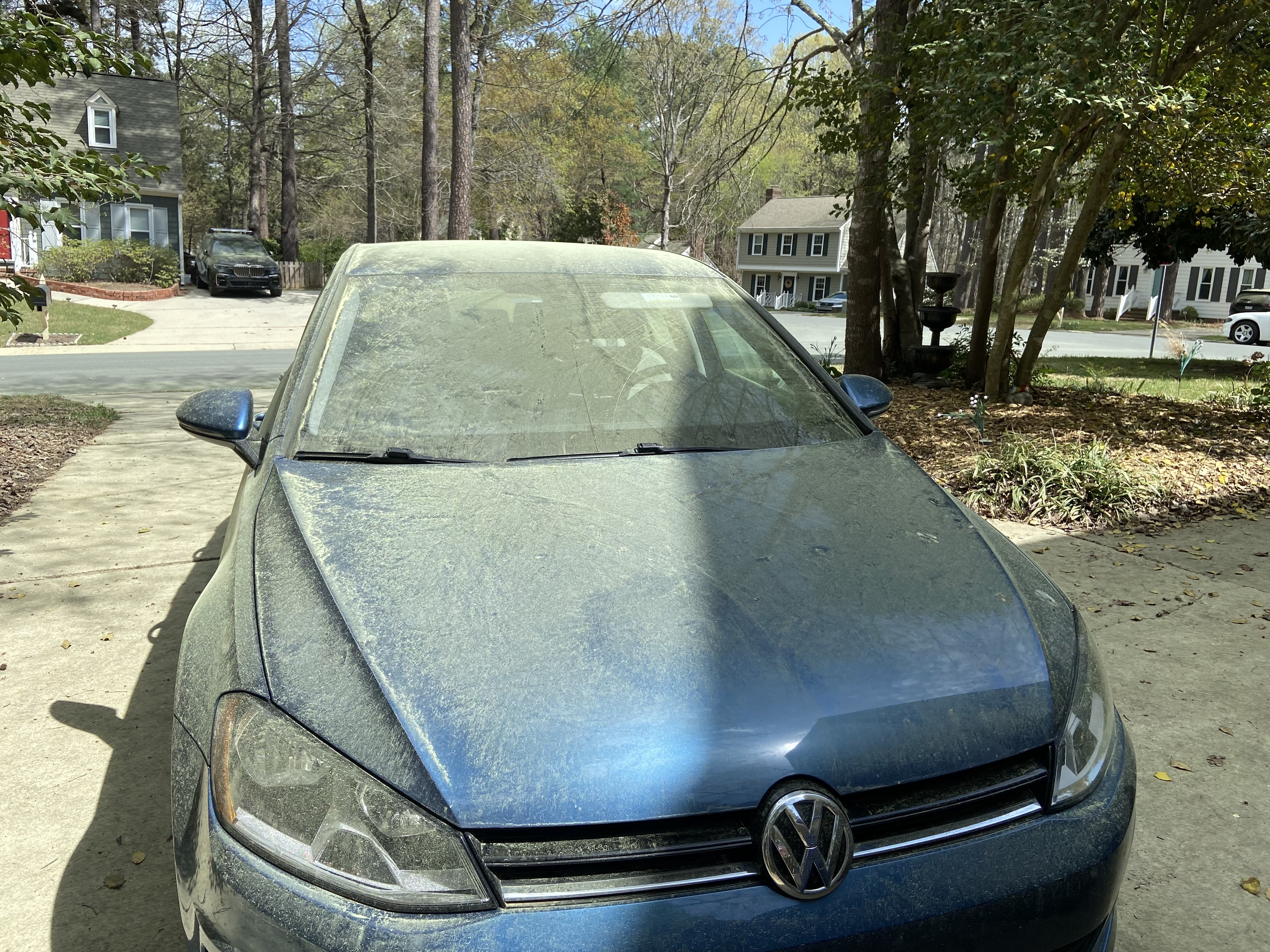
This has been an exceptionally pollinated week. Monday I could see clouds of the stuff blowing along the street; despite taking Claritin, I’ve been coping with occasional sneezing, scratchy throat and watery eyes all week. It still doesn’t wipe me out the way the pollen mix back in the Florida Panhandle did.

Pollen aside, it was a good week. The Local Reporter printed my story about musical duo Blue Cactus. At Atomic Junk Shop I discuss the pros and cons of sticking to the status quo when writing fiction. Unfortunately the site is glitching and not posting illustrations when I upload them so my second post couldn’t be posted; our tech person is AWOL and the hosting company hasn’t answered my questions so far.

I wrote another 6,000 words apiece on the next drafts of Impossible Takes a Little Longer and Let No Man Put Asunder. My decision to shift Impossible to the early 1980s is paying off — it’s working much better — though I’ll need to add more period detail.

I worked on rewriting Savage Adventures and watching more films for Jekyll and Hyde. I also worked on a couple of Local Reporter stories that won’t be out until next week. And I got to read part of Jekyll and Hyde to the writing group, the section dealing with Dr. Jekyll and Sister Hyde. Strongly positive reaction, though they pointed out that in a couple of spots I was dropping too many movie references without explanation. It’s a common problem and easy to course correct.

TYG’s birthday was this week too. Her birthday wish was to have it free of any responsibilities around the house so I took care of the dogs, including lunchtime drug-dosing while she went off shopping and eating lunch out. For dinner I made her zucchini lasagna, a labor intensive dish that’s one of her favorites. She gave the day thumbs up.

Oh, and I sold one ebook of Questionable Minds and one of 19-Infinity last month. If you’re reading this, thanks for purchasing.

Cover by Kemp Ward.

Leave a comment

Filed under Impossible Takes a Little Longer, Movies, Nonfiction, Personal, Time management and goals, Writing

Story Behind the Story: The Schloss and the Switchblade

We’ve come to the final story in 19-Infinity. Like A Famine Where Abundance Lies, The Schloss and the Switchblade started as a contemporary story. It didn’t sell — I had one editor tell me he loved it a lot but he only had so much room in his anthology (so yay! and sigh) — and as the protagonist, Ward Hanover, broke into movies in the late 1950s, that meant every year that passed without a sale made him more and more withered.

Another problem is that it deals with Nazis. I finished it in 2015; after Charlottesville’s Unite the Right rally in 2016 Ward wouldn’t be thinking of Nazis as a relic of the past. And as Trump continued dragging us further and further toward fascism, I kept rewriting again and again … so I finally decided to set it back during the Obama years. Pushing it back to 1999 wasn’t that big a jump.Like Where Angels Fear to Lunch, the seed of this story was the title. The Cross and the Switchblade was a 1963 autobiography about a heroic preacher leading street punks to Jesus; it went on to become a movie in 1970 (there was also a comic-book adaptation). I’ve no idea what led me to come up with a pun on the title but as soon as I did, I knew I wanted a story to go with it.

The idea that the story involved an awful low-budget movie hit me almost at once. The movie was The Juvenile Delinquents Meet the Nazis, part of the infamous Juvenile Delinquent series. The film series was a knockoff of the long-running Bowery Boys films (the title is a riff on The Bowery Boys Meet the Monsters), but so crappy it made them look like high art. This particular entry in the series involved Nazis, a resurrected Adolf Hitler and a monster, or so I recall.

My first draft, however, was little more than two people watching the movie on video, then an ending twist (whatever the twist was, it didn’t work). Sure, parodying low-budget movies made me laugh — the first draft was very much keyed to my sense of humor — but I had to make other people laugh too. And I needed a story that would justify all the time spent watching the movie because by itself the parody just didn’t work. I tried writing it as a review, which worked with Uneasy Lies the Head That Wears the Clown (available in Atlas Shagged as both ebook and paperback) but flopped with this story.Finally I hit on a plot that worked. Ward is the guest of honor at the science fiction convention Nevercon. To his surprise, the “classic Ward Hanover film” they’re screening isn’t one of his hits such as The Unforgiving Minute but his first film, lost when the studio burned in a fire, probably arson for insurance. The thought of seeing his younger, inexperienced self struggle with the terrible script and no-budget effects makes Ward cringe but he can’t see any alternative but to be a good sport about it.

In the film it turns out Hitler survived the Fall of the Third Reich and is now about to unleash a monstrous demon on the world, killing anyone who isn’t pure Aryan blood. He’s backed by a powerful American millionaire which has the government’s hands tied. They need agents who can’t be linked to the federal government, someone willing to fight for their own freedom and safety if nothing else. They need … the Juvenile Delinquents!

The movie starts out as bad as Ward remembered. But as it runs, some things seem … different. Sure, it’s been forty years but there are way too many extras in Nazi uniforms for a film this cheap. And the demon is way, way more realistic than the F/x budget would have allowed for. And why are so many people in the audience wearing Adolf Hitler masks?

I had a lot of fun with this one. Hopefully you’ll have fun reading it.

#SFWApro. Cover by Kemp Ward rights to images remain with current holders. 19-Infinity is available on Amazon in paperback and ebook and also available as an ebook on other websites.

Leave a comment

Filed under Short Stories, Story behind the story, Writing

Did I fall short or set my sights too high?

I may have been premature in declaring Wisp a contented indoor cat. We got Snowdrop to come in a couple of times this week and it was adorable: they nuzzled, licked each other and she bopped him on the head like she used to. However, it also looked at times like she was ready to follow him back outside. We discouraged this: she’s still a little slow on one leg and it’s just better (for cats and for the wildlife outside) if she stays inside.

The downside is that she’s still restless when she’s on the bed with me, though not as bad as when her leg was in the cast and the cone of shame.And I no longer get mornings to myself because she loves me and follows me down when I get up. The loss of privacy gnaws at me more than you might think. If that’s what it takes to keep her indoors, though, so be it. This morning was an exception and it felt great — until I discovered she wasn’t sleeping on the bed, she’d followed me into another room and been trapped inside when I closed the door. Oops.

While adjusting my schedule to fit our new indoor cat — write in the early morning, exercise later in the day — still feels awkward, I’m getting used to it, and managing my time a little better. The lack of sleep, however, still lowers my creative ability some. I was supposed to work on Let No Man Put Asunder this morning and I just couldn’t. That said, I did get quite a bit done.

I finished a Local Reporter article on Chapel Hill’s participation in Vision Zero, a program for eliminating road fatalities and serious injuries. However there’s a major development on the Chapel Hill town council agenda for the week after next and I wound up scrambling to prepare an article for next week. That sucked up a lot of time away from my own work.

I got another 4,000 words done on Asunder and I finally see where the action’s going after this current section of talk. That’s a relief. I got less relief working on Oh the Places You’ll Go — I still can’t fix the ending. But I did sell The Adventure of the Red Leech to a new Durham specfic magazine, Dimension Zero. No pay, but I’m still pleased.

I got more work done on Savage Adventures (that was the work I did instead of the creative stuff) and finished my press kit for future Behold the Book releases. I also did some other publisher-type work, not worthy of note yet. And I had a couple of Atomic Junk Shop posts, one on writers who think they have clever insights and musing again about the end of Netflix DVDs.I also sold a copy of 19-Infinity and someone checked it out from a digital library service. Thanks, both of y’all, whoever you are.

And so the week ends. Have a good weekend everyone.

#SFWApro. Cover by Kemp Ward, all rights to image are mine.

Leave a comment

Filed under Nonfiction, Personal, Short Stories, Story Problems, Time management and goals, Writing

Story Behind the Story: A Famine Where Abundance Lies

I originally wrote A Famine Where Abundance Lies as a contemporary story. It didn’t sell (I think I know why — I’ll get to that) so when collecting stories for 19-Infinity it occurred to me to rewrite it and set it in 1996. I think this improved the story (I’ll get to that too). Fair warning: this post includes spoilers so read the book first.The inspiration for this story was a friend observing on Facebook that the Seven Deadly Sins are invariably portrayed as six ugly old men — Gluttony’s a fat blob, Avarice is a withered Scrooge type — plus Lust, who’s female and super-sexy. In reality, she said, they should all be sexy: the reason they’re deadly sins is that they’re all super-tempting. Gluttony’s going to look like Gal Gadot, Jason Momoa or whoever it is floats your boat; they’re standing there in your living room in nothing but bikini briefs, a gallon tub of ice-cream under their arm: “Yes, I know, your cholesterol’s bad, your weight’s bad, you need to diet … but are you sure I can’t convince you to indulge, just a little?” Two hours later the ice cream is gone, you’re sick to your stomach but if they came back with another tub, you’d eat that one too …

In hindsight a scene like that would have made the story more sellable but I wanted something more overtly realistic. It involves an IT professional struggling under irrational deadlines and a boss whose solution to everything is “more meetings!” Both Hannah and her boss are Christian but her boss, Carla, is big on the prosperity gospel — forget what Jesus said about giving your spare coat to the beggar, God wants you to be rich! Carla gets the bonuses from the board, Hannah and her staff get a 3 percent raise if they’re lucky (the board of directors socializes with Carla — they’ve never met the IT department).

Hannah’s convinced her new project is a game-changer that will guarantee either big bonuses and raises for her team or they can easily move on to another employer. Except a rival company is about to beat them to the punch with a similar project — can Carla’s new, incredibly handsome consultant turn things around? And how exactly will he do it?

In addition to the Seven Deadly Sins angle this was partly inspired by stories from friends in IT. Another inspiration was a story I’d started years earlier, in which a supposed hacker is a literal wizard but hides his magic with technobabble (Big data! Proprietary algorithms!). And by my personal disdain for the rich, expressed some years back in Kernel of Truth.

Like I said, it didn’t sell. I suspect the problem is that the supernatural aspect was too well-cloaked: I gave hints something weird was going on but not enough to make it feel like fantasy before the ending reveal. Another problem may have been that I never got into details about Hannah’s cool new project; I could never think of anything that sounded right.

Setting it in 1996 fixed that. Search engines were in their infancy so having Hannah come up with an intuitive, easy-to-use engine was a plausible innovation that anyone reading would get. With a little advice from IT professionals I adjusted the tech details and voila!

#SFWApro. Cover by Kemp Ward. 19-Infinity is available on Amazon in paperback and ebook and also available as an ebook on other websites.

Leave a comment

Filed under Short Stories, Story behind the story, Writing

Wisp the indoor cat? Time will tell

I’m not placing any bets but Wisp seems remarkably content staying indoors all the time, even . now that she’s mostly healed. She’s not trying to rush out past us when we open the door, even when Snowdrop’s on the deck. While we come in from walkies to see her sitting near the door, it seems more like she’s worried we’re not coming back. Cool if so: safer for her, safer for local wildlife. But if she’s determined to go out, we’ll let her.

Here’s a photo of her nuzzling Snowdrop right before we trapped him last week. This week was taken up with a lot of non-writing stuff. Day off for Labor Day. Wednesday afternoon off to give blood. Two trips to the vet with Plushie because of heavy vomiting (seems to have passed, no underlying problems detected, just one of those dog things). A couple of contractors. Even so I got stuff done.

The biggest was sitting and rereading Southern Discomfort, the first step toward self-publishing it next year. I was pleasantly surprised to find that it holds up — no major changes needed. However I changed it quite a bit when I rewrote it last year to shift Maria’s POV scenes to first person and a lot of the changed scenes need polishing or tightening. But the manuscript is, over all, sound, and this should be slightly less work than anticipated.

I also began work on an appendix to go with the book. This will go chapter by chapter, identifying the various 1970s references I’ve worked into the manuscript. Hopefully I’ve done it so well, and written such a good book, nobody will worry about looking stuff up until they’ve finished, but still, I like including the information.

That consumed much of my writing time, plus I edited a short story for the collaborative anthology, Ceaseless Way, that I’m participating in. And I got a new story in The Local Reporter, a business profile. Over at Atomic Junk Shop I discuss the limits of the Marvel app and the time Professor X woke up in bondage gear.I’m also in a Con-Tinual panel on time travel that just got posted to YouTube.

Oh, and someone checked a copy of 19-Infinity out on a digital library service. I got paid. Whoever you are out there, thanks for reading.

#SFWApro. X-Man page by John Romita Jr, 19-Infinity cover by Kemp Ward. All rights remain with current holders.

1 Comment

Filed under Southern Discomfort, Time management and goals, Writing

Story Behind the Story: Where Angels Fear to Lunch

We’re now up to 1996 in 19-Infinity with what was, in hindsight, my first 20th century historical fantasy. It came out in 2000 in Realms of Fantasy but there were reasons for setting it four years earlier.

The story began when I came up with the title. It was a small step from that to the opening line: “It never bodes well when an angel shows up at my office first thing before breakfast. Especially when the first word out of its mouth is— ‘Murder!'” Almost immediately the core concept formed: a hard-boiled detective who was really the Wandering Jew, cursed by Jesus for mocking him as he walked to Golgotha. Still pissed off — there were guys who kicked Jesus or flung poop at him, why single Ahasuerus out? — he works to balance the scales in a world where divine justice is often nowhere to be seen. Now an angel claims he’s marked for death, but who could possibly be behind it?

IIRC the story took on finished form fairly quickly. At the time there seemed little point to throwing in pop culture references of period touches for a setting just four years earlier. As 1996 is now almost 30 years in the rear-view mirror, I considered going back and adding some but decided not to.  I did, however, rewrite the story to fit in with No Good Deed Goes Unpunished.

The thing about the Wandering Jew is, even though he’s a Jew, he’s a Christian myth. Most probably the inspiration is Jesus declaration that some of those now living would see the Second Coming. While several other immortals are referenced in early Christian folklore for the same reason we don’t hear of the Wandering Jew until 1300 or so. However the legend is referenced as one everybody discussing it knew so it had clearly been around a while.

Ahasuerus, AKA Al Soares, PI, isn’t a particularly observant Jew but in No Good Deed Goes Unpunished he’s much more conscious of being a Jew. My original thought was that he’s gone back and forth, having a crisis of faith every hundred years or so, so his thoughts about Judaism in the 1930s and 1996 were distinctly different. In rewriting I decided instead to emphasize that much of the Christian stuff he’s dealing with, like eternal damnation, isn’t a thing in Jewish faith. I’m not quire sure how to reconcile the two faiths in the world of the story but then, neither is Al.

This is the most urban fantasy story I think I’ve ever written: hardboiled, snarky PI, a world of magic existing just outside people’s awareness … It could have been the start of an entire series, but it wasn’t. I’ve written nothing further but the prequel story and I don’t know if I’ll do another. I know series make sense but my creative side doesn’t want to write them. Still, this one’s fun even if it’s an (almost) stand-alone. I hope you agree.

#SFWApro. Cover by Kemp Ward rights to images remain with current holders. 19-Infinity is available on Amazon in paperback and ebook and also available as an ebook on other websites.


Leave a comment

Filed under Short Stories, Story behind the story, Writing

The Story Behind the Story: Death Is Like a Box of Chocolates

Death Is Like a Box of Chocolates came out last year on Mythaxis. It’s also available in 19-Infinity. Here’s my account (reprinted from last December) of why the title turned out wrong: the McGuffin in the story is really a box of Stuckey’s praline candies.

This story scratched several itches for me. One is a minor idea of a female lead whose first name is Pershing, though she’s very different from the character I’d originally had in my head. The original had no story attached to her so it wasn’t much of a sacrifice.

Another is my desire to write a story about the kind of reporting job I used to have. A government reporter whose work focuses on dull stuff such as budget hearings, development approvals and the like as opposed to busting crime rings, writing searing exposes or simply as shallow media whores. As Death is Like a Box of Chocolates is set in 1983, the issues I discussed regarding Internet journalism aren’t relevant. However Pershing does share my frustration that crime news grabs more eyeballs than government and budget hearings which have more effect on people’s lives.

A third itch was Foz Meadows’ writing about how women’s looks in fiction become generic rather than individual. Pershing’s a stunningly beautiful woman but she dresses down to minimize the impact: attractive enough to be taken seriously, not so attractive harassment becomes unendurable.

The oldest itch, going back to when I used to fly a lot more, was a fear of being robbed in an airport. What if I were on the toilet in the airport restroom and someone just reached under the door, grabbed my backpack from the floor and pulled it out? What if I took my time getting to the baggage pickup area, — what would stop someone just picking up my luggage and walking out with my stuff? Then my imagination kicked in and I saw the thief opening whatever they stole and regretting it — for the little time they had left to live. Maybe with modern airport security that wouldn’t happen, which is part of the reason I set it in 1983.

In the opening Greg Haughton, a sexist prick “who believed in the importance of big brass balls the way his grandparents believed in the inerrancy of Holy writ,” gets humiliated by a couple of women he hit on. Next day, after dropping his sister at the airport, he gets a sudden urge to prove how big his balls are by walking off with something from the baggage carousel. He sees a box of Stucky’s pralines among the suitcases and swipes it. And then he opens it …

When I first read the story to the writer’s group, it was dark, and heavily focused on misogyny, with guys doing strange, irrational things in pursuit of women. One of my cohorts objected, correctly, that what I was showing didn’t go much beyond everyday misogyny in the real world. Rather than amp up the misogyny I cast a broader range. There’s Pershing’s co-worker who suddenly quit to write a bestselling novel, saddling her with a lot more work; there’s her father, almost cancer free but abruptly stopping chemotherapy. Plus the guy who tried kidnapping a woman because he knew she’d love him if she saw how much he cared. And a whole lot more.

Much other strangeness follows, including the secret of the box of pralines. The switch from just a box of chocolates was because Stuckey’s stores used to be everywhere in the South, or so it seemed. Drive off any interstate and you’d find a Stuckey’s store; we stopped at a lot of them on family trips in the 1970s. So I felt it fit the era.

The end result is a quirky little story set in what’s a lightly fictionalized version of my old home turf back in the Florida Panhandle. Plus a lot of period detail — General Hospital when it was the hottest soap on TV, Reagan’s invasion of Granada, next to no security at the airport.

#SFWApro. Cover by Kemp Ward rights to images remain with current holders. 19-Infinity is available on Amazon in paperback and ebook and also available as an ebook on other websites.

Leave a comment

Filed under Short Stories, Story behind the story, Writing

Story Behind the Story: The Glory That Was

This story, set in 1974, was inspired, improbably enough, by the 2002 film The Banger Sisters.The film stars Goldie Hawn and Susan Sarandon as the legendary, eponymous groupies. It’s been twenty years since their glory days and Suzette (Goldie Hawn) is sleepwalking through her life as a bartender. On impulse, she looks up Lavinia (Sarandon) for the first time in two decades and discovers her BFF is now a button-down suburban mom. Hilarity ensues (not enough hilarity for me, alas) before both women end up getting a new lease on life.

As my mind runs on a fantasy track, I wondered what would happen if, instead of groupies, Lavinia and Suzette had adventured in a Narnia-like world as teens, then lost touch after returning to our world. The nickname “Sisters of Steel” came to me almost immediately but the story took longer to gel. Once again, putting it into the past juiced my imagination. Elizabeth, who grew up in a trailer park, is now a right-wing Republican backing Nixon despite Watergate. Molly, daughter of privilege, has become a notorious radical bomber (nobody killed, property damage only), determined to smash what she considers an unjust system. Oh, and I decided they really are sisters, or half-sisters at least; as Molly tells Elizabeth’s daughter, “My dad was a lech. Your grandma was gorgeous.”

The story still didn’t gel until I put it in first person alternating. Initially I had Molly, Elizabeth and Elizabeth’s daughter Diane but that proved cumbersome. Now it’s Elizabeth and Diane which isn’t perfect but it works. Like they say, don’t let the perfect be the enemy of the good.

I had great fun imagining the Sisters’ foes in Hellas, the alt.Greece they adventured in. Scylla with her monstrous sea creatures. Medea. Cadmus with his army of warriors spawned by dragon’s teeth. The Big Bad, though, and the villain of this story, is Daedalus, nicknamed “Big Daddy” by the girls in their youth (he didn’t like it. They used it constantly). An engineering genius, ruthless enough to give his son Icarus a defective set of flying wings so he’d crash into the sea and distract their pursuers. Now, twenty years after exiling the Sisters of Steel back to our world, he’s coming for them … but why now?

Read it and find out.

#SFWApro. Cover by Kemp Ward rights to images remain with current holders. 19-Infinity is available on Amazon in paperback and ebook and also available as an ebook on other websites.

Leave a comment

Filed under Short Stories, Story behind the story, Writing

Story Behind the Story: Shadows Reflected in Darkness

Set in 1960s England, this is a much more personal story than The Savage Year. Not that I have anything in common with my protagonist, Maud Binks, other than a love of reading but I connect with 1969 England much more than I do with the U.S. in 1968The inspiration came from my disappointment in John Brunner’s Black is the Color. The text on Katherine Jeff Jones’ cover gives you the novel’s hook, which I found intriguing. The book, as detailed at the link, did not deliver.However that got me thinking about using the setting myself. My protagonist was a teenage girl in ’69 “Swinging London.” Maud, a working glass girl stuck in a posh school, has impressed her classmates by pretending to be tough, wild, sexually experienced and generally outrageous. Now one of her classmates has called her on it so Maud proves herself by sneaking a few of her friends into a black Soho jazz club. It turns out the club she picked was the wrong place at the wrong time and embroils Maud in the schemes of Death’s Jester.

Several elements in the early drafts stuck through to the finished product. There’s seemingly suicidal Hilda, whom (Maud and her classmate Prue try to help; Death’s Jester lives inside mirrors; and he’s transformed Hilda’s family into monsters. The villain was based on an episode of the cartoon Shazzan, The Evil Jester of Masira, about a jester who’d acquired a book of magic and transformed the royal family he served into monsters.

Much of the earlier material wound up on the cutting-room floor. After the initial encounter I had the Merryman (the villain’s alternate name) come after Maud and Prue; the attacks were creepy enough but the way his powers worked didn’t make enough sense. Nor could I figure out the ending and how they’d beat him. When I read the parts I was satisfied with to the writing group however, they said it worked perfectly by itself — all I needed was a stronger ending. I wrote one I thought worked; if you read it, you can decide for yourself.

#SFWApro. Top cover by Kemp Ward. All rights to images remain with current holders. 19-Infinity is available on Amazon in paperback and ebook and available as an ebook on other websites.

Leave a comment

Filed under Short Stories, Story behind the story, Writing

Story behind the Story: The Savage Year

As this one just came out last fall in Metastellar, some of you may remember the following “how this story came to be” post from back then. But for those who came in late —

Walking past a half-naked couple making out next to a picnic basket, Artemis West wished she could turn invisible. I never thought my first assignment would involve working magic in front of a park full of hippies.

It’s 1968, Robert Kennedy has just been assassinated, and the country is mourning. And as Artemis soon discovers, her job as a Secret Service sorcerer is about to get much more complicated, thanks to a British black magician and a bronze-skinned, golden-eyed drifter, Diana Savage. Whose father is some kind of brilliant scientist and philanthropist, and everyone expects her to follow in his wake. So she’s run away for a summer of love before she heads to college. Only there are innocent people in danger, and in her heart she’s her father’s child …

Why yes, this is the story about Doc Savage’s daughter that I wrote about starting several years ago. As noted at the link, I’d wanted to write about her (or more precisely my version of her) since the early 1980s, but never came up with a story. Then I hit on teaming her up with Art West, great grandson of James West, the hero of Wild Wild West now following family tradition by working for the Secret Service, though as a mage.

When I reread the post at the link, it floored me: my protagonist has been Artemis West and female so long I didn’t remember ever considering a male lead (Jim West’s partner was Artemus Gordon. Descendants are stuck with the name). It’s not surprising though, as I write a lot of male/female teams. As to why I switched to make Artemis a woman … I have no idea.

The story idea beyond that shaped up early. Mages in the Secret Service actually have a dull gig. All they do is go around and touch up the bindings Native American shamans used to lock various

Lovecraftian outsiders away. As long as the mages do their job, the outsiders can’t get out.Except that when Artemis goes to check the local bindings (originally San Francisco, but it eventually shifted to the Midwest) she discovers someone is letting outsiders loose. Which is, of course, bad. Even alongside a bronze teenage tornado who fights like ten men (she’s Doc Savage’s daughter. She’s been well-trained) Artemis has her work cut out for her.

Refining the concept proved a lot tougher. I had no idea what the bad guy wanted, what exactly he’d unleashed and how the creature would help him achieve his goals. Nor did I know how to stop him. Eventually I figured it out, with the help of Lester Dent’s plotting formula — appropriate as he created Doc.

I also trimmed back a lot of the in-jokes, such as a reference to Artemis’ aunt Honey. I wanted to write the story so that someone who’d never heard of Jim West or Doc Savage could enjoy it, which meant avoiding any Easter eggs that would be more distracting than amusing.

When I was done, I presented it to the beta readers in my local science-fiction writing group. They suggested I needed to introduce the villain earlier to give him more of a presence, and that I needed to make the story weirder in a few spots. It was good advice. I followed it.

#SFWApro. Cover by Kemp Ward. Available on Amazon in paperback and available for ebook pre-order on some channels (more to follow).

2 Comments

Filed under Doc Savage, Short Stories, Story behind the story, Writing