I did read a couple of books this week but I’m still exhausted from coping with sick dogs so the reviews will be postponed. Instead, here’s a cover by Ralph Brillhart —
— and two uncredited covers.
And to finish up, here’s an old favorite, Gervasio Gallardo’s cover for The Last Unicorn.
In a recent substack post, Celeste Davis of Matriarchal Blessing discussed the many rich and famous guys who’ve gone from pudgy and nerdy looking to buff and muscular, including Jeff Bezos and Christ Pratt. I don’t find this terribly remarkable — while the pressure on men to look good isn’t as intense as with women, it does exist. In our modern world I don’t think it’s that far off from someone forty years ago getting rich and switching to bespoke suits.
Davis argues that what this is really about is becoming invulnerable: “The invulnerability arc shows up in just about every myth, story and hero we have for boys—be they modern or ancient, religious or secular. The story goes like this: once upon a time there was a weak, shrimpy boy, who eventually through pain and violence is transformed into a fortress of muscle and power. Now no one makes fun of him. Now he is a hero.” Cases in point, Disney’s Hercules, Harry Potter, Batman, Captain America. Davis goes on to argue that if your goal is a long, healthy life (and for a lot of these dudes, it is), becoming buff or paying for radical medical treatments won’t work as well as having a community of friends around you.
That conclusion I do not dispute. Davis’ interpretation of the “invulnerability arc” as the essential Boy’s Journey … not so much. Since she brings up the Marvel and DC cinematic universes, let’s look:
Iron Man: Tony Stark (Robert Downey Jr. of course) discovers his munitions manufacturing has made the world worse. Sets out to atone. And far from being invulnerable, he starts the movie in good health, then ends up a guy relying on the world’s most advanced pacemaker. The comic book doesn’t start Tony out in such a guilty place, but does emphasize even more that he’s not invulnerable —drain his armor’s power, he’s dead. Jack Kirby cover below.
Superman: No arc. He’s an invulnerable child who grows up into the world’s most invulnerable man.
Thor: Arrogant jackass whose arc is learning not to be such a jerk.
Captain America: (Steve Rogers in the Jack Kirby scene above is saving a Cap imposter, by the way). No question his origin involves going from a scrawny 4-F into the perfect man. But I think it’s more significant that his quest isn’t to become strong, it’s to fight fascists. That’s why he applies in the comics (and IIRC in the film). That’s what drives him. And it’s not that he’s invulnerable —
— it’s his indomitable spirit, as in the Gene Colan image above.
Hercules? Disney’s take is an outlier, portraying him as a wimpy kid; in mythology, Hercules strangles venomous snakes while he’s still in the cradle. Marvel’s Hercules (at the bottom of Kirby’s cover) and most other pop-culture presentations are much the same — superhuman from the get-go.
Harry Potter is far and away the worst argument for her position. Her synopsis: “A shrimpy nerdy orphan is shunned by his family, forced to live in the hall closet and be beat up by his cousin. Eventually he fights in some battles and after securing The Deathly Hallows, becomes the master of death and savior of the world.”
Okay, that’s technically true, but only technically. The real story is a miserable lonely good gets away from his abusive caregivers, make friends, finds a parental figure who isn’t shitty and learns to be happy. The books are an endorsement of exactly what Davis says we need, community. Harry wouldn’t have made it to book two if he didn’t have Ron and Hermione (particularly, of course, Hermione) fighting alongside him. He wouldn’t have finished the series alive if he hadn’t trained his fellow students into Dumbledore’s Army.
Harry is all about community. In a sense that’s what makes him the perfect opposing player for Voldemort, who has no use for other people except as pawns or followers.
Likewise, few superheroes these days come without a supporting cast. Green Arrow and Flash on the CW have sizable backup teams, for instance. Movie Batman is probably the closest to what Davis talks about; I think he’s more an anomaly than a template.
Looking at pop culture more broadly, I think the post underestimates the number of characters who don’t have origins in a conventional sense. In cop shows we may get some backstory but a lot of the time they’re simply there, no origin. Jack Bauer on 24 ditto — his childhood and how he came to be a tough guy is never detailed that I recall.
In short, I don’t think the post nailed the zeitgeist as much as she thinks.
“Strengthen the female mind by enlarging it, and there will be an end to blind obedience; but, as blind obedience is ever sought for by power, tyrants and sensualists are in the right when they endeavour to keep women in the dark, because the former only want slaves, and the latter a play-thing.” That quote from Mary Wollstonecraft (from the Matriarchal Blessing substack) convinced me to read her VINDICATION OF THE RIGHTS OF WOMEN — but in hindsight I wish I’d looked for an annotated edition. She refutes authors I’ve never heard of and I often suspected that the two centuries since she wrote have altered enough word usage I may not be getting her meaning.
The gist of Wollstonecraft’s argument is that women are not shallow ninnies obsessed with fashion, incapable of deep thought and never accomplishing anything: this is, rather, what they are trained to be. They’re told their value is their looks, told their value hinges on landing a man, they’re discouraged from thinking, cut off from education — free the mind and the rest will follow. Her comparison point is the idle rich whom she sees as engaging in the same sort of frippery and shallowness. What happens to an uneducated woman if her husband dies and she has to care for the family? What will occupy her mind once she’s an empty nester? If a relationship is purely based on looks and sex, how long can it last?
This argument hasn’t aged — lots of people today would agree with Wollstonecraft about the effects of educating women but they’d think the effects are bad. However while it hit the late 1700s like a bomb, it’s not as radical today — at 300-plus pages I found it interesting but not compelling (though if I’d never read anything on this subject before …).
SHADOW OF THE GOLDEN CRANE by Chris Roberson and Michael Avon Oeming is a spotlight on BPRD agent Susan Xiang. As she investigates various cases (most notably involving a demon-possessed biker granny) she keeps getting visions of a Chines precursor to the BPRD, the Order of the Golden Crane. Each time she flashes back, she gets a clue to how to handle the monster of the issue and learns more about the society.
I like Susan and a series focusing on her should have been fun, but this was “meh.” Like several of these bounce-through-history Hellboyverse series, it doesn’t really build, it’s just four stories of Susan battling monsters, with the history stories. Can’t say I’d have missed it if it didn’t exist.
ARCANA ACADEMY: Book One by Elise Kova is a romantasy I picked up for this month’s Genre Book Club. It’s set in Oricalis, an oppressive kingdom where magic is channeled through the Tarot’s Minor Arcana and tightly controlled by the crown. All practitioners train in the eponymous school; practicing magic outside it will get you imprisoned or sent to the mines, where you’ll die fast extracting the minerals used for the magical card-inking (this reminded me of Diana Wynn Jones’ quip that in fantasy worlds, miners are always slaves).
Clara, the protagonist, was a rogue arcanist, imprisoned, but suddenly released by Kaelis, the sinister second son of the king. He passes her off as a lost heir to one of the great houses and his betrothed, part of a scheme to get her into the Academy and use her skills in his plan to remake the world. Clara soon finds he’s less of an ogre and more of a charmer than she thought, but can she trust him? Can his plan work? What about her missing, possibly dead sister?
The romance doesn’t play any bigger role here than in most fantasies; I’d have decided “romantasy” is purely marketing but the other members of the book club say otherwise. It’s definitely the weakest part — when they finally get physical (400 pages through a 500 page book) it feels like an absurdly rapid escalation rather than a slow build.
That said, I like the book. I love the idea of Tarot-based magic, the plot is complex, the characters are fun. I might have liked it better as a one-in-done rather than a series — the last 60-80 pages suddenly fling in so many twists, reveals and complications it felt rushed. Nevertheless I’ll pick up book two when the library gets it.
Covers by Oeming and Concorina, all rights remain with current holders.
(Title taken from Rudyard Kipling. I’ve used it before).
Wednesday is, as we all know, hump day — once we pass it, we’re on the downhill slide toward the weekend. Lately, however, I seem to be having trouble getting over the hump. My Wednesday is a slog.
Part of that this Wednesday was Plush Dudley (seen in an older photo while he was still on cage rest). Usually he sleeps most of the afternoon. For whatever reason, he was lively. Bark. Whine. Try to get my attention. Licking my feet. A lot. I finally had to give up getting work done for the last couple of hours, though I wasn’t able to read or relax much either.
He’s still my boy.
Even before that, I was struggling to write. I had a relatively simple article to write on Carrboro’s budget discussions but it turned into a plodding exercise, though I think the results were good. Reflecting on it, I realized one problem is Monday and Tuesday evenings. Monday I work into the evening to make up for us taking the dogs to PT during the day; Tuesday I often have my Zoom writer’s group. After I finish, it’s typically another hour to take care of the dogs. I end up going to sleep later than usual and I don’t usually make it up in the morning. This Wednesday that left me tired; I also woke up late (compensating for Tuesday’s late night) which always throws me off my game. Mentally that left me behind the eight-ball.
Monday and Tuesday were productive though. I worked on Savage Adventures, went through all the books where my manuscript was unclear (why did Doc Savage do X? What exactly was the villain’s plan?) and made the corrections. This draft is done!!!!!
Next up: rereading some of my Doc Savage reference books for anything worth adding, working on the bibliography, then printing the manuscript out and proofing it. Then the writing is done and I can look at indexing (sigh), finding a cover and I’ll be ready to rock.
Thursday I put in more time writing for The Local Reporter. I got in one good story about Chapel Hill’s budget decisions — they have $3 million left over from fiscal year 2025 to spend — but nothing else. Nobody returned my calls. Annoying. However I already have the materials for one, possibly two stories for next week, and there’s a Carrboro Council meeting. So I’ll be in good shape.
And this blog is still getting lots more hits than average. Hi there, whoever you are. I hope you stick around. If nothing else, the pet photos are adorable.
Doc Savage cover by James Bama, all rights to images remain with current holders.
“When a writer is rightfully outed as being abusive/hateful, I hate to see takes like “I knew there was a reason I didn’t like their work”. It only adds to the fallacy that equates quality of work with quality of character which is a HUGE part of how abuser artists are justified in the first place!”
“Artists are not vending machines of joy, obligated to dispense performance on demand. They are human beings. And their decision to step away from this moment is not divisive; it is a refusal to be conscripted into propaganda.” — Sharon E. Cathcart on artists refusing to appear at the Kennedy Center. There’s also the practical aspect that some artists perform and don’t get paid.
I’ve not seen Heated Rivalry but this seems like a good post on its success and why it baffles Hollywood.
Mo Ryan: “A thing that often makes me see red is execs saying “but we’re doing an elevated version of [x].” What if you… just did x? When an exec says “elevated version of” you can be pretty sure they mean “I think this is trash so we’re trying to not do the thing you want but make you think we’re doing it” Total agreement with this and the rest of the thread — as she notes, specfic gets a lot of this attitude (creators who sneer they’re taking some comic book character and Transcending The Genre).
Senator Eric Schmitt is horrified Netflix might buy Warner Brothers/Discovery because Netflix is too woke.
“The sweeping cuts this week that axed crucial reporting teams on the foreign, local and sports desks, eliminated all staff photographers and most of the video team, raised the prospect that The Post is on the brink of a death spiral as subscribers flee and advertisers walk away under Bezos’ ownership.” — from a look at Jeff Bezos choosing to kill the Washington Post as a functioning newspaper rather than put money into it (he could afford it) or sell it to someone he cares. As Josh Marshall put it, “What we’re seeing is something that should be familiar to any close of observer of the news over the last generation. Let’s call it the formulaic billionaire white knight press baron doom cycle.”
“Flaws do not define a character or make him boring: bad writing does that. Flaws don’t make interesting stories: conflict does. Flaws just provide one type of internal conflict; choices present another, and the best stories involving Superman and Dr. Strange are about the choices they have to make. (Or about external conflict, which is heaps of fun.) Superman has the “can’t save them all” story, which gets reused regularly (and is vitally important for understanding the character); Dr. Strange has the “must condemn someone to save the world” story (same).” — the Mighty God King blog on writing Dr. Strange (obviously it has wider application).
“Words like “wondered,” “believed,” “my mind,” “idea,” “might,” and “thought” place distance between the point of view character and the narrative. And between the narrative and the reader. You probably don’t use those words when you’re talking to yourself in your head.” — Barbara Ross.
Art by Gene Colan, all rights remain with current holders.
Reading THE CIA BOOK CLUB: The Secret Mission to Win the Cold War With Forbidden Literature by Charlie English felt profoundly unsettling. Despite the title, this is primarily a history of Poland’s solidarity movement and Communist Poland, particularly when they try to break the resistance foreshadows what we’re seeing in the US today: ruthless repression, detention, constant monitoring and spying, intolerance for anyone questioning the state, a desire to control everything the people read, learn or watch. Against this we have a resistance that refuses to stop and struggles to keep pushing for freedom and reporting on what the regime is really doing.
(There’s a school of thought that objects it’s not enough to compare Republicans to tyrants, you have to pick the right tyrants — Jim Crow states a century ago, the banana republics America propped up in Latin America rather than looking at Nazi Germany or the Communist Bloc. I think they now resemble all these things and I’ll use whichever comparison works in a given post).
The title refers to the CIA program spreading banned literature in Poland and other Soviet-dominated states (1984 was very popular) and helping underwrite the Poles’ own underground newspapers and publishing efforts. This program is fascinating, and largely ignored even in the CIA’s own histories; English suggests it’s because the agency prefers seeing itself as James Bond, not Barnes and Noble. Still the emphasis is so much on Poland I suspect that was English’s real interest and he highlighted the CIA purely for an American hook. It’s a good book, regardless.
ROBOTS HAVE NO TAILS collects Henry Kuttner’s stories (in the introduction CL Moore confirms they’re 100 percent her husband’s work rather than one of their many collaborations) of Galloway Gallegher, an inventor who does his best work when he’s too drunk to know that what he’s creating is impossible (if you find heavy drinking and alcoholism inappropriate for humor this is not the book for you). In one story he wakes up from an alcoholic blackout to find he has three clients demanding the miracle solution to their problems he promised; the only thing he’s invented is a machine that disintegrates dirt and sings drinking songs.
In my favorite story “This World Is Mine,” Gallagher discovers he’s built a time machine that’s brought three cuddly, rabbit-like Martians to Earth from the future; having read lots of science fiction they know it’s their destiny to conquer Earth with their terrifying superweapons, would he please build them one? Oh, and the time machine also keeps materializing his murdered corpse on the lawn … Kuttner seems to have as much fun with the future’s byzantine legal system as he does the SF but it’s funny stuff regardless.
All rights to images remain with current holders. Don’t know either cover artist.
Thursday I only worked a half-day because the housekeepers were here. Sitting in the spare bedroom with all the pets to keep them out of the way (and make sure Snowdrop and Wisp don’t run out) does not inspire creative work. For the first time in a few months, they showed up late enough I could have made a full work day out of it; by the time I realized that I’d turned my brain off.
And Tuesday I took one of my days off to devote to TYG and my “death document” — instructions about our finances, ordering dog drugs, when to give dog drugs, plans for our bodies. Because contrary to this Nick Cardy cover, death can come at any time. We’d like to be as much help to each other as we can.
I’ve been slack about updating the stuff I know but it turns out not much has changed since the last time I checked — Trixie has one added med, little things like that. Still it’s good to keep everything current and good to know that it is.
With Friday devoted to stuff like blogging and catching up on email, that left two days. I got another chunk of Savage Adventures rewritten, though not as much as I’d like. Then I had my work for The Local Reporter: a story on the snowfall and how local towns dealt with it (not up yet), one on how Carrboro is scoring its performance and one on what the former Chapel Hill Weekly was reporting when it started publishing in 1923 (“On the whole, Chapel Hill is ultra-conservative in the matter of hats.”).
As I mentioned a while back, they recently lost one of their government reporters so I’m doing more work. Which is good — more money — but it’s frustrating how much work I have to do to find enough stuff to write about (it consumes a surprising amount of time). The reporting and writing is relatively simple. But such is life.
I anticipate being way more productive next week.
One thing that did surprise me about this week — this blog has racked up 1,500 views the past two days. While there are times I can explain a rush in traffic, like my posts about Taylor Swift a couple of years back, I have no idea what triggered it. None of my specific posts have received a huge hit either. I’m not complaining of course and if any of y’all are reading this, thanks for visiting.
All rights to cover image remain with current holder.
Some years back, the Mighty God King blog made a series of blog posts on his ideas for writing Dr. Strange. They’re excellent and I wish he’d taken them and turned them into something of his own (only a few of them are Marvel Universe-dependent).
One of his early posts argued that a Dr. Strange series could be “House with wizards” in the sense of it being about Strange and his apprentices. I can’t say that one grabs me but that’s not the point of my post. In the comments one of (I gather) the regular commenters sounded off that he wasn’t interested in Dr. Strange because “there really is no way to define what magic’s physical limitations are and as such, its difficult to say what is and what isn’t believable for the character and any conflict he’s placed in … a character who simply ‘wields magic’ by itself, like Doctor Strange, is doomed to inevitable cases of Deus Ex Machina.”
This is nonsense but it’s an enduring nonsense among people who don’t like fantasy. Isaac Asimov asserted once that by definition, magic has no limits — it it does, then it’s just an alternate form of science. Closely affiliated is the view that this makes fantasy inferior to science-fiction — SF is bound by the rules of science, fantasy writer have no rules. It’s sloppy, easy, unlike the thoughtful rigor of science fiction (or in the case of that commenter, science-based superheroes).
First off, while it’s possible to write magic as some sort of super-science “magic with rules” isn’t the alternative. The difference between magic and science is that science works independently of who uses it; magic is selective. As Dr. Strange once put it fighting a villain who’d stolen his amulet, the Eye of Agamotto, the Eye isn’t a gun; you don’t control it simply because you’re holding it. Controlling it requires understanding the magic — and Stephen Strange understands much more than his foe. Likewise Lisa Goldstein pointed out that summoning light with magic requires understanding and wisdom; any idiot can flip a light switch.
So the commenter’s argument that magic can’t be defined or limited is bullshit. In the particular case of Dr. Strange it’s even more bullshit: Dr. Strange in the original Lee/Ditko run never wins by deus ex machina, he wins by sheer determination or by bluffing or outwitting his foe. There’s no clear statement as to his specific powers but it never feels like Ditko (who’s supposed to have been the lead creator of the two) is making it up as he goes along.
It’s true magic can be used as a get-together but so can science. In Spidey’s first battle with the Vulture, Peter Parker simply deduces the Vulture’s flight technology and then builds a gadget that nullifies it. Now it’s true Peter uses his scientific genius but pulling out a power-stealing gadget is just as much a fudge as pulling out some heretofore unknown piece of magic would be.
Magic can be badly used. Stephen Gerber in his Defenders run had some powerful mystical moments but he could also be hand-wavey in terms of Doc’s actual power levels. But it isn’t inherent in writing magic. Some mages have specific rules, some are implied; what matters, as Brandon Sanderson said, is that the writer not pull a deus ex machina. “An author’s ability to solve conflict with magic is DIRECTLY PROPORTIONAL to how well the reader understands said magic.” If you establish that Dr. Strange or Dr. Fate or Harry Potter can shrink in size, it’s cool to use that at the climax. If you pull it out of your butt without any set up, that’s bad writing.
I doubt anything I’ve said would convince the commenter. But then, I think they’re completely wrong, whether I convince them or not.
Art by Frank Brunner (top), then Ditko. All rights to images remain with current holders.
You may remember when I looked back at 2025, I was displeased by how fewer comic books than usual I’d read. As you can see, I’m workign to up my game for 2026.
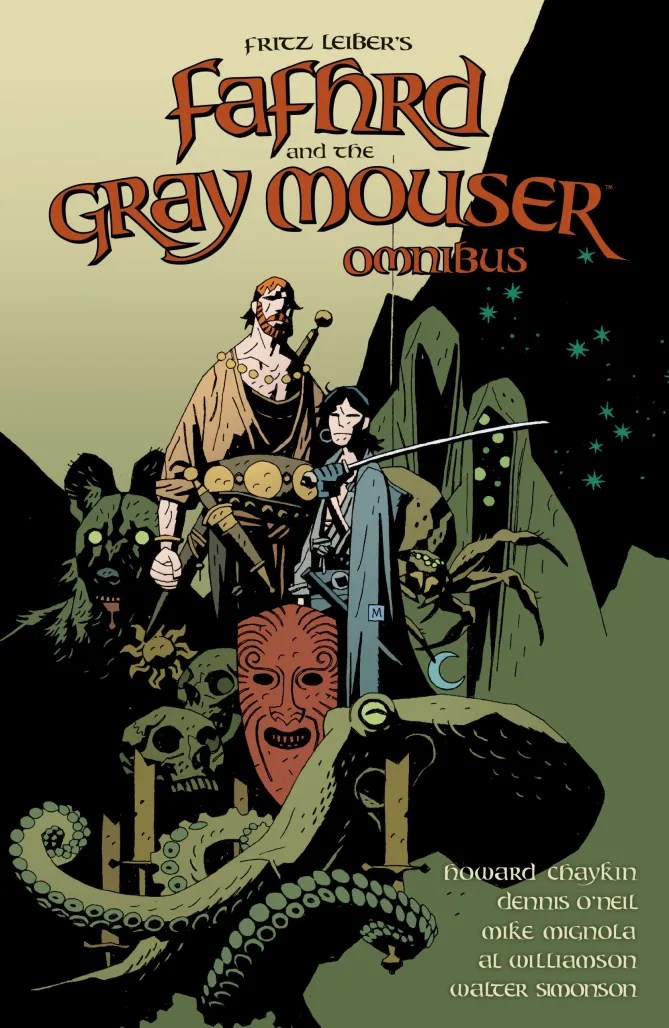
THE FAFHRD AND THE GRAY MOUSER OMNIBUS reprints the Bronze Age DC series Sword of Sorcery by Denny O’Neil and Mike Mignola and Marvel’s series from two decades later with Chaykin writing and Mike Mignola’s art. In the introduction, Chaykin tells how he worked on the DC series with no idea of what he was doing and little familiarity with Fritz Leiber’s characters, whom he later came to love (he describes them as fantasy hardboiled-crime stories and I think there’s some truth to that). For that reason he jumped at the chance to get a second shot.
I remember passing this up at the time, possibly because money was tight, possibly because I didn’t trust Chaykin to do it better. It’s excellent, with a much better sense of character and of the world, and Mignola’s art is perfect in its grotesque style. The only story that doesn’t quite work is “Lean Times in Lankhmar,” an amusing one in which the lack of any adventures or treasure to steal forces the two swashbucklers to get day jobs. It’s one where Leiber’s narration is really needed to carry off the humor.
As the Chaykin/Mignola stories include “The Price of Pain-Ease” a sequel to the heroes first encounter (in “Ill Met in Lankhmar”), I reread the first Sword of Sorcery story, which tackles the same material. In the context of the original series, this is a downbeat one that has the guys dealing with, and overcoming, their grief for their murdered first love. That carries over in the Marvel story but O’Neil’s script for some reason makes it a straight swashbuckler with no emotional heft. And he way overwrites the dialog — Fafhrd and the Gray Mouser can’t seem to do anything without quipping about how amazing what they’re doing is. Still, most of the book is made up of the early series and that’s very good indeed.
MURDERBURG by Carol Lay is a comedy set in Muderburg, a Maine coastal town whose mayor, Leo Scazzi, is a professional hit man and most of the town seems to be underworld adjacent (providing fake IDs, disposing corpses). Over the course of several stories, Leo and his beloved wife Antonia deal with unwanted visitors, rivalries with the neighboring town, people trying to bump one of the Scazzis off and similar trouble. This was a lot of fun; if Lay wasn’t influenced by The Addams Family I’ll be surprised (the lead couple have very much a Gomez/Morticia vibe).
Al Ewing and Steve Lieber do an absolutely amazing job with the six-issue METAMORPHO, THE ELEMENT MAN — not simply reviving the Bob Haney/Ramona Fradon creation from the Silver Age but recreating the madcap style of the original, with some updated details (AI, Sapphire as a social media pop star) and cameos from multiple later iterations such as Element Dog and the New 52’s Element Woman. It’s incredible fun, though as I discuss over at Atomic Junk Shop it’s the fourth version of Metamorpho in the past decade and it bugs me there’s no continuity between them.
ALPHONSE MUCHA: The Artist and His Masterpieces by Terasa Barnard is a coffee table book devoted to the Czech art deco painter/sculptor/glass-worker, lavishly illustrated as such books are and covering his life as well. Mucha was a passionate supporter of the Slavic revival of his day (a movement I’m not familiar with) which explains things like him designing currency for the new nation of Czechoslovakia. As a fan of Mucha’s work I enjoyed this, though some of the Slavic figures and stories he’s working with are unknown to me.