Category Archives: Comics

No, zero to hero is not the universal theme of all fiction

In a recent substack post, Celeste Davis of Matriarchal Blessing discussed the many rich and famous guys who’ve gone from pudgy and nerdy looking to buff and muscular, including Jeff Bezos and Christ Pratt. I don’t find this terribly remarkable — while the pressure on men to look good isn’t as intense as with women, it does exist. In our modern world I don’t think it’s that far off from someone forty years ago getting rich and switching to bespoke suits.

Davis argues that what this is really about is becoming invulnerable: “The invulnerability arc shows up in just about every myth, story and hero we have for boys—be they modern or ancient, religious or secular. The story goes like this: once upon a time there was a weak, shrimpy boy, who eventually through pain and violence is transformed into a fortress of muscle and power. Now no one makes fun of him. Now he is a hero.” Cases in point, Disney’s Hercules, Harry Potter, Batman, Captain America. Davis goes on to argue that if your goal is a long, healthy life (and for a lot of these dudes, it is), becoming buff or paying for radical medical treatments won’t work as well as having a community of friends around you.

That conclusion I do not dispute. Davis’ interpretation of the “invulnerability arc” as the essential Boy’s Journey … not so much. Since she brings up the Marvel and DC cinematic universes, let’s look:

Iron Man: Tony Stark (Robert Downey Jr. of course) discovers his munitions manufacturing has made the world worse. Sets out to atone. And far from being invulnerable, he starts the movie in good health, then ends up a guy relying on the world’s most advanced pacemaker. The comic book doesn’t start Tony out in such a guilty place, but does emphasize even more that he’s not invulnerable —drain his armor’s power, he’s dead. Jack Kirby cover below.

Superman: No arc. He’s an invulnerable child who grows up into the world’s most invulnerable man.

Thor: Arrogant jackass whose arc is learning not to be such a jerk.

Captain America: (Steve Rogers in the Jack Kirby scene above is saving a Cap imposter, by the way). No question his origin involves going from a scrawny 4-F into the perfect man. But I think it’s more significant that his quest isn’t to become strong, it’s to fight fascists. That’s why he applies in the comics (and IIRC in the film). That’s what drives him. And it’s not that he’s invulnerable —

— it’s his indomitable spirit, as in the Gene Colan image above.

Hercules? Disney’s take is an outlier, portraying him as a wimpy kid; in mythology, Hercules strangles venomous snakes while he’s still in the cradle. Marvel’s Hercules (at the bottom of Kirby’s cover) and most other pop-culture presentations are much the same — superhuman from the get-go.

Harry Potter is far and away the worst argument for her position. Her synopsis: “A shrimpy nerdy orphan is shunned by his family, forced to live in the hall closet and be beat up by his cousin. Eventually he fights in some battles and after securing The Deathly Hallows, becomes the master of death and savior of the world.”

Okay, that’s technically true, but only technically. The real story is a miserable lonely good gets away from his abusive caregivers, make friends, finds a parental figure who isn’t shitty and learns to be happy. The books are an endorsement of exactly what Davis says we need, community. Harry wouldn’t have made it to book two if he didn’t have Ron and Hermione (particularly, of course, Hermione) fighting alongside him. He wouldn’t have finished the series alive if he hadn’t trained his fellow students into Dumbledore’s Army.

Harry is all about community. In a sense that’s what makes him the perfect opposing player for Voldemort, who has no use for other people except as pawns or followers.

Likewise, few superheroes these days come without a supporting cast. Green Arrow and Flash on the CW have sizable backup teams, for instance. Movie Batman is probably the closest to what Davis talks about; I think he’s more an anomaly than a template.

Looking at pop culture more broadly, I think the post underestimates the number of characters who don’t have origins in a conventional sense. In cop shows we may get some backstory but a lot of the time they’re simply there, no origin. Jack Bauer on 24 ditto — his childhood and how he came to be a tough guy is never detailed that I recall.

In short, I don’t think the post nailed the zeitgeist as much as she thinks.

All rights to images remain with current holders.

Leave a comment

Filed under Comics, Movies, Reading, TV, Undead sexist cliches

Three books about women

“Strengthen the female mind by enlarging it, and there will be an end to blind obedience; but, as blind obedience is ever sought for by power, tyrants and sensualists are in the right when they endeavour to keep women in the dark, because the former only want slaves, and the latter a play-thing.” That quote from Mary Wollstonecraft (from the Matriarchal Blessing substack) convinced me to read her VINDICATION OF THE RIGHTS OF WOMEN — but in hindsight I wish I’d looked for an annotated edition. She refutes authors I’ve never heard of and I often suspected that the two centuries since she wrote have altered enough word usage I may not be getting her meaning.

The gist of Wollstonecraft’s argument is that women are not shallow ninnies obsessed with fashion, incapable of deep thought and never accomplishing anything: this is, rather, what they are trained to be. They’re told their value is their looks, told their value hinges on landing a man, they’re discouraged from thinking, cut off from education — free the mind and the rest will follow. Her comparison point is the idle rich whom she sees as engaging in the same sort of frippery and shallowness. What happens to an uneducated woman if her husband dies and she has to care for the family? What will occupy her mind once she’s an empty nester? If a relationship is purely based on looks and sex, how long can it last?

This argument hasn’t aged — lots of people today would agree with Wollstonecraft about the effects of educating women but they’d think the effects are bad. However while it hit the late 1700s like a bomb, it’s not as radical today — at 300-plus pages I found it interesting but not compelling (though if I’d never read anything on this subject before …).

SHADOW OF THE GOLDEN CRANE by Chris Roberson and Michael Avon Oeming is a spotlight on BPRD agent Susan Xiang. As she investigates various cases (most notably involving a demon-possessed biker granny) she keeps getting visions of a Chines precursor to the BPRD, the Order of the Golden Crane. Each time she flashes back, she gets a clue to how to handle the monster of the issue and learns more about the society.

I like Susan and a series focusing on her should have been fun, but this was “meh.” Like several of these bounce-through-history Hellboyverse series, it doesn’t really build, it’s just four stories of Susan battling monsters, with the history stories. Can’t say I’d have missed it if it didn’t exist.

ARCANA ACADEMY: Book One by Elise Kova is a romantasy I picked up for this month’s Genre Book Club. It’s set in Oricalis, an oppressive kingdom where magic is channeled through the Tarot’s Minor Arcana and tightly controlled by the crown. All practitioners train in the eponymous school; practicing magic outside it will get you imprisoned or sent to the mines, where you’ll die fast extracting the minerals used for the magical card-inking (this reminded me of Diana Wynn Jones’ quip that in fantasy worlds, miners are always slaves).

Clara, the protagonist, was a rogue arcanist, imprisoned, but suddenly released by Kaelis, the sinister second son of the king. He passes her off as a lost heir to one of the great houses and his betrothed, part of a scheme to get her into the Academy and use her skills in his plan to remake the world. Clara soon finds he’s less of an ogre and more of a charmer than she thought, but can she trust him? Can his plan work? What about her missing, possibly dead sister?

The romance doesn’t play any bigger role here than in most fantasies; I’d have decided “romantasy” is purely marketing but the other members of the book club say otherwise. It’s definitely the weakest part — when they finally get physical (400 pages through a 500 page book) it feels like an absurdly rapid escalation rather than a slow build.

That said, I like the book. I love the idea of Tarot-based magic, the plot is complex, the characters are fun. I might have liked it better as a one-in-done rather than a series — the last 60-80 pages suddenly fling in so many twists, reveals and complications it felt rushed. Nevertheless I’ll pick up book two when the library gets it.

Covers by Oeming and Concorina, all rights remain with current holders.

Leave a comment

Filed under Comics, Reading, Undead sexist cliches

Graphic novels and a graphic artist: books read

You may remember when I looked back at 2025, I was displeased by how fewer comic books than usual I’d read. As you can see, I’m workign to up my game for 2026.

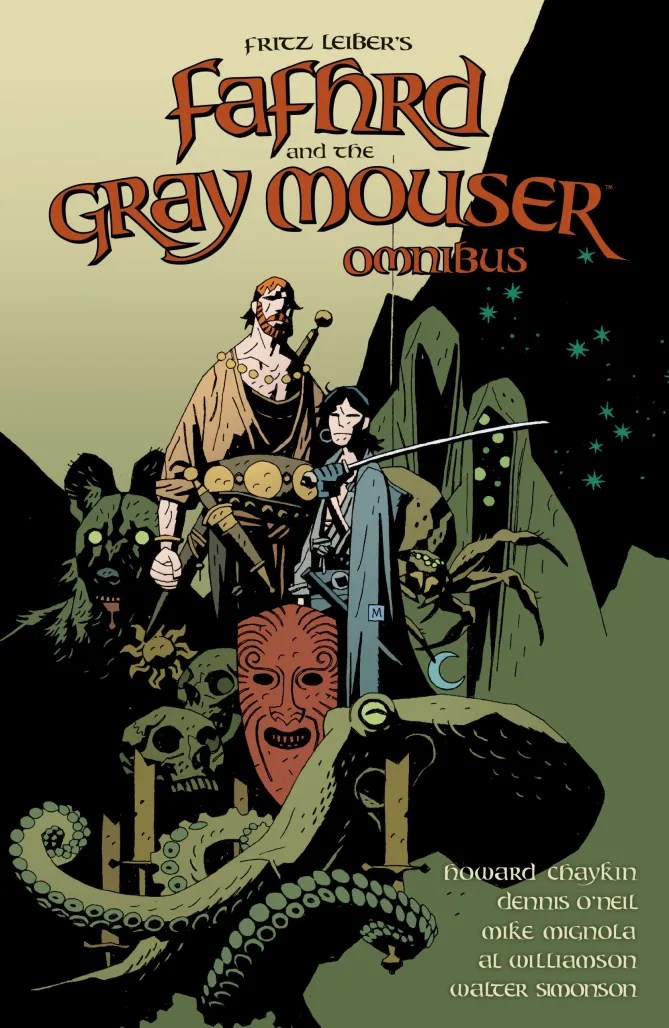
THE FAFHRD AND THE GRAY MOUSER OMNIBUS reprints the Bronze Age DC series Sword of Sorcery by Denny O’Neil and Mike Mignola and Marvel’s series from two decades later with Chaykin writing and Mike Mignola’s art. In the introduction, Chaykin tells how he worked on the DC series with no idea of what he was doing and little familiarity with Fritz Leiber’s characters, whom he later came to love (he describes them as fantasy hardboiled-crime stories and I think there’s some truth to that). For that reason he jumped at the chance to get a second shot.

I remember passing this up at the time, possibly because money was tight, possibly because I didn’t trust Chaykin to do it better. It’s excellent, with a much better sense of character and of the world, and Mignola’s art is perfect in its grotesque style. The only story that doesn’t quite work is “Lean Times in Lankhmar,” an amusing one in which the lack of any adventures or treasure to steal forces the two swashbucklers to get day jobs. It’s one where Leiber’s narration is really needed to carry off the humor.

As the Chaykin/Mignola stories include “The Price of Pain-Ease” a sequel to the heroes first encounter (in “Ill Met in Lankhmar”), I reread the first Sword of Sorcery story, which tackles the same material. In the context of the original series, this is a downbeat one that has the guys dealing with, and overcoming, their grief for their murdered first love. That carries over in the Marvel story but O’Neil’s script for some reason makes it a straight swashbuckler with no emotional heft. And he way overwrites the dialog — Fafhrd and the Gray Mouser can’t seem to do anything without quipping about how amazing what they’re doing is. Still, most of the book is made up of the early series and that’s very good indeed.

MURDERBURG by Carol Lay is a comedy set in Muderburg, a Maine coastal town whose mayor, Leo Scazzi, is a professional hit man and most of the town seems to be underworld adjacent (providing fake IDs, disposing corpses). Over the course of several stories, Leo and his beloved wife Antonia deal with unwanted visitors, rivalries with the neighboring town, people trying to bump one of the Scazzis off and similar trouble. This was a lot of fun; if Lay wasn’t influenced by The Addams Family I’ll be surprised (the lead couple have very much a Gomez/Morticia vibe).

Al Ewing and Steve Lieber do an absolutely amazing job with the six-issue METAMORPHO, THE ELEMENT MAN — not simply reviving the Bob Haney/Ramona Fradon creation from the Silver Age but recreating the madcap style of the original, with some updated details (AI, Sapphire as a social media pop star) and cameos from multiple later iterations such as Element Dog and the New 52’s Element Woman. It’s incredible fun, though as I discuss over at Atomic Junk Shop it’s the fourth version of Metamorpho in the past decade and it bugs me there’s no continuity between them.

ALPHONSE MUCHA: The Artist and His Masterpieces by Terasa Barnard is a coffee table book devoted to the Czech art deco painter/sculptor/glass-worker, lavishly illustrated as such books are and covering his life as well. Mucha was a passionate supporter of the Slavic revival of his day (a movement I’m not familiar with) which explains things like him designing currency for the new nation of Czechoslovakia. As a fan of Mucha’s work I enjoyed this, though some of the Slavic figures and stories he’s working with are unknown to me.

Rights to all images belong to current holders.

Leave a comment

Filed under Comics, Reading

Women superheroes of WW II, psychic teens of 1970: books

LIBERTY GIRL by Barry Reese was a fun novella based on the same-name indy comic book about the eponymous Wonder Woman-like superhero vanishing in WW II and returning in the present a la Captain America (but with more thought to the gulf between Then and Now). Fun, though hardly groundbreaking; what made it work for me is that the golden-eyed, bronze-skinned protagonist is Doc Savage’s daughter (though as with my own The Savage Year they can’t spell it out). I might take a look at the comic some time, though it appears it’s only available in single issues rather than a trade paperback.

The sixth volume of BOMBSHELLS, War Stories (cover by Ant Lucia) has Amanda Waller’s new Sucide Squad stop Nazi ally Edward Nigma from unleashing the worst of the Tenebrae while large numbers of supernaturals and superhumans gather at the Siege of Leningrad where Kryptonian Faora Hu-Ul reveals her master plan for Earth. As usual this was fun, though it also feels a little too sprawling, with characters we’ve never met (like Faora) showing up at the end and other plotlines apparently vanishing (this is the final volume but perhaps there’s some resolution in the spinoff Bombshells: United).

NINETEEN SEVENTY: The Seven Book One by Sarah M. Cradit is the first in a prequel series to a mythos (the House of Crimson and Clover) that I’ve never read. Here we see the future heads of the witch clan (though like many fictional witches they seem more psionic) as teens in 1970 variously coping with first love, periods of hedonism, Duty Vs. Love, Finishing School vs. Saving the World etc. This was better than most Buy This Book In The Series Cheap offers on Kindle, enough I might pick up more in the series later. However it’s both a prequel and an installment (there are several more 1970s set books) which is a little frustrating, and suffers from repeated anachronisms such as “trophy wife” and “chill pill” as phrases. I still enjoyed it.

All rights to image remain with current holder.

Leave a comment

Filed under Comics, Doc Savage, Reading

Atlantis, a Gorilla World, and the Last Son of Krypton! Books read

THE MAGIC OF ATLANTIS was an anthology edited by Lin Carter collecting various Atlantis-set fantasy stories from the pulp era. On the low end we have Carter’s own contribution (okay, nothing special) and a Robert E. Howard King Kull story (I don’t find Kull brooding about the nature of reality terribly interesting). On the high end we have one of Clark Ashton Smith’s Poseidonis stories and an Edmond Hamilton fantasy, “The Avenger from Atlantis,” in which a bodysnatching Atlantean scientist spends centuries hunting down the bodsnatching schemer who caused the sinking.

Overall the collection is fun but the sexism annoyed me. Not that I’m unfamiliar with the sexism of that era’s specfic, but having the women be either sex objects with no personality or bad girl sex bombs got old fast. The only exception was Nictzin Dyalhis’ “The Heart of Atlantis,” which has a female protagonist (it’s one of the middle-ground stories in the book).

I’m a sucker for the old Julius Schwartz SF comics Mystery in Space and Strange Adventures so it was inevitable I pick up the collection DC FINEST: Gorilla World from the early 1950s (it also includes the space adventures of Tommy Tomorrow, a backup in Action Comics). This includes a number of series characters (superhero Captain Comet, scientist Darwin Jones, the Space Cabbie and Interplanetary Insurance agent Bert Gordon) and a lot of standalone stories. Not the best of the series but still fun for me despite the frequent absurdities (a road crew accidentally turns a road into a moebius strip, for instance).

Sometimes they’re quite clever. In “The Counterfeit Earthmen,” the inhabitants of Saturn’s moon Titan refuse to believe Earth astronauts are from Earth — if there’s intelligent life that close to the sun’s light it would have to be blind and navigate by sonar! In “Gorilla World” (shown by Murphy Anderson above) a couple get sucked into a parallel timeline where gorillas have evolved to the equivalent of humans. The couple go on display in a freak show but it turns out they’re very happy — the husband was a sideshow act on our Earth and the gorillas treat him a lot better. Definitely not for everyone’s taste but it is mine.

The first SUPERMAN SILVER AGE OMNIBUS isn’t as much to my taste — Mort Weisinger’s stable of creators always aimed their stories slightly younger than Schwartz seemed to. That said, this covers a wildly creative period including the debut of Brainiac (captured by Curt Swan above), the first appearance of the Arctic Fortress of Solitude, the introduction of Bizarro, Supergirl, Metallo, the first Earth-One Mxyzptlk appearance — well, it’s a creative time for the mythos, as I blogged about here. Balanced against that we have the sexist treatment of Lois Lane and a lot of Wayne Boring art (once considered the definitive Super-artist, I’ve never been able to get into his work). As always with old comics, you pays your money and you takes your choice. I certainly don’t regret spending the cash.

All rights to images remain with current holders.

1 Comment

Filed under Comics, Reading

Arthur’s descendant, black actors and some graphic novels: books read

It’s been two years since Tracy Deonn’s second Legendborn book, Bloodmarked, came out but OATHBOUND was worth the wait. In the aftermath of being almost possessed by Arthur’s spirit, Bree — a black teenager, linked to Arthur by blood (his slaveowning descendant raped her ancestor) flees the Order of the Table and strikes up a deal with Erebus, sorcerer of the order and secretly a demon. He’ll use her and train her both, but the cost is partial memory erasure — she no longer recognizes anyone in her life.

And what of the two boys Bree’s possibly into? Selwyn’s demonic side is eating him alive. Nick, the descendant of Lancelot who thought he was the Scion of Arthur, is out looking for them both. Inevitably Bree and Nick wind up meeting; unfortunately it’s undercover at a demonic collector who’s offering an artifact Erebus needs. Can they help each other get out alive?

This was a bit too sprawling — Selwyn’s scenes (more his mother’s scenes) were mostly “remember I’m a character in this!” — but overall it was another excellent volume. I know Tracy but my admiration for her work is neither bought nor paid for.

COLORIZATION: One Hundred Years of Black films in a White World by Wil Haygood looks at the great and not so great moments of black filmmaking and acting (looking back from 2021 when this came out): Sidney Poitier, Denzel Washington, Oscar Michaux, Stormy Weather, Friday Foster, John Singleton, Spike Lee … And also the racial history happening in the real world as these movies were coming out. And the constant frustration by black moviegoers, creators and actors that no amount of money seems to convince Hollywood making black-centric movies is a winning strategy.

This wasn’t as good a read as I expected, partly because I know a lot of what Haygood has to say (which is absolutely not his fault). Partly because I’d have liked less politics and black history and more on the movies — there’s much more material worthy of coverage that doesn’t get any (nothing about The Color Purple, for instance). The conclusion, like The Black Guy Dies First, is surprisingly upbeat that the dam has finally cracked.

AQUAMAN: Amnesty by Kelly Sue DeConnick and Viktor Bogdanovic faded from my memory almost as soon as I’d read it. Primarily that’s because it’s a post-New 52 reboot that spends most of its pages establishing what is and isn’t in continuity and filling in an amnesiac Aquaman on his secret origin.

OMNI: The Doctor Is In by Devin Grayson and Alitha E. Martinez is the first (I think) in the new Ignition! universe: protagonist Cecilia, always bright, now discovers she’s super-intelligent because she’s somehow been ignited (equivalent to the jumpstart in the Ultraverse, I’m guessing, though that may mean diddly squat to you). With her heightened intelligence comes the certainty that more ignited are on the way and the governments of the world may not respond well … Too much set-up for me, and not that different from Heroes or the CWverse on TV.

Jeff Lemire’s FISHFLIES has a panicked petty crook kill a boy, hideout in a grain silo, befriend the abused daughter of the farmer and then turn into a giant bug. Switching from crime drama to a riff on Metamorphosis is an odd choice but overall this worked for me, though it didn’t work hugely.

Comics cover by Brian Bolland. All rights to images remain with current holders.
Leave a comment

Filed under Comics, Reading

Wednesday is Woden’s Day …

So let’s celebrate with some Thor covers. Here’s one showing all the key players getting ready for the coming conflict.

Here we see Thor facing off against villains while burdened by a helpless Jane Foster. No dialogue but the captions give us a sense of the stakes.

Thor dies! Simple, dramatic high stakes.

Those three were by Jack Kirby. Here we have one by John Buscema. It’s less clear what’s going on but Infinity is capturing entire worlds and the Silent One looks suitably ominous.

Last but not least, the first cover of Walt Simonson’s glorious run on Thor. Shattering the title logo and showing us Thor apparently turned into a monster.

All rights to images remain with current holders.

Leave a comment

Filed under Comics, cover art

Would you buy a diamond from DC Comics?

Over at Atomic Junk Shop I’ve blogged about advertising in comics but the image below may be the weirdest one yet.

Comics sold a lot of random, surprising things back in the Silver Age but diamonds? Is the overlap of “guys who read comics” and “guys who need to buy diamond rings” that huge? I notice the specific reference up top to “military men” but the same question applies. Was the advertiser misjudging the market? Or was the rate so cheap they could afford to take a chance?

And, of course, did the rings ever show up when you sent the money? Were they worth anything? As Mail-Order Mysteries didn’t cover this particular mail-order option, I may never know.

Leave a comment

Filed under Comics, Miscellanea

New adults, kaiju, reporters and more: graphic novels

Kate Gavino’s A CAREER IN BOOKS: A Novel About Friends, Money and the Occasional Duck Bun follows three Asian-American twentysomethings struggling to make it in publishing, and their discovery one of the tenants in their apartment building is a famous author. This suffers from too much New Adulting (that’s not a genre I go for, though that isn’t Gavino’s fault) but also from her art style. This feels less like a graphic novel and more like a collection of standalone one-panel cartoons. The story would make a good movie though.

Chris Gooch’s IN UTERO didn’t quite click with me but it’s better. Tween Hailey winds up in a holiday camp in an abandoned office building where she meets a kid who can walk through walls, discovers a kaiju in the basement — and meanwhile a hazmat team in the building is assuring their scientists that clumping these strange oozing organisms together in one big jar won’t cause any problems …

DC PRIDE: To the Farthest Reaches is the 2025 annual anthology celebrating DC’s LGBTQ characters. It suffers from me not being up on current comics: tie-ins to big events don’t work, I don’t know some of the characters (never met Circuit Breaker before which makes it harder to care he’s dating Pied Piper) and some things completely baffle me (Raven’s acting like a normal twentysomething?). However Phil JimenezSpaces about his lifelong love for Wonder Woman (surely an island where women ride giant kangaroos would welcome a weird little kid?) and the importance of that kind of fantasy space was incredibly moving.

BURY THE LEDE by Gaby Dunn and Claire Roe has an imprisoned, manipulative killer recruit a rookie reporter as the one person she’ll give interviews to, steering her towards a rising political star with a very dark secret. There was a lot I liked about this, even though the killer’s Hannibal Lector-style games felt unnecessary. However protagonist Madison gets seriously unethical over the course of the story; there are some kinds of journalism stories where that works dramatically, but this wasn’t one of them.

IONHEART by Lukas Kummer is the story of a knight in a parallel world where our technology, drifting across the dimensional borders, is seen as dangerous magic. This didn’t click with me even slightly so like A Career In Books I put it down unfinished.

Art by Gooch and Roe, all rights to images remain with current holders.

Leave a comment

Filed under Comics, Reading, Wonder Woman

Maps, chemistry, a woman and Pride: books read

Cartography and the way maps shape our perception of the territory fascinate me and I’ve read several good books about them (here’s one. Here’s another). I thought Seymour J. Schwartz’s THE MISMAPPING OF AMERICA would be another with its look at how early American maps often got it wrong: California as an island, non-existent islands in the Great Lakes, a Northwest Passage and other fantasies that would make it easy to sail to the Pacific and thence to the Far East. Unfortunately the book is a dull catalog of “This person made a map, then this other person, then this third person ….” and I found it unsatisfying.

I read HISTORICAL STUDIES IN THE LANGUAGE OF CHEMISTRY by MP Crosland to see if it would help me understand some of Doctor Jekyll’s chemical terms when he explains his theories in the Stevenson novel.

It doesn’t, but it is fascinating to read how the chemical notations and abbreviations I learned in high school took so long to become definitive. Crosland starts with the alchemists and their enthusiasm for symbolic and cryptic writing that hid their knowledge from the uninitiated. Making matters worse, neither they nor the first chemists had the knowledge or skills to identify compounds and they had multiple false assumptions, such as color geographic location being significant (i.e., gold from Bavaria might be significantly different from gold from the New World). Trends in language also changed: mundane descriptors such as oil of vitriol, butter of arsenic or milk of magnesia lost out to technical terms, which eventually became standardized so everyone knew what they were talking about. Specialized but interesting. And someday I would love to work “butter of arsenic” or “vital air” (a one-time name for oxygen) into a story.

LAURA by Vera Caspary is the source novel of the 1944 movie, wherein a surprisingly educated detective is called in to investigate the murder of the free-spirited, strong-willed title character — could it be her rather wimpy fiancee? Waldo, the well-known newspaper columnist who feels she friendzoned him (I cannot stop seeing him as Clifton Webb in the movie, despite Caspary making it clear he’s built more like Jack Black)? The twist is — well, I won’t reveal it just in case you don’t know.

I prefer the movie. This is more a literary story than a mystery, told from multiple points of view; while the writing is good, “literary” is a tough sell for me. And I really can’t swallow the degree to which the detective hangs out and chats about the case with his suspects.

I’m a fan of Phil Jimenez’ run on Wonder Woman and his story “Spaces” was the highpoint of DC PRIDE: To the Farthest Reaches, an anthology for Pride Month (DC’s done several of these). Jimenez reflects on how the weirdness of pre-Crisis WW convinced him that if he could only get to Paradise Island he’d be welcome there, weird as he was, and how much it meant to him to work on the series. It’s lovely.

The rest of the book didn’t work as well for me, mostly because I’m only occasionally reading current comics. I don’t know most of the couples and some of the characters are complete unknowns (Circuit Breaker, master of the still force) or wildly different (why is Raven so normal and chill?). That’s not a fault of the storytellers but it did make it harder to get into, particularly when some of the stories tie in to ongoing plotlines. Still, it’s good DC has added so many more LGBTQ cast members; I do hope current trends and corporate takeovers won’t change that.

All rights to images remain with current holders. Cover by Jimenez.

Leave a comment

Filed under Comics, Reading, Wonder Woman