
I mentioned one example yesterday. Today’s was for one of my novels (Impossible Takes a Little Longer) and it’s almost identical to the one I got a couple of months back: It’s a very competitive market, we can only afford to bring out outstanding books, and yours isn’t. Oh, and your mother dresses you funny. (OK, made up that last bit). Apparently this is the new “not suited to our needs.”
Hmm, come to think of it the fact the letter began with “Dear Contributor” should have been a tip off too.
On the plus side, they got back to me within a month, and I’ve had published take six months to give me a no, or decide not responding is sufficient.
Monthly Archives: June 2013
Another sign of a form rejection letter
Filed under Impossible Takes a Little Longer, Writing
Goodbye William Hartnell
My Netflixing of William Hartnell’s tenure as the First Doctor is now done.
DOCTOR WHO: The War Machines is the last intact serial from the Hartnell era (one of the special features details what it took to reassemble it), and the first contemporary-set story. Very contemporary, in fact, not only shot on location in London but focusing on the Post Office Tower, the newest, tallest building in London at the time (I remember it being a very big deal back in the day—some of the other special features go into that).
The plot, for the time, was very contemporary too: A big computer set up in the tower decides (as computers in those days invariably did) to take over the world from those inefficient humans and run it better. To that end it mind-controls scientists and politicians, tries taking over the Doctor (referred to as “Doctor Who” for the only time in the series) and unleashes the war machines, remote-controlled tanks, on the streets of London.
The War Machines, designed with flame-thrower/gas guns and hammer arms for smashing obstacles, are a striking design: They look entirely plausible, the sort of thing someone would design as an urban tank. That practical look does, however, lack the special charm the show gave the Daleks.
This introduces two suitably contemporary companions: Polly, a blonde who likes hanging out in swinging night spots, and Ben, a sailor (working class heroes were becoming trendy at the time). Dodo gets enslaved by the computer and shuffled off mid-story.
Watching Doctor Who as an adult it’s easy to spot some of the moments where Hartnell lost track of the script, but there are no problems here. He’s in top form, whether it’s chuckling over hanging an “out of order” sign on the TARDIS or staring down an onrushing war machine.
The Lost Years is a DVD of the remaining fragments of the era: Two episodes of the historical drama The Crusades, three of The Dalek Master Plan and the final episode of The Celestial Toymaker. The Crusades is routine, though well-performed, but Dalek Master Plan looks like a much stronger one. Of them all, Celestial Toymaker is the one I’d most like to see. The serial starred Michael Gough as a cosmic entity who traps the Doctor, Dodo and Steven in a world of toys, pitting them against his dolls in deadly games, with the price of defeat being turned into dolls himself. And as we learn this episode, even if they win, they lose.
It’s weird and eerie, although dressing Gough up in a mandarin’s robe is an odd choice (he’s “celestial” in the sense that he’s apparently Chinese, though not done in yellowface). Even so, I’d love it if this one shows up someday.
And last but not least, one of the few bits preserved from the Cybermen’s debut, The Tenth Planet, is the Doctor’s first regeneration. At the time, this was absolutely mind-blowing—the Doctor we knew and loved turning into someone else? WTF?
At the time I didn’t much care for Second Doctor Patrick Troughton, never seeing him as anything but an imposter. I’m curious to see if my view changes now, nine Doctors later.
(#SFWApro)
Filed under TV
Books
The Teen Titans were a second-string super-team until Marv Wolfman and George Perez made them A-list when they launched a new Titans series in 1980 (the cast of the Teen Titans toon was straight out of that era). THE NEW TEEN TITANS: Games was a graphic novel they worked on in the late 1980s (after Perez had left the book) but never finished until a couple of years back (when Wolfman wrote a new story to include Perez’ 70 drawn pages). The story involves federal agent King Faraday recruiting the team to take on a nutball terrorist (hoping by a mass terrorist attack to dramatize threats our government refused to recognize); the result is solidly entertaining, and it’s great to see the Titans at the top of their game (Wolfman’s 1990s work included turning them very dark). On the downside, the ending revelation about the villain really didn’t work and this gaves way too much space to one of the later members Danny Chase (Wolfman’s last shot at proving him an A-lister only makes him look like the Titans’ Wesley Crusher). Great even so.
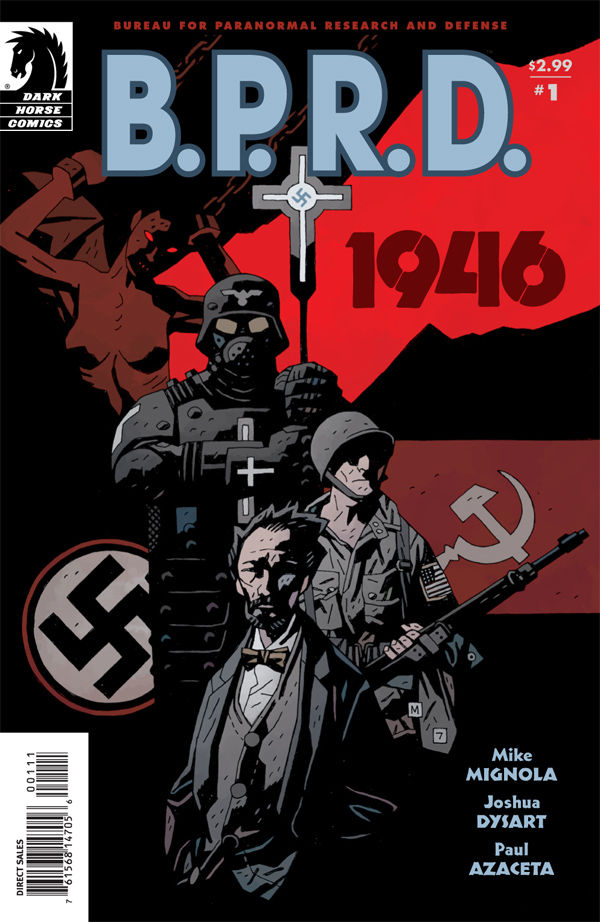
BPRD: 1946 by Mike Mignola, Joshua Dysart and Paul Azaceta is an outstanding entry set a year or so after Professor Bruttenholm found Hellboy in a ruined church. Now he’s in Berlin hoping to learn just what the Nazis summoned the kid for, only to get caught up in a Nazi experiment in vampirism and the parallel investigations of the Russian demon-child Varvara (“My dolly Katya will conduct this interrogation!”), who remains one of my favorite characters. Despite the mythos-developments this is a stand-alone collection, which is unusual with the Hellboy universe these days. Thumbs way up.
THE AMERICAN WAY OF EATING: Underground at Walmart, Applebee’s, Farm Fields and the Dinner Table by Tracie McMillan comes off as a food-oriented Nickel and Dimed, as McMillan uses various minimum wage jobs as the basis for a look at how our current food production and distribution systems developed, how they operate and what may lie ahead (the more Walmart dominates a community the less of a price cut it offers). Perfectly competent, but it didn’t grab me at all, maybe because much of this isn’t news to me.
Of course Jessica Valenti’s THE PURITY MYTH: How America’s Obsession with Virginity is Hurting Young Women is familiar stuff too, but it’s also closer to my own interests. Valenti looks at purity balls, fact-free abstinence-only education, she-asked-for-it rape critics and opposition to the HPV vaccine as signs of the religious right’s madonna/whore fixation, which she argues is tangled up not only with sexism but classism and racism (so white girls on spring break in Mexico get more attention than nonwhite women in sexual slavery). On top of that, Valenti argues, the right-wing’s refusal to treat any deviation as anything but Sodom and Gomorrah makes them ineffective to boot, as jokes about Friends on downloading porn are seen as just as objectionable as actual child porn. An excellent analysis.
Like Cornell Woolrich’s Black Angel, his MANHATTAN LOVE SONG doesn’t age well (even worse in fact). The noirish doomed romance of the narrator with a woman working for unstated players in New York’s power structure is well written and well plotted, but the protagonist is an abuser whose history includes throwing scalding-hot coffee on his wife and deliberately stepping on her feet to teach her who’s boss; I suppose this might have worked for a flawed protagonist back in the 1930s, but I found it impossible to have any sympathy for his plight.
I would fist-bump myself if I weren’t so tired
So after debating about it Tuesday, I decided to jump in and go for finishing 125 Demand Media articles this month.
Financially, it will pay off (apparently I can be bought), and I’ll make up the lost time for other projects in July. But man, it’s exhausting. I’ve been doing eight articles a day, which (barring Internet outages or other disasters) will put me slightly over the cutoff point for the bonus by Thursday, so everything should be approved by June 30. It’s not hugely difficult, but it’s quite draining.
One reason I doubt I’ll do it again unless I really need the money is that it’s tiring enough even leftover time just gets left. In theory, I should have been able to do a little fiction this week, but in practice? Not so much. Okay, not so any at all.
And I hate that.
Still, I’m very pleased that I stayed on schedule despite having a contractor sanding the floor this morning, and a quick unplanned doctor’s visit yesterday (unnecessary as it turns out, but I can take comfort in knowing I’m fine).
No fiction to talk about, but here’s my article list approved this week:
•Deduction of Business Acquisition Expenses
•How Does Being Near a Granite Mine Impact Real Estate Values?
•What Is the Minimum Initial Investment for a Traditional IRA?
•Are Personal Liability Insurance Premiums Tax Deductible?
•Roth IRA Vs. Stretch IRA Conversion
•Which Forms of Business Organization Have a Limited Liability Feature?
•How Do I Transfer Real Estate Property Into Someone Else’s Name?
•What Is Fair Compensation to a Tenant for Breaking a Lease?
•Tax Implications of Retiring With a House Owned by a Self-Directed IRA
•What Is a Jumbo Home Loan?
•How to Report Credit Sales for Income Tax Purposes
•Tax Deductions for International Business Travel for Partners
•Can Investment Seminar Expenses Be Tax Deductible?
•Can Companies Deduct Car Allowances From Taxes?
•Tax Deductions for Dentists
•How to Deduct a House You Partially Rent
•Tax Deductions for Donating Professional Services
•Is LMI Insurance a Tax Deduction for an Investment Property?
•Are Masonic Dues Tax Deductible?
•Tax Deductions for Impairment-Related Work Expenses
•Can You Deduct Renovation Costs for a Home Office?
•Can Disability Premiums Be Deducted as Self-Employed Health Insurance?
•Can I Deduct My Mortgage Interest After a Cash-Out Refinance?
•Can Co-Homeowners Claim Deductions?
•Are Property Taxes Deductible in Subsequent Years?
•What Can Be Deducted on Income Tax for Building a New Home?
•AGI for Passive Loss Limitations for Married & Filing Jointly
•How to Account for Real Estate Closing Fees
•Tax Deductions for Business Property Improvements
•Top Five Ways That Real Estate Easements Are Created
•Accounting for a Limited Partnership Distribution
•Employee Stock Option Plans and Taxes
Thank goodness the weekend’s here and my slave-driving boss will now let me take it easy.
(#SFWApro)
Filed under Nonfiction, Personal, Writing
The tarantula strikes! Oops, it’s actually James Taranto, but that’s even worse.
Following his column about the supposed war on male sexuality, James Taranto got a lot of flak (including my blog post, but I have a strong suspicion it wasn’t on his radar) and so he responds with what conservatives love to do, wail about how he’s persecuted, as quoted here:”All this viciousness was in the service of denying that there is, as we wrote in yesterday’s article, a ‘war on men.’ Well, imagine if a prominent feminist journalist wrote about the ‘war on women’ and dozens of conservative male writers responded by subjecting her to similar verbal abuse. Would that not be prima facie evidence that she was on to something?”
As Roy Edroso and his commenters point out at the link, women do write about the war on women, and they do get verbal abuse. Yet somehow Taranto thinks they’re full of shit, so what’s his point? Of course, the abuse isn’t at all similar to “woman-hating troll” which is one Taranto singles out; as shown here (I’ve linked to this one before) it’s much, much worse.
And of course, the war on women is a real thing: A push against abortion, birth control, job and pay equality, charging a woman with murder for not getting a C-section, discussions of “legitimate rape” and how rape victims are asking for it—stuff that actually affects women’s lives.
Taranto’s example? Finding a guy guilty of sexual assault (Taranto objects in his column to being called a rape apologist as the guy wasn’t actually charged with rape. I have a strange feeling he wouldn’t have changed his arguments any if the charge had changed, so I’ll stick with it). And it’s not like he generally supports the rights of defendants or believes we need some higher layer of supervision to protect their rights—in fact, quite the opposite.
And of course, being criticized doesn’t prove anyone is “on to something” as Taranto would like to think. It’s not in itself, proof that feminists are right: their arguments do that. Taranto’s, on the other hand, don’t.
As Robert Park once said, “To wear the mantle of Galileo it is not enough that you be persecuted by an unkind establishment; you must also be right.”
Filed under Politics, Undead sexist cliches
Linky Friedman
Digby discusses how much fundamentalist Muslim violence is fueled by US aggression. That this is not the same as saying it’s all our fault, but our tactics overseas (supporting tyrants, supporting terrorists when it suits us, blowing innocent bystanders up with drone strikes, locking people up without trial) probably have as much or more to do with violence than any innate psychopathology in the Islamic faith. And I do think Digby’s spot on when she says that part of the difference between Christianity and Islam is that American Christians haven’t had to fight this desperately in a long time.
•At least one American company has committed to better treatment for Bangladeshi garment workers. And JC Penny says it will require tougher inspections of the buildings.
•Activists are pushing for a bill that would keep medical debts from staying on your credit report once they’re paid off.
•The idea that women and children get saved first in shipwrecks is often invoked as proof of male dominance or why women were better off in the Good Old Days. Only it turns out men do better than women, adults do better than kids, and the crew do better than passengers.
It’s also worth noting, as many feminists did after the Titanic, that being willing to let women reach the lifeboats first didn’t stop men from treating them like shit the rest of the time (sweatshop labor, for instance).
•CS Lewis on why theocracy is the worst sort of government: “If we must have a tyrant a robber barron is far better than an inquisitor. The baron’s cruelty may sometimes sleep, his cupidity at some point may be sated; and since he dimly knows he is doing wrong he may possibly repent. But the inquisitor who mistakes his own cruelty and lust of power and fear for the voice of Heaven will torment us infinitely more because he torments us with the approval of his own conscience and his better impulses appear to him as temptations.
•Does AdBlock let money from advertisers influence which ads get seen?
•SawStop is an invention that turns off table saws if they touch flesh. The table-saw industry doesn’t want to use it.
•Just in case you had any doubts, the war on terror is going on forever.
•The law says payday lenders can’t hit military members with usurious loans. Here’s how the lenders get around that.
•A new computerized rifle rarely misses. Is it too dangerous to sell to the public?
•Here’s a look at how various Internet players protect (or don’t) our privacy. More recently, Apple admitted (which didn’t score well in the survey) it’s received more than 4,000 requests for customer data, but won’t say from whom, or about what, or how many it complied with.
•Stocks are doing fine, so no need to worry about unemployment, right? Digby discusses Washington comments that we’re out of a “crisis” mentality.
•Mahmoud Abbas of the Palestinian Authority insists only one million Jews died in the Holocaust, and that Zionists exploited and encouraged the final solution to advance their own agenda.
•Pundit Michael Kinsley is shocked, simply shocked, that anti-gay speakers who compare gays to pedophiles are criticized and condemned for their views. With gay marriage triumphant, “it’s a moment to be gracious, not vindictive.”
Kinsley argues we’re not at the point where opposing gay marriage is inherently wrong, so we should cut them some slack. This shows, as I’ve mentioned, that for some conservatives and pundits being criticized is the same as being silenced.
Skepchick details the difference between criticizing someone and trying to shut them up quite well. I’ll just add that accusing someone of being the moral equivalent of a pedophile is a pretty in-your-face statement, yet Kinsley seems to feel that’s within the bounds of propriety. So why object only to the blowback and not the original comment?
And let’s not forget, with gay marriage illegal in more than half the states, the glorious victory is still a ways off.
Filed under Politics
Doc Savage: The Brand of the Werewolf Who Shook the Earth (#SFWApro)
(That hashtag in the title is to connect this with the SFWA twitter feed)
DC Comics editor Julius Schwartz often came up with a striking cover first, then directed his writer to find a matching image. I can’t help wondering if the Doc Savage book Brand of the Werewolf was titled following the same principle.

After all, there’s absolutely no werewolf. Nor any explanation why the villains use a werewolf sigil as a warning sign, other than justifying the title.
The book starts well. Doc is off to visit an uncle and cousin he’s never seen, unaware Uncle Alex is dead. Strange goings on take place on the train, and some of those involved are convinced Doc’s involved. Meanwhile, at the uncle’s Canadian cabin, cousin Patricia tries to figure out why her father’s killers are after a seemingly useless ivory cube.
As it goes on, though, the story peters out into a stock tale of skullduggery and murder in the Canadian wilderness (a setting that was much more popular back in the pulp day than it is now, so it’s not surprising Lester Dent used it), with the McGuffin a lost pirate treasure (Marvel’s 1970s adaptation of the story named the pirate “the werewolf” which gave slightly more logic to the title. Though not much). The shuffling Negroes and shiftless Indian characters don’t help things.
What does make the story worth reading is the debut of Pat Savage, Doc’s cuz. An eighteen year old who can shoot, fight and track, she has the same taste for adventure that Doc has. She shows up multiple times in the series, usually trying to horn in on the adventures, though Doc does his best to keep her out of the action. Realizing on rereading this that she’s only 18 makes his protectiveness more understandable (Doc’s in his early 30s) but no less sexist—not for a minute do I think he’d have been so worried about a male cousin.
Curiously, most of the discussion of Doc’s history and amazingness comes midway through the book; by that point it’s not like the readers should be doubting it. I’m beginning to think the gush was partly Dent’s way of padding the word count.

The Man Who Shook the Earth is much better. It’s also the first SF-type threat since Land of Terror, in this case a super-weapon that causes earthquakes. A nice touch is that the bad guys, during their time in New York, are constantly freaking out at the sound of quarry blasting or subway trains for fear of a quake.
Once again, someone shows up in New York to ask Doc for help, and once again the bad guys intercept them. Following up eventually leads Doc and his team to Chile, where prominent nitrate mine-owners have been dying in geologically impossible quakes, and (as Doc learns) citizens of a Sinister European Power have been taking over the companies, with an eye to getting a lock on nitrates for explosive manufacturing before the next war.
Dent doesn’t attempt to identify the warmonger nation; I’d assume Germany, but the bad guy specifically refers to himself as becoming bigger than Hitler or Mussolini, so maybe not (not that it affects the story).
This one’s a good read, but the revelation of the villain involves a laughably improbable twist I won’t detail here.
Important developments are that Doc operates on Johnny’s eye (injured in the Great War) in an opening scene so that he no longer needs glasses. Doc, who used some nerve pinches to paralyze Pat in the previous book (to keep her still at a crucial moment) now uses them in combat (a more dynamic version of the drug-tipped thimbles he was using a few books back). And Ham’s sword cane is now coated with a knock-out drug, continuing the emphasis on Doc’s team not killing.
(Covers by James Bama, all rights reserved to current holders)
Filed under Doc Savage, Reading
Rape apologist James Taranto and more undead sexist cliches
In the latest column from Taranto, the editor of the Wall Street Journal (not a direct link), he complains that the fight against sexual assault in the military is “an effort to criminalize male sexuality.” Because, presumably, rape and sexual assault are just what guys do.
Specifically, Taranto complains that Lt. Gen. Susan Helms, nominated by Obama for a leadership position, has been placed “on hold” because she granted clemency to Captain Matthew Herrera, an officer convicted of sexual assault. And really, when you look at the case (Taranto says) where’s the evidence he was guilty? It’s he said/she said, she claiming he fondled her while she was passed out, he claiming she was awake and consenting. Plus she flirted with Herrera before the groping, and sent him text messages after. And another woman who accused him actually went to a bedroom with him! So if the guy is guilty of “sexual recklessness,” the woman were just as reckless.
And that proves proposals to stop commanding officers from intervening to get assault victims off are totally unreasonable because my god, there was obviously no grounds to convict Herrera.
In addition to the She Asked For It tone of his column, he seems to take it as a given that the victim couldn’t possibly have been more believable than the accused, so the conviction is invalid by definition. I’m less convinced.
•Speaking of rape apologists, here’s a Catholic Church official arguing that it’s really children who molest priests—desperate confused boys looking for a father figure who make homosexual advances to troubled older men, who then can’t help themselves. So it’s not the priests’ fault.
•LGM points out that for years we’ve been hearing from the right that Roe vs. Wade is wrong because abortion is a matter for the states to decide. In reality, they’re perfectly fine with the federal government deciding, so long as it’s anti-abortion.
•Here we have a critique of one of my least favorite arguments for complementarianism (not that I have any favorite arguments): if your husband isn’t happy with you, it’s your fault: “Does your husband ever speak to you harshly, criticize you unduly, treat you unfairly, neglect you, impose on you, or in any way mistreat you? The important thing is not what he does but how you react.”
This was the thesis of the Total Woman, a book from the 1970s, and many since: If you behave in the right, submissive way, your husband will adore you and do everything you want. What that book never mentioned is what would happen if he didn’t fulfill his part of the contract. The answer at the link: Suck it up. Endure.
•A TSA agent yells at a 15-year-old for not dressing modestly enough.
•Amanda Marcotte on the Protestant right’s growing push against birth control, which helps make Catholics such as Santorum palatable even to Protestants who used to condemn Catholics as the whores of Babylon.
•A Maine politician mansplains that his superior male brain naturally thinks more accurately about Obamacare than some chick’s mind can.
•A woman complains that the new XBox slate has no female-protagonist games. Male gamers immediately explode with outrage, complaining that this would be a ridiculous demand unless there’s a market for games about cooking and flower-arranging. And besides, women are soooo inferior, and they shouldn’t be doing guy stuff like gaming anyway and—well, more of the same.
•The continuing fascination with how powerful women dress.
•Repubs are still claiming that rape won’t get women pregnant.
Filed under Politics, Undead sexist cliches
This will be a learning experience
So as I’ve mentioned in the past, Demand Media is giving out a lot of bonuses this month. And if I finish 125, I get an extra chunk of change—this is actually a regular bonus, but I usually don’t find it practical to try for it.
But when I thought about it today, I realized that if I put in the extra 35 or so articles by the end of next week, and then do that much less articles next month, I could make the quota without neglecting my other writing.
On the other hand, trying to bat out an extra 35 in time to get them all approved will be exhausting and stressful. And given that I’m not desperate for the extra money (I’d love to get it, but I can pay my share of the bills without it), maybe it’s not worth the candle.
Whatever I do, I figure it’ll be a learning experience about my limits.
Okay, enough about my awful first-world problems, on to links!
•My new And column is out, on the NSA spying revelations.
•Echidne links to several stories, including one about Virgin Airlines proposing to help passengers hit on each other. Another link is to an article about the age gap between Hollywood leading men and their woman, actually looking movie by movie at the gap for Brad Pitt, Tom Cruise, Tom Hanks, George Clooney and others.
•The growing popularity of hummus means a boom in chickpea farming.
•Paleofuture looks at the decline in mass transit in LA, and argues that it wasn’t the result of a scheme by car companies to destroy mass transit. Rather it was the transit companies delivering sub-par service, so the automobile looked the ideal solution. The comments include some disagreement.
•Texas Rep. Michael Burgess sees fetal hands moving and brilliantly deduces that male fetuses can masturbate at 15 weeks. And therefore, they can feel pain. But right-winger Ann Althouse (while insisting on her support for abortion rights) complains that this is hideously disrespectful: “At the heart of liberty is the right to define one’s own concept of existence, of meaning, of the universe, and of the mystery of human life.” So there! Meanwhile, anti-abortion activist Lila Rose assures us “abortion is never necessary to save a woman’s life.” So never worry about the facts.
Filed under Personal, Politics, Time management and goals, Undead sexist cliches


