Monthly Archives: September 2012

Movies and Books

SUMMER HOURS (2008) is a French film about the Boomer dilemma of disposing of parental stuff that no longer fits in our lives—in this case, mother Edith Scob’s (of Eyes Without a Face) spectacular art collection and country house when two of the kids live outside France and the one stay-at-home has problems of his own. Well performed but slow and largely lacking in drama. “I want us to agree and to decide what’s best for everyone.”
BLAME IT ON FIDEL (2006) is a good dramedy about a French pre-teen girl whose comfortable bourgeoisie life is knocked for a loop when her father decides to commit to radical activism to make up for everything he never did growing up fascist Spain. Very nicely done; Gerard Depardieu’s daughter Julie plans the mother. “I know—Vietnam is where children are burnt with napalm.”

OWL IN LOVE by Patrice Kindl is the first-person story of a teenage shapeshifter whose obsessive passion for her science teacher (“Owls fall in love once—and mate for life.”) gets derailed by the odd experience of acquiring a human friend and by meeting another were-owl. Good, mostly due to the protagonist’s distinctive voice.
VIETNAM: A History by Stanley Karnow does a very good job following Vietnamese history through centuries of resistance to the Chinese, the Japanese (during WW II) and the French before America decided Indochina was the place to make a stand against International Communism. Karnow having been reporting on ‘nam since the stirrings of nationalism in the 1950s, he has the advantage of both institutional memory (“This is why reporters should save their notes.”) and contacts with a lot of key players in the years after the war (which taught him things he didn’t know—according to the North Vietnamese, the CIA’s Operation Phoenix really did cripple operations in the South). Depressingly familiar in showing clashing agendas, bad calls and missed opportunities leading to a war everyone would have rather avoided; well done.
GREAT FORTUNE: The Epic of Rockefeller Center by Daniel Okrent chronicles how a proposal John D. Rockefeller buy land for a new Metropolitan Opera building mutated into a plan for a massive office/retail/entertainment complex that provided the only work for the city’s architects, steelworkers and other workers at the height of the Depression. Despite an array of colorful characters and anecdotes, this didn’t work for me at all—I suspect it’s because I don’t really feel for Rockefeller Center as anything more than a big real-estate development (for me it has none of the cachet the Empire State Building does).
THE AFTERLIFE OF CHARACTER, 1726-1825 by David A. Brewer looks at what amounts to 18th-century fanfic as various writers offered the public Untold Tales of Falstaff, Gulliver, Pamela and now-forgotten figures such as Roger de Coverly. Brewer argues that the widespread popularity made it possible for readers to see themselves as part of (so to speak) a fan community and to imagine the characters had more life than we saw on the printed page. Unfortunately, this is written in dry-as-dust academese, and I can’t share Brewer’s surprise at people imagining the childhood of Falstaff, since it seems perfectly natural to me. I’m not sure if this means I’m just missing the point, or that Brewer’s responding, in part, to academic theories that Falstaff and Gulliver have no childhood (i.e. a fictional character cannot have any life experiences not in the book). Brewer likewise argues that fanfic is really quite different (the cutoff date in his title is because he believes Sir Walter Scott, by aggressively defending his right to sequels to his characters, killed the original fanfic concept in the 1800s), but he doesn’t make that case either.
3 Comments

Filed under Movies, Reading

No, I didn’t

Much to my relief, I followed through on not succumbing to my imp of the perverse on Friday. I actually put in extra hours so I could finish the Monster Earth story, Peace with Honor. And that despite taking a long lunch to go shopping for furniture and food (the Whole Foods is having a gay pride event today so the parking lot is packed).
The writing went well. Several changes I made this go-round will have to be tidied up but the plot is sound, the character arcs hold up and I included everything I wanted to get in on this draft, such as physical descriptions, settings and stuff (I sometimes forget readers aren’t privy to what I see in my mind’s eye). I’m confident I’ll have it in by deadline.
I also resubmitted four of my older stories to boot.
TYG’s operation being more extreme than last year’s, she’s not recovering as fast—not that she’s lying in the ICU or anything, but she tires more, hurts more and gets frustrated more than at this point last year. As expected, helping out is taking up time, but I allowed for that this week (and next week) so I’m not thrown off (despite the Thursday mess linked to in the first paragraph).
As for this week’s Nest articles:
•When Does FHA PMI Stop?
•Is It Tax-Deductible if a Business Makes a Donation?
•The Advantages of Bimonthly Mortgage Payments
•Can an Ex-Wife Receive Social Security Benefits From a Dead Husband?
•What Are the Tax Implications of a Cancelled Debt?
•Can You Do an Itemized Deduction of Sales Tax or Property Tax?
•When Are Early Distributions From an IRA Not Taxable?
•Will Homeowners Insurance Cover Water Damage from Melting Snow?
•How Much Taxes Do I Have to Pay in Order to Qualify for Additional Child Tax Credit?
•Can Health Insurance From Payroll Deductions Be Deducted From Federal Income Tax?
•Can Georgia Charge Income Taxes on Income From Florida?
•Are Travel Expenses for Educational Conferences Tax-Deductible?
•The IRS Tax Credit for a Disabled Person
•When a Person Dies Is His Estate Responsible for His Credit Card Debt?
•Can You Claim a Down Payment on Purchasing a House on an Income Tax Return?
•How to Handle a Fire Insurance Claim on Your House
•Does an IRA Count as an Emergency Fund?
•The Removal of Incorrect Tax Liens
•How Do You Get Your Homeowners Insurance to Pay for Your Leaking Roof?
•How Much Money Can Parents Gift Their Children Without Tax?
•Is Royalty Income Subject to Social Security Tax?
•Can Bonuses Be Included in Income for a Mortgage?
It was high this week because they were offering bonuses for stuff completed by deadline. Next week will probably be slower.

Leave a comment

Filed under Nonfiction, Personal, Short Stories, Time management and goals, Writing

Here we go again. On second thought, no we don’t

As I mentioned last year in the aftermath of TYG’s first surgery, I don’t go halfway when I goof off. Instead, if I’ve wasted an hour, say, I figure well, I’m not going to make my day’s quota of work … and I wind up doing nothing productive. Even the goofing off is more fiddling aimlessly on the Internet than something I really want to do.
And sure enough, it happened again today. I got up late, and I knew TYG would need help with some stuff … so the will to make use of my remaining time disappeared. That being said, I did get my fiction and a couple of ehows written, bicyled a little and continued the ongoing work of sorting books and kitchen items. So it’s actually doing better than last year.
That being said, I will not fall into the same pattern of doing this day after day, or any day TYG needs stuff done. I shall wrestle my imp of the perverse to the ground.
Now, links!
•Generation Y now reads more than the Baby Boomers. The article also discusses problems libraries have obtaining and lending e-books, which the Slacktiverse goes into more detail on.
•A columnist for The Guardian points out the old argument in favor of marriage was that it was unnatural—a way to repress the natural impulse to sleep around.
•A legal writer argues that affirmative action is important, that it isn’t the same as Jim Crow segregation morally or legally and that nothing in the law or Supreme Court decisions mandates color-blindness.
•Echidne of the Snakes critiques some of David Brooks’ sexist columns over the year. I took my most recent shot at Brooks yesterday.
•The New York Times tries to balance the image of the USA promoting democracy around the world with the fact that we actually don’t.
•The Economist finds the Catholic Church’s bookkeeping is almost as dubious as its sexual-abuse scandals. Among other things, churches have diverted retirement funds for holy orders into other uses and shifted assets around in ways that suggest they’re trying to put money where sex-abuse lawsuits can’t access it.
•A writer wonders why we have fewer cults and new faiths popping up now than we did in the previous century. If it’s accurate (and it sounds right)I wonder if Wicca and paganism are sucking up a lot of the same impulse. Plus, of course, the growth of atheism as an alternative to traditional religion.
•A debate over the destruction of books to create art.
•While I often think the Benoit Mindset List (looking at the life experience of this year’s college freshmen) makes too many dubious assumptions, it’s also a fun read. This year’s freshmen have grown up with women running the U.S. State Department, have never seen an airplane ticket, associate Twilight with vampires and not Rod Serling and they may never had have a print encyclopedia. On the dubious side, “They have lived in an era of instant stardom and self-proclaimed celebrities, famous for being famous” could easily apply to most of my lifetime, and I’m 54. Likewise “They have come to political consciousness during a time of increasing doubts about America’s future.” could apply to the 1960s or the 1970s easily enough.
•The AbeBooks website looks at little-known memoirs.
•Thoughts on casting a female Expendables.
•Obama has appointed far fewer judges than Bush did, and not particularly liberal ones. As Repubs have no problems appointing right-wingers, once again we end up getting tugged rightwards.
•An argument that Christian conservatives who object to rape do so for the wrong reasons—It’s premarital sex—rather than the lack of consent.

2 Comments

Filed under Personal, Politics, Time management and goals, Undead sexist cliches

What the hell, I’ll take another shot at David Brooks

Yep, David Brooks, the man who thinks the current depression is good for morals and that the problem with American leadership is that we don’t shut up and obey them more is once again endorsing the joys of traditional lifestyles of a hundred years ago. The new column combines two favorite Brooks themes: We need the great leaders of the past in all their sexist, racist glory and Americans today aren’t moral enough. Oh, and conservatives apparently are the only people who care about America being great.
Back in the 1980s when he started writing, Brooks explains, conservatives included a)economic conservatives who “spent a lot of time worrying about the way government intrudes upon economic liberty. They upheld freedom as their highest political value” and b)traditional conservatives who “wanted to preserve a society that functioned as a harmonious ecosystem, in which the different layers were nestled upon each other: individual, family, company, neighborhood, religion, city government and national government … They believed that people should lead disciplined, orderly lives, but doubted that individuals have the ability to do this alone, unaided by social custom and by God. So they were intensely interested in creating the sort of social, economic and political order that would encourage people to work hard, finish school and postpone childbearing until marriage.”
As Echidne points out, by Brooks’ standard Saudi Arabia is a fabulous country. The leaders believe in discipline, God, social custom and work to preserve them all, albeit at the point of a gun.
And the America of a century ago, for which Brooks has repeatedly pined, was also pretty damn good at enforcing a social, economic and political order—one where if you weren’t a white, Anglo-Saxon, male Protestant, you went to the back of the line. Or you weren’t allowed in the line at all.
The point Brooks is trying to make is even weirder: Modern conservatives have dropped the traditionalist side and become completely economic: All they care about is shrinking government and slashing spending, instead of worrying about morality and social order.
To quote Charles Pierce on another Brooks piece (he weighs in on this latest column too), here’s where the magic mushrooms kick in. The Republican Party today is all about the social order, at least as far as it concerns shoving gays back into the closet and putting women into the kitchen all barefoot and pregnant (see this And column for more). Hell, even the idea of women getting health insurance to cover their birth control outrages them.
Nor are Republicans particularly interested in slashing spending or cutting government. The deficit rocketed upward under Reagan in the 1980s, and then again under Bush. The myth that Republicans are wise stewards of the government budget (“The economic conservatives were in charge of the daring ventures that produced economic growth.” in Brooks’ words) is just that, a myth. They spend government money like a drunken sailor in a whorehouse (a metaphor I wish I could take credit for).
And for that matter, even Brooks assertions—fairly standard ones—that conservatives value tradition and custom is a load of codswallop. We’ve had laws guaranteeing equal rights—to vote, to get hired, to stay in a hotel or an apartment regardless of race, color, sex or creed—for almost 50 years. We’ve had the New Deal for 80. Yet conservatives still kick and whine and scream about how much better everything was when business owner could fire women just for being women, refuse to let blacks stay in their hotels and when workers had no right to unionize or get a minimum wage (albeit they usually phrase it more obliquely).
I don’t think custom and tradition mean what Mr. Brooks apparently thinks they mean.

12 Comments

Filed under economics, Politics, Undead sexist cliches

Say you want a REVOLUTION?

Caught the first episode of Revolution on Hulu this morning, and it left me with mixed feelings.
For those who don’t know, the series is that old SF warhorse, the post-apocalyptic world: Electricity in all its forms dies, and the world falls apart. Fifteen years later, the US has been balkanized into various petty “republics” (the Republic of Monroe in which we start out seems about as much a Republic as the Union of Soviet Socialist Republics) and life exists at the medieval level, but with guns. And there’s some sort of conspiracy involving the original blackout and the mysterious McGuffins that can keep electricity working.
The end result is reasonably entertaining—enough I’ll watch a few more episodes—but not terribly distinctive, despite the conspiracy. It doesn’t look that different from countless other post-apocalypses—The Postman, Peter Dickinson’s Weathermonger or even TV’s Genesis II from the 1970s (which was conceptually a lot more imaginative). For all the critical gush, I suspect even the non-SF fans in the audience won’t find it that novel (which, of course, is not the same thing as not enjoying it).
I don’t have much problem with the premise at this point. We don’t have any explanation, but it’s no more ridiculous than countless other starting points for SF series. As this discussion at Mighty God King points out, however, the execution isn’t particularly logical, which bugs me more.
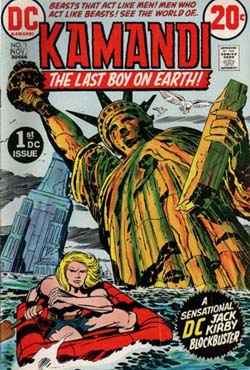
As one of the commenters at the link put it, the creators seem to think there was no technology before we invented electricity. As a result, the Earth After-Disaster (as Jack Kirby put it in Kamandi, the Last Boy on Earth) has no windmills or water mills. There’s no refrigeration even though “iceboxes” predate electrical power. And since one character asserts he has the last bottle of single-malt Scotch in Chicago, that suggests nobody’s distilling either, and that doesn’t take electricity (in fairness it might just be that he doesn’t like the local hooch, or that whisky, as opposed to moonshine, is unavailable in his neck of the woods).
And the guns? At the time of the blackout America would have been awash with guns (seeing as the time is now). So why are some of the government troops bothering with muskets instead of automatic weapons? Hell, where would you get muskets?
Other apocalypses have made sense of similar set-ups. In Weathermonger there’s a good reason England has reverted to the Middle Ages. And the standard post-nuclear war can explain the loss of technology and of people who know how to rebuild. Here? Not very convincing, even given the chaos that must have resulted from the blackout.
That being said, I “liked the movie” enough to overlook the logic gaps, for now at least. It’s the same way I can tolerate Firefly giving us a future where people on the frontier of space decide to dress like it was the Old West frontier (crinoline? Why?)—it’s absurd and silly, but Firefly was a great show despite that.
I doubt Revolution will be as good, but I’ll be happy if I’m wrong.

1 Comment

Filed under TV

Listening to the critics

It says a lot about how stressful Friday through Sunday were that getting two stories returned didn’t even faze me a little.
Nevertheless, that’s two more stories, continuing my unwinning streak. If I were Bizarro, that would be cool (“Hah! Me am more unpublished than any author in history! That mean me am big genius!”)—but of course, I’m not.
As I’ve mentioned before, there are times to ignore feedback. Possibly this is a good time to start taking it. While my writing group has been positive about almost all these stories, editors have given me some. So over the next month, I’ll start thinking about whether it’s time to rewrite some of my rejections. Even though I’ve sold stories after being told It Sucks by someone else, other times the editors have been spot-on about the suckage.
Mage’s Masquerade. Beneath Ceaseless Skies said the hero needed to show more emotion so they could connect with him. This fits into something I was already thinking about, adding some flashback material to beef up the romance. So I may try it.
Abyss and Apex said it had too much style, but not enough plot. Since I worried the story was slightly overstuffed with events, I’m not sure what, if anything to do about that, but I’ll keep it in mind.
I Think Therefore I Die. Abyss and Apex thought the magic wasn’t distinctive enough. Beneath Ceaseless Skies said, again, that the lead character didn’t care enough to hook them. I think both may have a point—and both points are relatively easy to fix (and if you’re submitting anything yourself to BSS, take note of this point)
Leave the World to Darkness. I got one recommendation a year or so ago that I make the opening more of a grabber. I think I’ve done that but I may revisit it just to be sure.
No Good Deed Goes Unpunished. No specific feedback, so I’ll stick with it as it is.
And He Caught a Crooked Cat. Ditto. I’m very pleased with this one (obviously if someone raises an issue I hadn’t thought of, that’s different)
Kernel of Truth. Ditto.
Tale Spinners. I got a couple of complaints this didn’t have a strong enough plot—it was more like a scene—so I rewrote accordingly. Hasn’t helped so far.
Glory That Was. No feedback to date.
Heads Up. No feedback but it’s only been out once.
Wodehouse Murder Case, An F&SF author said it just didn’t work for her. Which I think indicates a matter of taste more than a flaw in the story (PG Wodehouse fantasy knockoffs aren’t everyone’s cup of tea).
Number of the Least. Allegory’s editor said it got a little preachy in the middle. I think I’ve fixed that … but so far the editors still aren’t biting.
Grass is Greener. My oldest story currently still going out. I must ask the writing group what they think of it.
The Savage Year. One that came back this weekend. No feedback as yet.
We’ll see how it goes from here.

Leave a comment

Filed under Short Stories, Story Problems, Writing

One book, no movies: The Authoritarians

Between unpacking and TYG’s surgery, I didn’t get a lot of reading or done the past week (go figure). So I’ll discuss one I read a few weeks back that I saved to discuss separately, because it’s that interesting.
Robert Altemeyer’s THE AUTHORITARIANS is a study of what he calls “right-wing authoritarian followers.” Right-wing not in the sense that they’re conservative but that they support established authority (as opposed to left-wing authoritarians who favor revolutionary leaders). Authoritarian in that they trust, blindly, established authority and believe it should have great power to deal with all threats, foreign and domestic. And followers in that these aren’t the people who seize power, but the people who want someone else to seize it and tell everyone what to do.
Altemeyer says in the book that while it’s easy to imagine why someone would want to rule as a dictator, he was curious what characteristic led people to support that kind of power without participating (yes, the post-9/11 era of Republican extremism was on his mind). What he found was that right-wing authoritarians—who can be anyone from conservative Christians to Communists in the USSR (loyal Soviet citizens show the same authoritarian attitudes as the hard right in the USA). What they have in common is not politics as much as:
•Intense support for anyone they consider a legitimate leader. Said support includes a belief that you don’t question leaders, argue with them or expect them to obey the same standards as everyone else.
•Willingness to use violence. Though not at all inclined to be lone vigilantes, they have no problems dealing with troublemakers as long as the government or the community is with them. They even like the idea.
•General intolerance for nonconformity or dissent. Anyone who doesn’t shut up and obey the leaders deserves punishment.
•Fear. For the typical authoritarian follower, society is on the brink of collapse. and anyone who questions the way things have always been done or crosses the traditional moral boundaries is bringing on armageddon.
Altemeyer is very clear this is not some unique state of mind, more like a magnification of traits in most of us. In the authoritarian case, they’re exacerbated by growing up in an authoritarian family where parents always know best, and not being exposed to anything outside your comfort zone (meeting people of different faiths, races or sexualities tends to lower authoritarian rankings). While religion doesn’t lead to authoritarianism per se, it can make the traits that much more intense since now the authority dissenters are challenging is God’s.
The appropriateness of the leader is also very significant. Clinton, for example, was despised by millions on the right: He was anti-war, moderately liberal, gave us Don’t Ask Don’t Tell (up until that point, homosexuality had been a dischargeable offense, whether you told or not) and had a wife who saw herself as an equal partner in matters political, all of which went against The Way Things Should Be. So the rabid authoritarians on the Repub fringe couldn’t stomach him, whereas they lined up to support Bush and Cheney, who evaded the draft just like Clinton but said all the right political things (like how they supported the war they didn’t fight in). Authoritarians have a high ability to maintain double standards and ignore bad logic if they like the conclusions (though again, this is an intensified version of something that shows up in non-authoritarians too).
I do find Altemeyer’s use of right-wing/left-wing a little clumsy (though I’m not sure what would work better) and I do wish he’d gone into more detail on left-wing revolutionary authoritarians. What would the personality differences be between one of the Patriot militiamen who opposes Obama and Clinton before him and say, a Red Brigade or Weather Underground member? Or is there one?
You can find Altemeyer’s book available for free download from his website, along with updates on the 2008 election and the Tea Party. They’re all worth reading.

20 Comments

Filed under Politics, Reading

Urgh

The weekend kicked my butt more than I thought it would.
Yesterday, TYG was in better shape than we expected, but once again I succumbed to the lure of unpacking. It was productive, though: Fiction out through the early “D’s” nonfiction rearranged, DVD movies set up alphabetically. Swept the kitchen. Cleaned the counters. Helped move stuff (as noted before, she can’t lift more than 1 lb). Went shopping.
Today, I’d planned not to do very much, but now the surgery seemed to catch up with TYG. She felt poor enough we spent most of this afternoon waiting around the E/R to see if there was a problem (probably not, I’m happy to say). Then dropping off an inter-library loan, then some quick shopping. So once again, wiped.
Proving once again that even when I think I’m prepared for crossing these rapids in the river of life, life is liable to surprise me. There’s always another axe-man.
PS: None of the above is meant as criticism of TYG. It’s not her fault she feels miserable and it’s 100 percent my responsibility to help her when she is. Doesn’t make it any less exhausting, but please don’t think I resent it. In sickness and in health …

1 Comment

Filed under Personal

Kicking back … sort of

All this month I’ve been compensating for the demands of the move by squeezing in extra eHows at every opportunity. As of yesterday, that’s done. I can get back to a slightly lower rate. Five hours freed up a weekend may not seem like much, but it’s a lot, trust me.
The catch: TYG has outpatient surgery today, a follow-up to an operation she had last year (this should permanently deal with the problem). As I know from experience, playing caregiver demands a lot of time—TYG can’t lift anything heavier than five pounds the first few weeks for instance.
So for next week and October, I’m not taking on anything beyond the basics: Fiction and eHow. That should leave me with enough time to adjust to my angel’s myriad needs without crimping my writing the way it did last year. Experience, hopefully, is a good teacher.
As for this week’s work, it went well. I got another draft of the Monster Earth story done and mapped out what needs to be done over the next month. And I did well with the ehows (not reflected here: This reflects what I got paid for which reflects how little I did last week)
•Can My Sister Make Me Share Life Insurance Proceeds if I Am the Beneficiary?
•What Happens to Delisted Shares?
•Tax Deductions for Donations Made to the Same Organization on Different Dates
•If Taxable Income Is Zero, Why Do I Owe Taxes?
•Can a Parent Transfer Their IRA to Their Child?
Now lunch, then off to the hospital with TYG.

4 Comments

Filed under Personal, Short Stories, Time management and goals, Writing

Undone by the unpacking

Going well, but phew!
I believe we have finally unpacked all the nonfiction, though it’s not shelved yet. But we have the space for it, which I’d actually wondered about.
Comic-book TPBs are up and roughly shelved.
Fiction … we’re going to need more bookshelves. Not to mention shelving my memorabilia and photos.
And of course, I still don’t know where to put all the fancy glassware TYG has (that we’ve never used even once).
So tonight, another linkpost.
•Lance Mannion rips into Mitt Romney’s complaint that the 47 percent voting for Obama are all freeloaders who don’t pay taxes. Slacktivist collects more incredulity. The Daily Howler points out that a few years ago, Bush was pushing to wipe out income taxes on more Americans and Republicans weren’t bitching about it. However, the Howler also notes that if liberals/Democrats don’t explain the truth, there are people who’ll swallow Romney’s bilge. So let’s be clear: The 47 percent are those who pay no income taxes, but they pay sales tax, gas tax and Social Security tax (and the vast majority of Romney’s income is not Social Security-taxed, as it taps out at around $110,000). And many of them pay no income tax because they’re retired and living on Social Security, or disabled, or kids or seniors dependent on someone else.
Spread the word.
•I reported Monday that a judge had blocked Obama’s power of indefinite detention. Thanks to an appeals court, it’s back on. Glenn Greenwald goes into detail on the issue.
•Echidne points out that a group at the Values Voters conservative summit is demanding women dress modestly and display “gentleness of spirit” (presumably meaning Don’t Talk Back To Your Masters). Think Progress goes into more detail, including that the group acknowledges that yes, the responsibility for lustful thoughts is the man’s but women just make it sooooooo difficult. If the excerpts from the group’s handouts are accurate, immodest dressing is an insult to God but apparently the lustful thoughts aren’t. As Echidne points out, the Taliban impulse is alive and well among some religious conservatives.
For an even odder bit of conservative Christian prudery, this review of Men in Flying Saucers, a 1950s nonfiction book (so to speak) revealing that flying saucers are a Communist plot to take over America by spreading “dancing, sex-freedom, and free love.”

Leave a comment

Filed under economics, Politics, Undead sexist cliches