Category Archives: Doc Savage

Pulp heroes and superheroes: this week’s reading

SIX WHITE HORSES: The Complete Adventures of the Gadget Man, Volume 3, by Lester Dent (V1 review here, V2 here) wraps up the series with inventor Clickel Rush getting into his usual jams — an inheritance from an uncle who doesn’t exist, becoming custodian of a foul-mouthed parrot, murder by feeding a man a poisoned pigeon — which lead to him doing Bufa’s dirty work and investigating. In the previous volume Bufa was completely manipulating Click; in this one Click’s spent a lot of his pay on unsuccessful startups to market his inventions so he’s got added incentive to crack the case. And may I say that getting a $10,000 bill for his work (they really hd those back in the 1930s) is way cooler than depositing the same amount in PayPal.

Regrettably this was the last of the series. Doc Savage expert Will Murray thinks Dent got PO’d when the publisher used Dent’s Doc Savage byline — Kenneth Robeson — on one of the stories. We’ll never know for sure.

THE MIGHTY CRUSADERS by Ian Flynn and Kelsey Shannon (who did the cover) is a sequel to Flynn’s The New Crusaders which I read a decade ago. The premise of the previous volume was that Archie Comics’ superheroes from the Golden and Silver Age have aged in real time and their kids are now stepping up as legacy heroes.

In this volume, the kids are still struggling to become an effective team. The new Shield keeps wanting to do it all herself; Golden Age hero Steel Sterling is becoming rigid metal; the Jaguar’s patron spirit keeps making her go crazy; and some of the team think they should be leader. When the villains show up, can the Crusaders rise to the task?

This is probably my favorite of the heroes’ many revivals since the Silver Age (if you’re curious, The MLJ Companion covers them from the 1940s through the end of the 20th century), though like the others it didn’t take — I think this volume was the last. Flynn does a good job cherry picking elements from previous versions, such as the female Jaguar from the 1990s DC !mpact line and a couple of villains from the 1980s Red Circle version.

Four years ago I picked up The Terrifics: Meet the Terrifics, in which Plastic Man, Mr. Terrific, Metamorpho and Phantom Girl join forces to become a DC version of the Fantastic Four. I don’t know when I’d have gotten back to the series but as I subscribe to the DC app for my Silver Age Reread at Atomic Junk Shop, I eventually worked through the rest of THE TERRIFICS, written by Jeff Lemire, then Gene Luen Yuang, with various artists (the cover is by Emanuela Lupacchino). In various stories the team gets trapped in a computer, battle Bizarro across time, meet their evil counterparts the Deplorables, meet Ms. Terrific (Mr. Terrific’s dead wife, but from a world where he died and she became the hero) and meet Simon Stagg’s evil son.

Do I miss getting these in hard copy? Not really. The series is fun, but not so much that I want to own it again. I was happy to learn the team is still active rather than forgotten once the series ended, as I’d anticipated. However it’s a little irksome that we now have this version of Metamorpho, one in Mark Waid’s World’s Finest and a third one in Al Ewing’s Metamorpho. I get that out-of-continuity books can be good but I’m not sure, which is in continuity, or if any of them are.

All rights to images remain with current holders.

Leave a comment

Filed under Comics, Doc Savage, Reading

Two books of TV horror, two pulps: recent reading

THE TELEVISION HORRORS OF DAN CURTIS: Dark Shadows, The Night Stalker and Other Productions by Jeff Thompson is an exhaustive look at Curtis’ career from his early days selling syndicated shows to local stations (Thompson speculates his awareness of syndication is one reason he made sure we had a complete run of DARK SHADOWS) to producing golf shows to Dark Shadows, The Strange Case of Dr. Jekyll and Mr. Hyde (the reason I bought this—movie review soon), adaptations of other horror classics (The Turn of the Screw, Frankenstein, Dracula) and non-horror work such as The Winds of War, based on Herman Wouk’s epic novel of America before Pearl Harbor. Even as a Dan Curtis fan I learned a lot here.

I kept watching Peacock’s Teacup partly because I like Robert McCammon’s horror novels and I knew it was based on his book STINGER. If I’d known how little the series kept of the book — alien refugee in child’s body, alien hunter, everyone trapped inside a force field, nothing else — I doubt I’d have made it to the flaccid finish. The much more entertaining 1980s novel has a lot in common with the decade’s TV miniseries like Winds of War — a huge, sprawling cast, epic action, and unlike the TV show, solid entertainment.

The book takes place in Inferno, a southwestern town slowly wasting away, which doesn’t stop the remaining populace from engaging in personal feuds, power struggles and occasionally love. Then a refugee from a crashed spaceship transplants her consciousness into a child until she can find a spaceship to go home (she’s shocked we don’t have any); worse, a scorpion-like alien bounty-hunter shows up looking for her and he doesn’t care how many humans die if it gets him what he wants. Worse, as Stinger kills people, he resurrects the corpses as cyborg agents so the numbers rapidly shift in his favor. If nothing else, at least Teacup prompted me to read this.

Now, the pulps: CRIMSON STREETS: The Devil Inside is the last of the six Crimson Street anthologies I got from the publishers and a good one to go out on. Mostly hardboiled mysteries or crime dramas without much of a fantasy element, but with that caveat it’s a solid set of stories. A beautiful dame doublecrosses her gang. A PI becomes a wraith. A beautiful dame assures readers her encounter with this shamus will follow the tropes they expect. And more. Good neo-pulp stuff.

I enjoyed Talking Toad, the first volume of Lester Dent’s Gadget Man series, but not as much as I’d expected. To my surprise I had more fun with THE DEVILS SMELL NICE: The Complete Adventures of the Gadget Man, Vol.2, probably because I know what I’m getting: low-key adventures with a strong comic element, much more down to Earth than Doc Savage.

In the first book, the mysterious Bufa hired inventor Clickell Rush to use his crimefighting gadgets (he hoped to sell them to the police and get rich. The police laughed) and take down the crooks Bufa pointed him towards. With a $10,000 bill for each mission accomplished, Clickell can afford to take it easy and stop putting his life on the line. Bufa, however, keeps pushing him into more crime-solving peril. If only Click could figure out who he is …

In the second volume, Rush discovers Bufa pays various PI firms to tip him off to impossible crimes (one of the firms, the Continental Detective Agency, comes from Dashiell Hammett’s stories — Dent was a huge fan). Surely he can work back through the agency to find Bufa. Instead he finds a strange egg containing a hairless animal, an innocent man facing the electric chair and killers who smell really good. The screwball stories that follow the opening hook are fun, though as with V1, the women are interchangeable eye candy, much less impressive than the women characters who show up in Doc Savage’s adventures.

All rights to images remain with current holders.

3 Comments

Filed under Doc Savage, Reading

From a spellshop to the valley of the kings: books

As I enjoyed Sarah Beth Durst’s The Bone Maker, I tried her fantasy cozy, THE SPELLSHOP, but ended up putting down unfinished.

The protagonist, Kiera, flees the imperial library when revolutionaries burn the capital. Accompanied by her pet spider-plant, she takes some of the surviving spellbooks back to the isolated island village her parents came from. She needs a found family, though she doesn’t know it yet; the dying village needs a shot in the arm. Hmm, this might work out well.

Durst said she wanted this book to be comforting, like a mug of hot chocolate, and she succeeded. However like a lot of stories about returning to your family’s small town it’s got the same worldview as the 1939 Wizard of Oz, that there’s no point in looking for happiness beyond your own backyard, and that really isn’t a perspective I can identify with. So it’s a no-go.

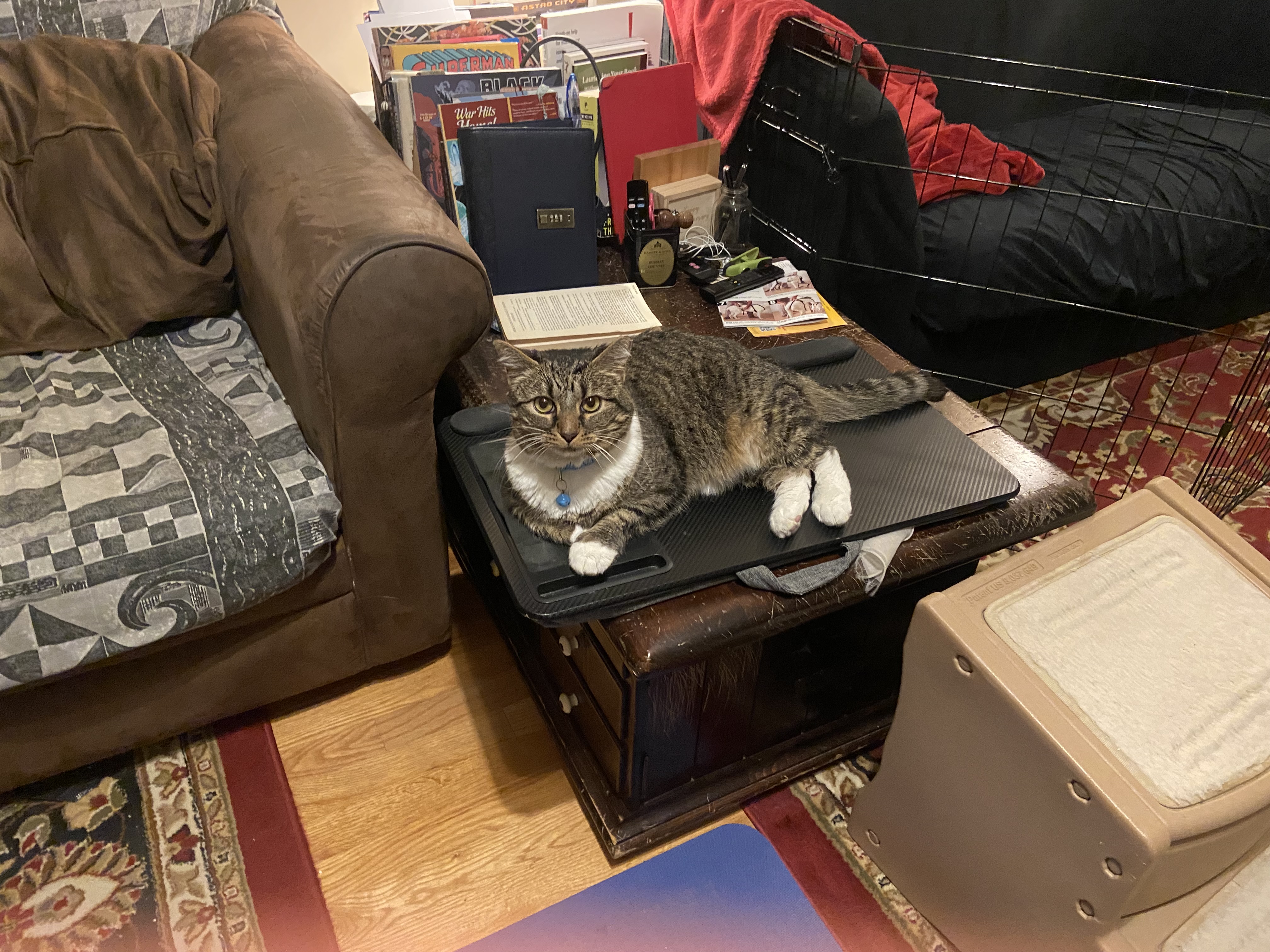
(Yep, another post where I’m throwing in random pet photos for eye candy)

In 1936, Lester Dent took a break from writing Doc Savage and among other writing sold two novellas, HADES AND HOCUS POCUS to the top magazine Argosy. In Hades, a med student whose education has ended early winds up helping out a movie producer who believes he’s uncovered a gateway to Hell — and something from Hell has followed him back. In Hocus Pocus, an unemployed stage magician takes a job investigating an evangelical fellowship’s alleged mind-reading powers and discovers the church has more sinister goings on than he anticipated.

The first has a fun cast, including the protagonist’s sidekick Haw (he laughs at his own, very bad jokes) and a professional strongwoman. However the plot feels too much like countless Doc Savage stories about elaborate supernatural fakes — I imagine Dent would have recycled this for the last novel in the series, Up from Earth’s Center, if his editor hadn’t insisted on a real supernatural threat. Hocus Pocus has less memorable characters but it’s a much stronger story.

EIGHT FANTASMS AND MAGICS is a mixed bag of shorts by Jack Vance. Three of them I’ve read before (two of the rereads are from The Dying Earth and Eyes of the Overworld), some are meh but the two best are very very good — the solution in “Telek” to the mutants vs. humans problem is really good. Overall, though, only fair for Vance.

WOMEN IN THE VALLEY OF KINGS: The Untold Story of Women Egyptologists in the Gilded Age by Kathleen Sheppard is a mixed bag. It’s a good look at 19th and early 20th century Egyptology with a particular emphasis on the women who were involved and largely eclipsed — excavators, authors, teachers, women who underwrote expeditions, artists who captured temples and tombs on paper (the best non-invasive way to record discoveries as photography would have captured things in black and white). And yes, Sheppard is fully aware of the colonialist/cultural appropriation side of what European archeologists did and doesn’t hide from it. Unfortunately a lot of the book bogs down in inside-baseball stuff — lists of famous names (often nobody I’ve heard of), schools and books. Still worth a read though.

#SFWAPro. Cover by Jack Gaughan, all rights to images remain with current holders.


2 Comments

Filed under Doc Savage, Reading

Terror and genius: the other Lester Dent

Late last year I read a couple of books collecting Lester Dent’s early pulp series heroes, Lynn Lash, Lee Nace and Foster Fade. As I found that useful for working on Savage Adventures I thought I’d read some more …

TERROR, INC.: The Weird Mysteries of Lester Dent is a collection of “menace” thrillers featuring various one-shot PIs tackling bizarre deaths — men turning into to skeletons, men bleeding to death through their pores, beheaded by a ray weapon and attacks by “The Invisible Horde” which uses an X-ray like beam to turn things and people transparent. Entertaining in their own right, and it’s easy to see elements Dent may have recycled into the Doc Savage series — invisibility in The Spook Legion, the skeleton death in Land of Fear, the beheading ray in The Headless Men (ghost-written by Alan Hathway).

In 1936, Dent stopped submitting (and presumably writing) Doc Savage stories for several months. Doc Savage expert Will Murray says there’s no clue to whether Dent wanted to take a break, hoped to walk away for good or what. During the sabbatical he submitted several detective stories to the critically acclaimed Black Mask magazine and also wrote GENIUS JONES. a screwball comedy that imagines Doc Savage a little differently.

The protagonist (who may have inspired a similar DC comics character a few years later) is the son of “Polar” Jones, an explorer who died in the Arctic leaving his son behind. With the help of the one surviving explorer and a ton of books, Jones educated himself in just about everything. However his lack of human contact gives him an almost Vulcan level of cluelessness about human behavior — and why does he get these strange feelings when he meets attractive women?

The plot involves a hardnosed millionaire who realizes Jones is that rarity, an honest man, and sets him a challenge: if he can find worthy recipients for a million dollars within one month, Jones will take charge of distributing the millionaire’s entire fortune. That’s very bad news for Lyman Lee, a scheming business associate (“Lyman Lee had gotten waiters fired for spilling soup on his jacket.”) who has his own plans for the money.

While the handsome, brawny, brilliant Jones has a lot in common with Doc Savage, the screwball take is completely different in tone. This one was thoroughly engaging; while the book includes the outline for a sequel, regrettably we never got one. It works better for me than the similarly humorous Gadget Man stories do.

#SFWApro. Top cover artist unknown; Genius Jones cover by Rudolph Belarski, all rights remain with current holder.

Leave a comment

Filed under Doc Savage, Reading, Uncategorized

Ambergris, iron and sexism in Hollywood: recent nonfiction reading

The Doc Savage novels Spook Hole and Colors for Murder both use ambergris, an essential ingredient in perfume making at the time, as a McGuffin. That got me interested enough to read Floating Gold: A Natural (and Unnatural) History of Ambergris by Christopher Kemp.

Contrary to some accounts, ambergris isn’t sperm whale puke but some sort of whale excrement, forming around the indigestible beaks of squid (something sperm whale love to eat) and either popping out the back end or floating free when the whale dies and the carcass decays (there’s a lot still unknown about the process). After year of drifting on the sea, it forms a hard substance that can enhance the smell and duration of perfume. Once essential to all perfumiers it’s used much less now due to concern over cetacean rights, though some of the dealers Kemp talks to claim it’s as in-demand now as ever.

The ambergris stuff is fascinating but Kemp spends more time talking about his personal odyssey hunting for ambergris on various beaches and Kemp is not fascinating. It was still worth reading but if you can’t put up with the personal stuff (or you like writers putting themselves in the story more than I do), skip it.

TOM PAINE’S IRON BRIDGE: Building a United States by Edward D. Gray argues that Paine, author of the anti-monarchy, pro-independence Common Sense was less the wild-eyed radical ready to tear down established institutions and equally concerned with building the new country up. One of the challenges for creating a country in North America was that the English colonial footprint was huge and split up by countless rivers. Nor did were bridge designs in the late 18th century able to withstand flooding or ice without being bulky enough to block river traffic.

Paine’s solution was to build bridges with large arches out of iron. The title refers to a sample bridge he made in England, showing he’d gotten around the technical challenges of iron bridges; however in a colonial era where forested land was everywhere, laminated wood proved a more popular choice in Paine’s lifetime. The book makes for an interesting look at American infrastructure and bridge-building methods in Paine’s day.

BURN IT DOWN: Power, Complicity and a Call for Change in Hollywood by Maureen Ryan is a blistering look at toxic workplaces (including Lost and Saturday Night Live), psycho bosses, sexual harassers, the many myths that excuse them — comedy should offend people! Being a jerk is the director’s creative process! — bosses who turn a blind eye as long as the money keeps coming in and rapists who get redemption without earning it. A depressingly familiar picture (a lot of the details were new to me) and the chapter on how to change things was weak — but in fairness, that’s a very big and difficult question. Definitely worth reading.

#SFWApro. Cover by Emery Clarke, all rights to image remain with current holder.

Leave a comment

Filed under Doc Savage, Reading

A bad week for our dogs. Challenging for us, too.

Monday morning, TYG discovered Trixie had bled onto the bedsheets. We checked her over and found bleeding from her butt. We were able to score a same-day vet appointment and they confirmed her anal gland had ruptured. They did whatever you did to fix that and sent me home with Trixie and some antibiotics.

She did not enjoy her vet trip.

The bottle of meds had a leak or something because there was nothing in it when I got it home. I picked up a replacement Tuesday. Fortunately Trixie made a full recovery almost as soon as they fixed her gland. Yay.

Yesterday TYG became convinced Plushie’s glaucoma had suddenly gotten worse. I took him to the vet today to check his eye pressure (TYG’s workweek has been insane which is why I handled the dog stuff). TYG was right — it’s elevated. They sent us home with directions to increase the dosage of some of his drugs. It worked, yay! However it’s still upsetting every time life reminds us Plushie will not be the world’s first dog with Wolverine’s healing factor.

Despite all that, I did get a full week of work done. Partly because with Jekyll and Hyde under way, I’m doing research reading which helped me make use of my time waiting at the vet. I also did some research reading for Savage Adventures and proofed another chunk of the book.

I did some good work on Southern Discomfort, cutting a couple of scenes based on writing group-feedback and going through to eliminate the excessive use of “but” (way too many compound sentences) and “just.”

I wrote an article for The Local Reporter on policing stats in Carrboro, one of the local towns in the Triangle. At Atomic Junk Shop I wrote about Marvel’s art in 1968 — much as I’m a DC fanboy (and find a lot of Marvel’s writing in this period mediocre), the visuals at Marvel are amazing. This simple but effective splash page by John Buscema, for instance—

— or John Romita’s shot of Spidey here.

I also blogged about several random Silver Age stories from the same period.

I did not get any work done on Let No Man Put Asunder. It would have taken more creativity than I could focus. Overall, though, the 4-day week continues its effectiveness.

Oh, and here’s a link to a Con-Tinual panel on character conflict in comics.

Send positive thoughts for our dogs, if you would be so kind.

#SFWApro. All rights to images remain with current holders.

2 Comments

Filed under Doc Savage, Nonfiction, Personal, Southern Discomfort, The Dog Ate My Homework, Time management and goals, Writing

The fake McGuffin

Alfred Hitchcock coined the term McGuffin to refer to whatever object put the plot of his films in motion (though not all of his films have a McGuffin). The mysterious bottles in Claude Rain’s cellar in Notorious. The microfilm in North by Northwest. The corpse in The Trouble With Harry. The tech secrets Paul Newman hunts in the Eastern bloc in Torn Curtain.

Hitchcock’s view was that the McGuffin didn’t matter, what matters is what you do with it. A bank robbery, for example, can give us Dog Day Afternoon or Cash on Demand.

Lester Dent used a fair number of McGuffins writing the Doc Savage books. In the first book, The Man of Bronze, it’s the golden treasure hidden in the Valley of the Vanished. In Spook Hole it’s a treatment that causes whales to mass-produce ambergris (whale snot) which at the time was an essential ingredient in perfumes, worth a fortune. In Repel it’s an anti-gravity element.

One of the things I’ve realized working on Savage Adventures is that one of Dent’s tricks is to make the McGuffin worthless: the villain has lost everything fighting for a useless prize. Dent first uses this ploy in The Phantom City: the Arab crimelord Mohallet is convinced the lost city’s gates are made of solid platinum but it was an error in translation: they’re solid lead. His dreams of wealth were a mirage.

The McGuffin in Colors for Murder is another ambergris-making process but this time it’s a scam — the treatment doesn’t work. In The Mental Wizard the McGuffin is the real deal — a drug that gives you invincible psi-powers — but it’s degraded through centuries in storage and doesn’t work.

I agree with Hitchcock, what Dent does with the McGuffin is more important than what it is. Even so, having a fake McGuffin can add an extra touch of irony.

I’ve seen this work outside Doc Savage stories. In Batman #81, “The Boy Wonder Confesses,” (David Reed, Sheldon Moldoff) Dick admits to being Robin as part of an elaborate ruse to prove he and Bruce aren’t the Dynamic Duo. Behind it is film footage that shows them changing into their costumes; disproving the connection before the film goes public will ensure nobody believes it. At the end of the story it turns out there film was underdeveloped to the point it doesn’t show anything.

It’s an effective trick for adding a little twist at the finish of the tale.

#SFWApro. Covers by Fred Pfeiffer Emery Clarke and Sheldon Moldoff; all rights remain with current holders.

Leave a comment

Filed under Doc Savage, Reading

A short but productive work week

Despite some distracting doomscrolling over the Supreme Court’s bring back the monarchy decision I had a good work week. Short, as my four-day week got chopped down to three for Independence Day, but I made up for that by not having any Local Reporter work (though they did publish an article I finished last week, on a local veterans memorial).

(For visuals, here’s Wisp and Snowdrop greeting each other from a few days ago.)

I reread Southern Discomfort and I think my beta-readers were right, the conversations in some sections do drag on a little too long. However it’s not a massive trim-all-scenes problem, just a problem for a few scenes, so it’ll be relatively simple to fix. I also went over the street references, making sure that I identify locations consistently — and wouldn’t you know, a magical trap at the Peachtree/Blake intersection is later identified as King Street. Next week I clean it up (I spotted a couple of other details that need fixing along the way), then I get it into paperback for a final proof. Phew — much less work than I thought.

I resumed work on my second draft of Let No Man Put Asunder. That one did suffer from the doom-scrolling and I didn’t get anywhere near as much as I’d hoped done. However I am working on it again after missing all last month, so that’s a (small) win. I continued proofing Savage Adventures and began some reference reading for my new Jekyll and Hyde film book.

Over at Atomic Junk Shop I looked at Gardner Fox’s last story for DC Comics, introducing the tragically lonely Red Tornado, a favorite of mine. Fox defined the Silver Age and the Justice League for me. While his replacement on the book, Denny O’Neil, tried to add more characterization, it’s very bad characterization.

Superman doesn’t shrug off things that way, neither do WW or Green Lantern. And every Leaguer knows “someone steals scientist’s machine” is a prelude to trouble.

I also look at Arnold Drake leaving DC and the Doom Patrol dying. Plus several other books that went under, such as Plastic Man and Hawkman.

#SFWApro. JLA art by Dick Dillin, whose style embodied the Bronze Age JLA much as Mike Sekowsky embodied the Silver.

Leave a comment

Filed under Doc Savage, Nonfiction, Southern Discomfort, Time management and goals, Writing

Though I’m working efficiently I didn’t get enough done

My first month of my new four-day work week gets a thumbs up. I’m more focused, more productive, and I seem able to work longer hours — Monday I put in a 10-hour day due to waking up way early.

Unfortunately I got nowhere near what I wanted accomplished. The huge town council meetings Carrboro had to wrap up for the summer consumed a lot of time, as did writing about them; Monday was entirely devoted to Local Reporter stuff. That includes Carrboro’s plans to charge for public parking, a local development controversy, and a local charity facing loss of its two business locations (or as I put it in the alliterative title “Carrboro philanthropy faces Fidelity foreclosure“).

Good stuff, my editor loves me and that’ll be a good-sized paycheck for the week’s work (I also got in next week’s story). However I’d planned to focus on fiction Tuesday and the long hours Monday left me too wiped. It was Savage Adventures the rest of the week.

That’s the other reason this month was unproductive. As I said last week, my book on the Doc Savage series simply isn’t polished enough, ergo it takes more editing. I’m officially pushing it back to October (hopefully early October) before I release it through Behold the Book. That will allow me to proof less of it next month and devote time to other stuff.

Nothing on Let No Man Put Asunder. Nothing on Southern Discomfort. I do not want to repeat that next month, and I will not.

Other stuff just ran into bad luck: my cover artist was traveling overseas this month so asking for updates didn’t seem appropriate. And I would almost certainly have gotten some fiction done yesterday but the housecleaners arrived early in the morning which made our schedule nuts in various ways.

My exercise schedule is once again shot, simply because I had a lot of extra dog care. Which, as I hope I’ve said before, is fair — it’s a lot easier than TYG having to handle all the IT stuff on her job — but our pets insist exercise is some kind of signal for them to come snuggle. Hard to do vigorous exercise at the same time.

Over at Atomic Junk Shop, I blogged about the outside influences shaping comics in 1968, the beginning of Wonder Woman’s Diana Prince years, and Stan Lee’s insufferably preachy Silver Surfer series. Quite aside from being heavy-handed in the writing, a guy who found planets for Galactus to destroy is hardly the pure soul Mephisto claims he is.

Though John Buscema sure makes it look purty.

To leave on an up note, someone checked out one of my books via Hoopla and I had some sort of sale on Amazon. I haven’t got the data yet (Amazon’s very unhelpful with that) but whoever you were, thank you! I hoped you liked whatever of mine you read.

#SFWApro. Art by James Bama, Mike Sekowsky and Buscema, all rights remain with current holders.

Leave a comment

Filed under Doc Savage, Nonfiction, Southern Discomfort, The Dog Ate My Homework, Time management and goals, Writing

What’s not getting done

My four-day/seven hour workweek continues to be a productive approach. The downside is, not everything I need to get done gets done.

(As I’ve said before, there’s always one armored killer you don’t realize you need to deal with).

If there’s something specific that needs doing — picking up dog meds, dealing with contractors, giving the pups dog meds — I’m on it. But there’s non-urgent but necessary stuff (cleaning things, sorting stuff, keeping up with non-urgent paperwork, dog exercises) that I don’t get around to during the week. I end up too focused on work, which is good, and on the weekends I’m focused on relaxing. Doesn’t leave much time.

Also my efforts to Pomodoro and take a break every half hour somehow get forgotten when I’m working so intensely. This relates to the not-doing as there’s stuff I might squeeze into these breaks except I don’t take them.

This week was unsatisfactory as it was all nonfiction. I cover Carrboro Town Council for The Local Reporter and this week was their last meeting until September. They had a lot on their agenda. Sitting and watching a 4.5 hour streaming meeting and recording the key moments is more work than you might think. I did have one story, published, about expansion plans for the Kidzu Children’s Museum.

The rest of the time I continued proofing the first 30,000 words of Savage Adventures. I got it done but still have to go back and confirm some of my details about the books are correct. It’s definitely looking like September will be pushing it to finish the book. I’m not definitely postponing yet, though.

I sat down and mapped out a rough schedule for my Jekyll and Hyde film book. It’s a lot of work but it’s doable without knocking myself out the way I did for The Aliens Are Here. The list of movies I need to see is much smaller.

And that was it. No Atomic Junk Shop — getting all my blogging done on Friday is proving harder than I’d hoped. No fiction (sigh). No submitting stories — I came across one market that might be good for Obolus but I balked at $10 for an 8,000 word piece.

Efficient scheduling can’t solve everything, just some things.

#SFWApro. Luke Cage cover by Billy Graham, Doc Savage by James Bama. All rights to images remain with current holders.

Leave a comment

Filed under Doc Savage, Nonfiction, Time management and goals, Writing