
Don’t let the smiles fool you.

If you’re not scared yet, you should be!
Don’t let the smiles fool you.
If you’re not scared yet, you should be!
Filed under Miscellanea
Years ago, evangelist Billy Graham established an Evangelical Council for Financial Accountability to oversee church finances and ensure everything was on the up and up. Now they’re adding a new standard, that boards are watching over church leaders’ integrity. Which seems like an excellent idea given church leaders perform plenty of sinning and boards often do nothing. And more sinning. And. And. Nevertheless, Billy Graham’s son Franklin has withdrawn the Graham ministry from the ECFA over the new rules. As Slacktivist says, “When somebody literally runs away from accountability, you’ve got to ask why.”
“To James, “the world” refers to the systems and structures and Powers That Be that deny the worth and humanity of those orphans and widows, the aliens and the poor. To be polluted by the world is to accept what “the world” tells us about them — that they don’t matter, that their distress is just how it is or, even worse, that their distress is what they deserve.”
“This is how we conquer the hatred and prejudice of the world: not with an eye for an eye, but with an inundation of love.“
Oklahoma state Senator Dusty Deevers, a self-righteous theocrat misogynist, who unsurprisingly thinks separating church and state violates his rights. I guarantee if a Christian America embraces some version of theocracy that doesn’t fit Deevers’ beliefs, he’ll be screaming about tyranny. The same for theocratic creep Joshua Haymes who claims “liberalism is a greater threat to the US than neo-Nazism, and that the Bible is “pro-Ice raids”. On X, he has also advocated for capital punishment for adultery and abortion, and appeared to call for the drowning of LGBTQ+ Pride marchers.” If your religion thinks liberals are worse than neo-Nazis …
Homophobic hatemonger Tony Perkins is optimistic the Necrotic Toddler he reveres will convince Americans dictatorship is good.
“Rep. Mary Miller (R-Ill.) … Miller wrote on X that the man, Giani Surinder Singh, “should never have been allowed” to lead the prayer and called for Congress to uphold the “truth” that “America was founded as a Christian nation.” George Washington would like a word.
Is there a difference between Christian leaders and D&D dungeon masters?
“The Civil Rights Movement and the brief Second Reconstruction it produced were not about sex, drugs, and rock & roll.”
What Johnson, Deevers, Perkins and other believers in theocracy don’t admit or don’t grasp: “the establishment of one, official state religion might inhibit the freedom of those not belonging to the One True Official Sect, but they don’t perceive how such an establishment also fundamentally alters the relationship of members of that official sect to their own church — requiring lockstep assent to its official doctrines and practices as set forth thereafter by its official and legal enforcers.
The establishment of any sect casts suspicion on all members of that sect. Coerced belief is belief that cannot be trusted. Coerced belief, therefore, will never be trusted — it will be dis-trusted, inspected, codified, measured and forced to demonstrate its loyalty and legitimacy time and again.”
Filed under Politics
“In those moments before the Greyhound bus crossed the Pharisee County line, I had no idea what was waiting for me. My worries riding through Georgia were the same as they’d been when I left New York: were any of the other passengers cops? After three years on the run, it was automatic to look around and wonder whether the Maria Esposito, Girl Fugitive series was about to be canceled.”

(Figured I’d use some Southern-related images I already have in my files as illustrations)
That’s the opening paragraph in Southern Discomfort (while I’m still waiting for the final cover image, I figured I’d start posting about the book again so people remember it’s coming out. Eventually). I think it’s a good opening. It establishes some initial stakes, gives the location, and introduces readers to Maria’s voice.

What it doesn’t do is establish genre; as that agent said about Let No Man Put Asunder during the writer’s work day earlier this year, there’s no hint of the supernatural. The previous draft had a second sentence to the effect that “I’d never heard of the daoine sidhe and malocchia was something from Grandma Sophia’s stories” which establishes something of what you’re going to find. One of my beta-readers (thanks Maggie!) said foreshadowing that heavily didn’t work and I’m inclined to agree (not 100 percent convinced but convinced enough).
I don’t think anyone who picks up Southern Discomfort will be confused — there’ll be the clearly supernatural cover, the back of the book copy — but no, they won’t get genre at all from the first chapter. The most supernatural things are a freak rain storm once the bus crosses the Pharisee County line, and Maria’s constant sense of something wrong when she looks at the storm clouds.

I’d originally started the book with Olwen McAlister’s murder, but it’s not tense and almost all the action is on the bad guy’s side. Maria’s bus ride is a stronger hook and it establishes that even in a book with an ensemble cast, she’s the center. And I think the character, the voice and the mood are strong enough to keep people reading even without any magic yet.
I may not find out until next year (siiigh) but I think I’m right.
Cover by Vince Stone. All rights to images remain with current holders.
Filed under Southern Discomfort, Writing
It’s an old saying, that you can judge a man by his enemies, and NYC mayoral candidate Zohran Mamdani seems to have the right ones.
Dimwit Senator Tommy Tuberville.
Right-wing bazillionaire Trumper Bill Ackman. Who has no problem flinging campaign donations at alleged sexual harasser Andrew Cuomo.
Whereas Letitia James, the AG under indictment for daring to file charges against the Felon of the United States is all in on Mamdani.
The most striking one here is Cruz, because what is a senator from DC doing tut-tutting a New York mayoral election? He’s certainly within his rights, but I’m quite sure if Mamdani started questioning some of Texas’ election picks, Texas politicians would be outraged.
Filed under Politics
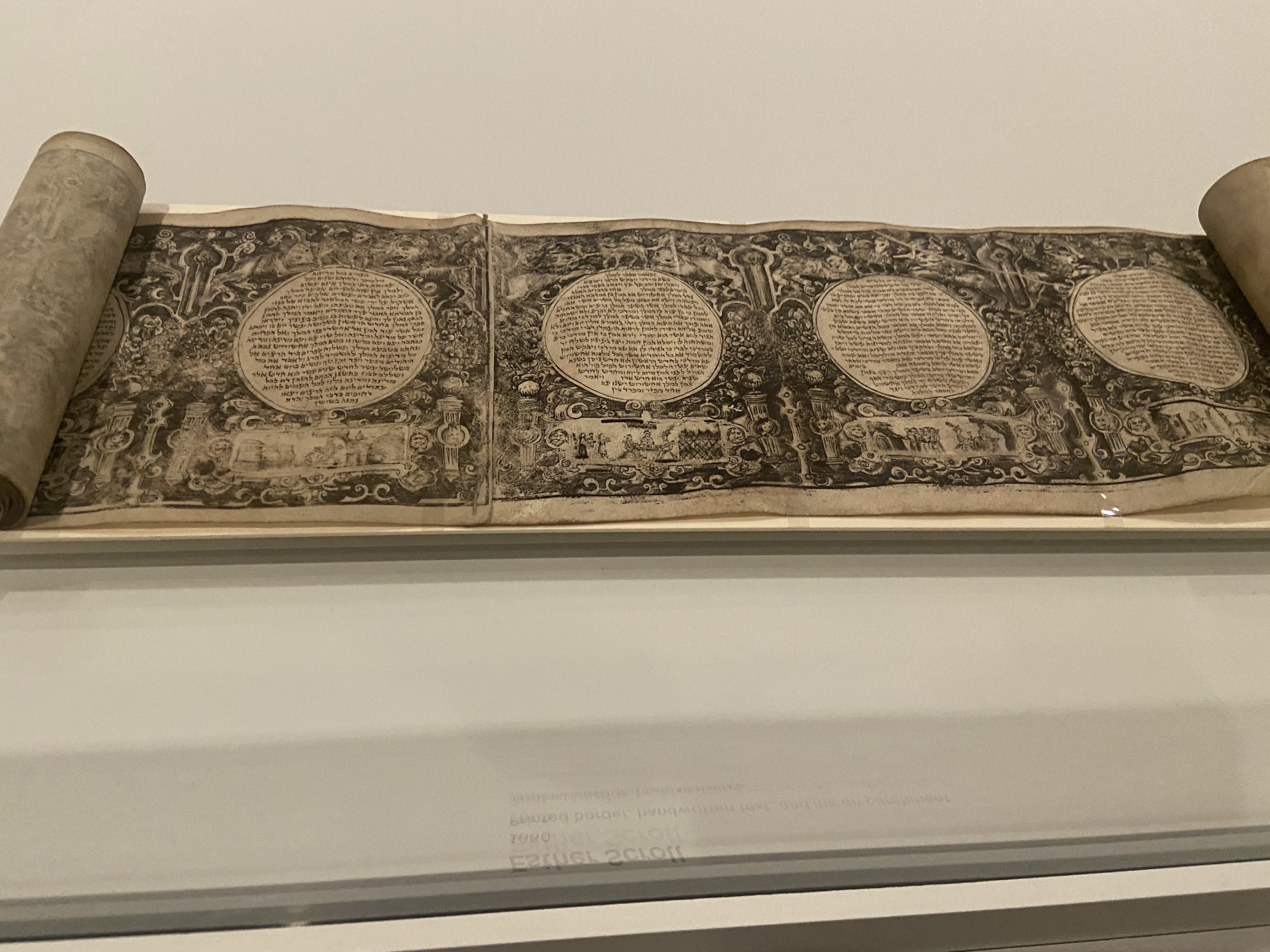
Earlier this month, TYG and I took in an exhibit at the North Carolina Museum of Art on “The Book of Esther in the Age of Rembrandt.” The story of Esther, who saves her people from a Royal pogrom launched by a vindictive official (which is what Judaism celebrates at Purim), was immensely popular in 1600s Netherlands. There were a lot of Jews who’d emigrated there for a relatively high religious tolerance, and many of the Dutch identified with Esther as a symbol for their own fight for freedom from the papacy. It’s typical of the kind of cool niche exhibits we get at local museums.
There were Esther scrolls from Jewish communities —
— a cast list for a stage version of the story —

— and names from a lottery drawing, one of the ways poorer Jewish families raised money for dowries.

And, of course, art. The two paintings directly below are Rembrandts.


And some modern art, such as this painting by Fred Wilson comparing Esther to Harriet Tubman.

We had limited time but we did check out some of the other exhibits including a display of North Carolina photography. The second photo below is of a covered, unused swimming pool.


All rights to images remain with current holders.
Filed under Miscellanea, Personal
I’m not sure where I read that title line recently, but I think it’s spot on. It goes back to the yosta bees who turned hard right after 9/11. Or the anti-anti-racists and anti-anti-feminists — no, they’re not misogynists or racists, they just support the Necrotic Toddler because the push for equality has gone too far (no, it hasn’t. Give us one day without rape or harassment and we’ll talk).
Hollywood producer Brian Grazer, for instance insists he’s a centrist who only voted for the Felon because Biden was obviously losing it. Which given Biden was not on the ballot, is dubious reasoning. Michelle Goldberg notices his new film, After the Hunt, is classic reactionary centrism: “a loathing of wokeness so intense, it led some elite former Democrats to support Donald Trump.” Grazer has specifically said the movie — about the damage spawned by false accusations of rape (or harassment or something bad — it’s unspecified) is to dramatize how MeToo has gone too far.
Suffice to say it hasn’t, but lots of important men — and men not so important — recoil from the thought that they, or someone like them, can be held accountable for the way they treat women. Columnist Ron Hart, who believes putting an innocent man to death is an acceptable price of having the death penalty, has also written that he finds false accusations of rape absolutely unacceptable. So killing a man isn’t as bad as accusing (not imprisoning, nor convicting, nor even charging) him of sexual assault. The Felon bragging about “grab them by the —” for some people, was a sign that voting for him would bring back the good old days.
The media, of course, give excuses too. Biden was too old and losing it. Hilary Clinton didn’t manage her email servers properly. Yet the Felon administration is as bad on both counts and we still get coverage asking is Portland in ruins or not? It’s not. This is not a subjective assessment. The Felon Administration is lying.
Or consider this: “NBC News eliminated its teams dedicated to covering issues affecting Black, Asian American, Latino and LGBTQ+ groups” This seems to be partly a response to Republicans’ ongoing war on POC and LGBTQ but I wonder if it isn’t also that the people at the top of the company are happy not to have to show interest in that stuff any more (much as Ronan Farrow’s bosses at NBC weren’t excited about him exposing Harvey Weinstein). Certainly the media were conscious about diversity when they were sending reporters to single out white Felon voters and ask what they think.
Paul Campos probably has a point about how one of the fuels for Trumpism is how the “practically universal experience of sexual frustration gets ideologized among young men into a kind of pervasive nihilistic rage against the world in general and women in particular.” He lists several other factors driving the shift to the right, as do some of the commenters (“It’s crucially important that this is mostly a movement among culturally Christian white people. No group suffering more has anything like the institutions telling white-wingers how they’re entitled to have all the power and all the goodies.”).
Aaron Huertas defines the problem as reactionary centrism: “Someone who says they’re politically neutral, but who usually punches left while sympathizing with the right.” (which would include anti-anti racism). These are people who for whatever reason claim to believe Both Sides Do It — the left are just as bad about X as the right! And yet when they start throwing punches, as Huertas says, they throw them more at the left. People who think MeToo goes too far never give more than lip service to “sexual harassment is bad too.”

Rather than the centrist standing in the middle between two extremes, they wind up getting hooked by the right, even as they deny it.
So we wind up with the recent reveal that Young Republicans in private texts drop ethnic slurs, joke about loving Hitler and sending people to the gas chambers, crack rape jokes. I doubt we’d find anything as extreme in text messages on the left (I wouldn’t be surprised to find some rape jokes, though) — “Stalin was so cool! Yeah, let’s send everyone in the Republican Party to the gulag!” And JD Vance would not be defending them as kids making edgy jokes (the youngest person in the group chat was in their late 20s). People who want to be edgy, like so many centrists, are far more likely to decide being misogynist and racist is cool rather than mocking rapists and Klansmen.
Filed under Politics, Undead sexist cliches
When I picked up The Case of the Borrowed Brunette from the library recently, I picked up a couple more Erle Stanley Gardner novels, both from the late 1940s.
THE CASE OF THE DUBIOUS BRIDEGROOM starts when Perry Mason catches a gorgeous woman sneaking down the fire escape from the office overhead — and did she have a gun in her hand before dropping it in the alley? An investigation reveals the owner of the company one flight up has his share of problems, including a dubious Mexican divorce (“In the US you’re a bigamist. As long as you and your new wife stay here in Mexico, you’re legally married.”), a vengeful first wife and a scheme by her to take over his business — who could have guessed that she’d turn up with a fatal bullet in her? Fun. The cover takes us back to the days when Sex Sells was the basic rule of paperbacks (as I discussed here). I don’t know the artist.

THE CASE OF THE LONELY HEIRESS kicks off when the owner of a lonely-hearts magazine — the hard-copy version of a dating site — tells Perry he’s uneasy that an allegedly wealthy woman has paid to put an ad in his paper. Why would an heiress need an ad to find a man? Does she have an angle and if so could it get him legal trouble?
It turns out the heiress is the one in trouble: rivals for her inheritance are contesting the will by trying to suborn a witness to the deceased signing it and the ad is part of an overly elaborate scheme to thwart them. That, of course, makes the heiress suspect number one when right after she visits the witness, the woman is found dead with a cracked skull … This has an astonishing number of agendas in play and an improbable romance to wrap up on but it was still fun. It’s also interesting that 1)even back people made the same observations about women having to wade through a lot of crap to find anyone even half-decent; 2)based on discussions I had online, the old slang used herein such as “make a pass” and “chiseler” is now obsolete (I have a sudden urge to write a 1940s story where I can use them).
All rights to image remain with current holder.
Filed under Reading
I can thank my brother for reminding me that DARK SHADOWS included a Jekyll and Hyde plotline though my research reading would have tipped me off to it anyway.
The legendary supernatural soap concerns Barnabas Collins (Jonathan Frid), a vampire from the 1700s released in the present where he winds up protecting his modern-day kin from assorted supernatural threats. Other characters included Quentin Collins (David Selby), immortal werewolf; Willie Loomis (John Karlen), Barnabas’ sniveling, perpetually frustrated Renfield; Elizabeth Stoddard, the family matriarch (Joan Bennett); Julia Hoffman (Grayson Hall), a doctor and haematologist helping Barnabas; Angelique (Lara Parker), Barnabas’ witch wife and tormentor; and Maggie Evans (Kathryn Leigh Scott), the reincarnation of Barnabas’ lost love Josette.

The story takes place in 1970 as one of the plot strands in the “parallel time” era. After Barnabas and his kin defeat the Lovecraftian Leviathans, Barnabas wanders into Collinswood’s east wing and discovers a gateway into another timeline. Watching, he discovers that in that timeline he married Josette, lived a happy mortal life and rose not from his grave. He stumbles across the time boundary only for Willie’s counterpart — author Will Loomis — to trap Barnabas in his coffin and force him to recount the truth about his life, which Loomis will turn into a book. This kept Barnabas offstage while filming House of Dark Shadows, the theatrical spinoff movie (I believe Maggie’s absent from a chunk of this plotline for the same evening).

The Jekyll figure is Cyrus Longworth (Christopher Pennock), BFF to Quentin Collins, here the head of the clan and newly married to Maggie. The opening of the story has Cyrus making the usual research into dividing our good and evil natures. As in the Jack Palance adaptation Curtis produced a couple of years earlier, Cyrus wakes up the morning after testing his drug with no memory of where he’s been; there’s a bottle in his pocket, though, and other evidence he’s been having a very wild night.
Initially Cyrus’ new life as John Yaeger follows the movie’s plot arc but not entirely. For one thing he has a fiancee, Sabrina (Lisa Richards), which Palance’s Jekyll didn’t. For another, Cyrus is caught up in the other plotlines swirling around Quentin — is his late first wife Angelique really dead (yes, but she gets better)? Can Maggie step into Angelique’s shoes (a plotline borrowing heavily from Rebecca)? While Yaeger takes the usual mistress (as Palance’s Hyde did), she doesn’t die, she simply vanishes from the story once Cyrus falls in love with Maggie (maybe she was just a placeholder until Scott got through with the movie?).
Once Cyrus meets Maggie, realizes she’s having trouble with her marriage (Angelique’s ghost is undermining it) and falls for her, things get creepy. Cyrus is too inhibited to make a move (his love for Sabrina doesn’t figure in at all) but if he becomes Yaeger again …and he does, and winds up kidnapping Maggie and eventually murdering Sabrina.
While Cyrus’ addiction to his free, daring life as John Yaeger is normal enough for a Jekyll, he’s carrying a great deal of self-loathing. Yaeger laughs at Sabrina “Don’t you have any idea how much he hated being himself?” I think he’s quite sincere.
Overall it’s an interesting take, well-performed by Pennock.
All rights to images remain with current holders.
Filed under TV
Which is to say this was a week of solid but unspectacular progress. Sufficient but no “I can coast now!” But “sufficient” is good.

It was an oddly disorganized week, though I can’t pin down why. Sunday afternoon it started with a zoom call for the new Ceaseless Way anthology. We’re not making the original deadline for getting all our stories in but we’re only slightly behind, much closer than we managed on the first book. We’re also beginning the critiquing, starting with my friend Ada Milenkovic Brown’s stories (I’ll get to them next week). Then come mine.

I got three Local Reporter stories in, though none of them are on the website yet. I also got back into the swing of Atomic Junk Shop blogging after several weeks away: one on the Sub-Mariner’s 1970 engagement, one on changing creative teams of the same era and one with cool comics images and the stories behind them.

Then there’s Jekyll and Hyde. I got a couple more chapters finished, completed watching Dark Shadows (er, that is, the portion relevant to my book), and watched the two Incredible Hulk TV pilot movies. Next week, more focus on writing, less on TV.
We’ve submitted the Plush One’s appeal for his CCR damage to the insurer but I’m still waiting on my eye doctor to deal with the insurance preapproval or to give me the information to handle it. Their office says it’s a billing-office problem, billing-office says not; given this was the doctor’s recommendation and they’re getting paid for it — it’s not like I’m challenging a bill — I’m baffled why this is such a slog.

Plushie is holding up well — if anything, he’s quite lively as he adjusts to his new situation. Still very needy so I sit with him in the cage a fair amount. As the vet said, he would probably end up okay if we didn’t give him the surgery but we think the outcomes are better this way. It’s next week, followed by a long stretch of recuperation. And then hopefully. as normal as our addled doggie ever gets.
I do feel a little dispirited realizing the year is ending and finishing Jekyll and Hyde will be the only goal I accomplish. I will have it done, and that’s something, but at my age the sense of running out of time constantly gnaws at me. But if I can focus as effectively on my writing next year … we’ll see.
Ceaseless Way cover by GetCovers based on concepts by Arden Brooks. Comics images by Jack Kirby (top) and Sal Buscema. All rights to images remain with current holders.
The past couple of years, deer have moved into our neighborhood. It’s a wooded community with lots of walking trails where we come upon them. Or sometimes in our yards. Or crossing the street. Here’s a small herd I ran into a few months back.


Despite the occasional fruit or tomato removed from TYG’s container garden, they’re still pretty cool.
Filed under Miscellanea, Personal


