
The fifth season of SAPPHIRE AND STEEL tries for a change of pace: the heroic duo show up at a nostalgia dinner party where everyone’s dressed 1930s style, entertainment is an old radio and even the meal is old-fashioned. This, of course, gives the forces of temporal evil a gateway, and before long a fog has isolated the house, the phones are dead and the guests are dropping like flies. Unfortunately this has none of the series’ usual weirdness, and it’s too flat to work as a tribute to Golden Age mysteries; Doctor Who‘s Black Orchid and Unicorn and the Wasp did much better. “They have so many ways of killing each other on this world.”
CHILDREN OF THE STONES is a much stronger series staring Gareth Thomas as Adam, an astrophysicist researching whether the standing stones around the village of Milbury could have been used an ancient observatory. However it becomes obvious that the Milbury residents are unnaturally happy, Adam’s son Matt is getting strange psychic flashes from the stones and other out-of-towners keep undergoing personality changes. This builds well but falls apart at the climax: having been primed for some sort of psychic battle, I was disappointed to have the villain thwarted by a mundane trick. It’s also very confusing in its babble about parallel timelines. “You lead them—but blindfolded, so they can’t see what you’re leading them into!”
Monthly Archives: November 2013
Two British SF shows
Filed under TV
Movies
THE HUNGER GAMES: CATCHING FIRE (2013) does an excellent job adapting Book Two: in the aftermath of Katniss'(Jennifer Lawrence) triumph in the Games and over the Capital’s rules, she’s become a symbol of resistance which makes President Snow (Donald Sutherland) very, very unhappy. So Katniss attempts to step back and become just an ordinary winner, but inevitably Snow and his new gamemaster (Philip Seymour Hoffman) decide the best way to deal with her is a Special All-Star Hunger Game Edition! I’m impressed that even though the book is first-person, the movie works in Snow POV scenes without feeling tacked on; very good. “Fear won’t work as long as they have hope—and Katniss Everdeen gives them hope.”
Deep Throat was, back in my teen years, an (in)famous porn film; INSIDE DEEP THROAT (2005) does a good job looking at how it became the porno that everyone had heard of, which it credits to the concept (Linda Lovelace can only achieve orgasm orally because her clit is in her throat) being so off-the-wall, it made it easy to joke about or discuss (so it made both the Tonight Show monologue and the New York Times). The documentary shows how the original concept for Doctor’s Housecall transformed after director Gerard Damiano saw Lovelace’s oral abilities (“I resisted suggestions to call it The Sword Swallower.”) and the film’s problems with organized crime (which was deeply involved in the porn industry) and government censors (one prosecutor trying to ban it claimed the film would harm women because it implied they could be satisifed with a clitoral orgasm alone). On the downside, it lumps the feminist critiques in with the censors (I’ve heard some good feminist analysis of the film in the past) and the interviewees come across very old fart in grumbling how tacky porn is today. Overall, though, good. “The judge had to have it explained what a clitoris was.”
ALL-STAR SUPERMAN (2011) is the late Dwayne McDuffie’s adaptation of the limited series, chopping out surprisingly little (Superman’s encounter with Bizarro is the biggest loss) in telling how Luthor successfully kills Superman with an overdose of solar energy, leaving Superman rushing to reveal his identity to Lois (“Superman, I will admit you do a great Clark Kent impression.”), thwart the Tyrant Sun, defeat ancient Kryptonian astronauts and try to turn Luthor to the Light Side before the final showdown. With voice actors Ed Asner as Perry, James Denton as Superman, Christina Hendricks as Lois and Anthony LaPaglia as Luthor, a good job, pleasantly and completely unironic about Superman’s heroism. “What is truth? You can’t buy it or hold it in your hand, can you?”
Filed under Movies
It’s at that awkward in-between length (#SFWApro)
But the latest Southern Discomfort draft (the third, I think) is done. As I was pretty sluggish this week, I devoted a couple of hours this morning to wrapping it up.
The length? 45,600 words, so it’s too long for novella, too short for a novel. I know I can expand it a lot in the next go-round, but I’m not sure I can expand it enough. Still, there’s lots I can do without padding it: longer action scenes, maybe more action scenes, character bits, more setting detail, more courtroom drama—so we’ll see.
Overall, the draft looks very good for a third-draft long-form work. It’s reasonably coherent, the characters are largely reasonably fleshed out, the plot holds up. Two things do need work:
•Maria’s arc has a workable ending (it didn’t last draft), but it’s still not strong enough. Her conflict over using violence needs to be consistent and come to a head at the climax. And her way out of the emotional mess she’s in needs more foreshadowing. But those are doable.
•I’m pretty much making up the magic as I go along. I can get away with a lot of that, as Gwalchmai’s supposed to be dabbling in weird and wild magery, but can I get away with it enough? Do I need to set more limits? Or at least make it feel like there’s some underlying logic? And again, once I know how everything works, I have to foreshadow it properly.
I’ll review it probably in January and see what I think then.
Other than that, it was a satisfactory week. I finished that Raleigh Public Record story, sent off a new query, submitted Atlas Shagged to a new market. And had a delicious time at Cafe Parizade yesterday. It’s a local restaurant that does a vegan Thanksgiving dinner, which TYG and I attend along with some friends. Great food, good company and TYG won an orchid and a lunchbox in the raffle.
Anyway, finishing the story was my last bit of actual work this weekend, though I’ll be blogging more off and on.
Filed under Nonfiction, Personal, Southern Discomfort, Writing
Supergirl Interrupted

Al Plastino, the definitive Silver Age Supergirl artist (that close-up from this post is his work—all rights with current holder) passed away this week. So I’m going to indulge my comics love and talk Supergirl.
DC had done a couple of stories with one-shot Supergirls before the definitive version debuted in 1959’s Action 252. Superman arrives at the sight of a spaceship crash and discovers his sunny cousin flying out of the ship. She explains that her home on Krypton, Argo City, was hurled away from Krypton intact, surviving under a protective dome created by Superman’s uncle, Kara’s father, Zor-El. Kara Zor-El grew up to a teen there, but then the ground turned into kryptonite so her father, having observed Superman on Earth through a telescope, built a rocket to send her to safety before the kryptonite poisoning became lethal.
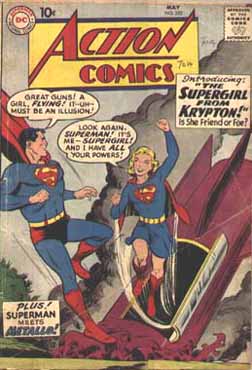
(Cover art by Curt Swan, rights with current holder)
Superman sets her up in an orphanage while training her to use her powers as his “secret weapon.” Over the next few years in her series (a backup to Superman in Action) she eventually got adopted (becoming “Linda Danvers’), went public as a super-heroine, went to college and around the end of the 1960s, acquired an arch-enemy (Luthor’s niece Nasthalthia) and went to work as a TV camerawoman. She also jumped from Action to the star of Adventure Comics.
As I’ve mentioned before, DC has a tendency to reinvent super-heroines over and over in a way it doesn’t do as often with male heroes. Leaping from Adventure to Supergirl to Superman Family (sharing the spotlight with Lois Lane and Jimmy Olsen), Linda Danvers was at various points an acting student, then a guidance counselor at a school for the gifted, then a soap opera actress, with a complete change in supporting cast every time.
Then in the Crisis on Infinite Earths, she died. For real. For good, or so it seemed. DC wanted Superman to be unique, no other Kryptonian survivors, and in the post-Crisis reboot she never existed, but Crisis let her go out in one blaze of glory.
Post-Crisis a new Supergirl did emerge, a lab-created shapeshifter whose physical powers, IIRC, were telekinetic rather than strength. She was a fun character for a while. Then Peter David—an admitted huge fan of the pre-Crisis Supergirl—had her merge with a suicidal woman named Linda Danvers. This kicked off a Supergirl book that didn’t really resurrect the pre-Crisis version but used a lot of its characters and concepts in new ways.
By the time the David book folded (he strongly implied the protagonist of a later series, Fallen Angel, was Supergirl, though), it was almost 20 years since Crisis and the commitment that all the changes were permanent had unsurprisingly worn off. So a couple of years later, a version of the original Supergirl, a fellow Kryptonian, made her appearance.
And she’s been an ungodly mess. We’ve had multiple different origins, constant shifting as to what she’s doing or who she works with and the few times that I’ve read an issue she comes off well, unpleasant. In Supergirl: Candor, she comes off as somewhere between Bad Girl and Self-Destructive Girl. In the reboot DC Universe, DC’s announced she’s going to become a Red Lantern, destructive counterparts of Green Lanterns, fueled by rage. She seems to have nothing in common with Superman’s heroic cousin from the pre-Crisis universe. Which wouldn’t be so bad, if she was, well, interesting, but it feels more like a dead end: they’re determined to use her (current Editor in Chief Dan Didio is obsessive about regressing as much of DC to the Silver Age as possible) but they really can’t think how. So they just fling stuff at the wall and hope it sticks (much like Hawk and Dove)
Sigh. Kara Zor-El deserves better.
On the edge of glory, but not quite (#SFWApro)
Despite my optimistic talk last week of improving my efficiency, I haven’t seen much sign of it this week. Primarily getting the Raleigh Public Record story finished took more time and more work than I thought; it’s a lot of disparate information and interviews so knitting them all into one story wasn’t easy. Plus a couple of Demand Media rewrite jobs proved unexpectedly tricky. Sometimes I get a story and I just cannot find a reliable source that provides me with the information I need, so I search, and search and search until I do.
And I had a couple of bad night’s sleep. Tonight, for instance, a sore muscle kept me tossing and turning, which woke up TYG, whose movement then woke me up … So I wasn’t as efficient working on the story as I should have been.
But barring rewrites on that story or my other Demand Media stuff still under review, I have tomorrow to devote to fiction and some marketing, which will be very nice. And then a four-day weekend (I may write more on Southern Discomfort Friday. I’ll see). And then I start December without this story to grapple with. A week of just my regular, dull, organized schedule will do me a world of good.
And on the plus side, I did get the story done, and it’s much better than it looked last week, when I didn’t have the last couple of interviews. And tomorrow, fun writing!
Filed under Nonfiction, Southern Discomfort, Time management and goals, Writing
Wide Awake in Dreamland
So I’ll fill the time with some links.
•”By getting married the woman consented to sex” so marital rape is impossible, according to Phyliss Schaffly.
•Tipping is part of what you pay for service. You shouldn’t refuse because your waitperson is gay. Nor is leaving religious advice a good substitute. Though it’s not unknown: I’ve heard stories about diners who leave a tip in the form of a Christian pamphlet that looks on one side like a $20 bill.
•A blog post from 2005 seems still timely almost a decade later, as the author speculates about how much the media keep from us.
•Slacktivist concludes that when you’re telling the people you’re keeping down to be meek and Christlike and submissive (not that Jesus was that, actually) You’re Doing It Wrong. And both Slacktivist and Rachel Held Evans discuss how accusations of being “divisive” are used to silence people who question the status quo.
That really struck home because I’ve seen the same thing so much on racial issues. Abolition was bad because abolitionists were pushing Southerners to destroy the Union. The civil-rights movement was bad because it set Americans against each other—couldn’t they move more quietly? Less stridently? It was weakening our country in the face of our enemies (a common theme in 1950s films). Obama’s preacher, Jeremiah Wright? Dangerously divisive and anti-American for his racial views. And recently a friend of mine proclaimed that Al Sharpton and other black activists are divisive because they’re attacking whites.
Notably the oppressor is never the issue. The white segregationists aren’t being divisive. People like Orson Scott Card who write about how Obama will lead black armies against white people aren’t divisive.
It’s another variation of the getting out of Egypt problem: if the Israelites would just stay quiet and make the bricks, we wouldn’t have all these problems.
And here’s a variation of the same: if the victims would just stay strong and proud, the oppressor couldn’t touch them.
•LGM argues that if we don’t act to prevent it, global warming will perpetuate injustice: the rich will find ways to stay rich and comfortable, the poor will suffer.
•Former Treasury Secretary Tim Geithner said in 2012 that he didn’t expect to take a new job in the financial industry. Wow, he changed his mind. Who’d have seen that coming?
•The idea that stillborn babies and aborted fetuses go into heaven is not unknown. But it has some disturbing implications …
•A reminder that old technology has a longer after-life than we credit.
•A fairly prescient look at 21st century video revolution, as seen from 1986.
•As my recent reading has reminded me, modern non-representational art used to be incredibly controversial. For some right-wingers, it still is.
Filed under Politics
About this Munich thing …
So as you’ve probably heard, the Obama administration has negotiated a six-month nuclear deal with Iran. Not really an end to hostilities, but certainly a step away from them. And unsurprisingly, right-bloggers are horrified. As Roy Edroso notes at the link, Obama is simultaneously fascist—Dems killing the filibuster in the Senate is exactly like the Third Reich—and a wimpy Neville Chamberlain appeaser. It’s Munich all over again!
Okay, I admit Chamberlain made a bad call, though as plenty of people have pointed out, there were no good calls. Nobody knew how bad Hitler would be; there was no support for going to war against him if it could be avoided. But my point is not to defend Chamberlain but to wonder if right-wingers (and pretty much everyone else who invokes Munich) isn’t blithely ignoring America’s conduct back in the day. Because it’s not as if the United States was champing at the bit to tackle Hitler. Lots of Americans saw getting involved in Europe again as a bad idea, period. And some saw it as a bad idea specifically because it would be a “Jewish war” for the benefit of European Jews, and of no interest to America. Irish Americans saw Hitler blasting England to bits as a wonderful thing (according to David Brinkley in Washington Goes to War).
Heck, even after World War II began, America continued trading with the Axis. It was only after Japan attacked Pearl Harbor and Germany declared war on the US that America got involved (and as the excellent book Trading With the Enemy points out, some companies kept right on doing business with the Nazis). So remove the beam from your own eye, why don’t you?
That aside, I think this blog post sums up the hysterical reaction: It’s not enough for them to oppose a policy — they have to persuade themselves that they’re the only ones preventing the destruction of civilization as we know it. So every foreign foe is Hitler, every deviation from laissez-faire is the brutal crushing of economic freedom, every immigration proposal is the takeover of America by vicious globalists. Red Dawn isn’t a movie — it’s what happens every time any non-conservative obtains any power whatsoever and dares to use it.”
•What fuels white rage? This Salon article argues that it works partly by using race as a substitute for class: It’s not that the poor and middle-class are getting squeezed by the rich, it’s the white people getting oppressed! This makes it easier to support capitalism no matter how it hurts, while blaming everything on blacks, Hispanics or Jews.
•A really good post from Film Critic Hulk on rape and rape culture.
He includes a link to yet another guy on another news show discussing how a 14-year-old girl who goes out drinking pretty much has it coming: What did she expect to happen when she got to drinking?
To paraphrase Critic Hulk, suppose that a gang of thieves were ripping off homes at night, when the owners were out. Joseph DiBenedetto (the rape apologist in question) is out for dinner, comes home, finds himself ripped off. Anyone would think he’d nod sagely and agree if people said “Well, what did you think would happen? You knew there was a risk.” Or if the cops announced that people in DiBenedetto’s neighborhood should not leave their homes at night, and implied anyone who did was at fault for the robbery. Somehow I doubt he’d see it the same way (unfortunately I don’t know he’d make the connection to the crap he spews, either).
And as I’ve pointed out before, a healthy society is one that protects 14-year-olds from the results of their youth and inexperience.
Filed under Politics, Undead sexist cliches
Writing as a Hobby (#SFWApro)
The standard advice is that even if you’re not published yet, you should approach writing fiction as a business. Set regular hours. Set productivity goals. Keep your nose to the grindstone.
Sometimes I think (and by sometimes I mean lately) it makes more sense to think of it as a hobby.
After all, if I thought of fiction a business … I’d stop. Even though I sell stories, my bottom line as a freelancer doesn’t depend on fiction. In the three years I’ve been full-time freelancing, fiction has never made up even five percent of my income. From a bottom-line perspective, I’d better off working on more Demand Media or other articles.
There’s always the possibility something I write will pay off big, or at least big enough I can afford to do more fiction. But again, that’s enough of a long-shot I’d be crazy to build a business plan around it. As I’ve written, I’ve not been able to replicate the level of success I had in 2007, and even then it didn’t add up to much cash.
But if I think of fiction as a hobby I’m really, really passionate about, it makes much more sense.
Keep in mind, a hobbyist doesn’t have to be a dilettante or talentless. Take community theater, which is the hobby I know most about. It has deadlines you have to meet, hours of work you have to commit to a director who will dress you down if you’re not doing well enough (not all directors are good enough to see you’re not up to snuff, admittedly) and an audience full of people who will see if you fail. When I did it (and hopefully next year I’ll do it again in some capacity), I worked hard to make sure I could deliver a good performance, and I got better as I learned and improved.
Or take golf. There’s a hobby where I know people can be extremely obsessive about improving their game. Or poker, music, art, gaming. Not that everyone commits themselves to get better and improve their skills, but a lot of people do.
And there’s no pressure other than your own. You don’t worry about the fact you’re not getting paid, or whether you’ll ever get paid. Which also makes me much more comfortable submitting to small markets that don’t pay much. If it’s getting published, good enough. Of course, I still shoot for the best markets if I can find some that a story is right for, but if they don’t bite, I don’t feel too bad (and don’t worry about whether I’m taking steps towards eventually cracking bigger markets).
I know of writers who have approached their fiction with a dogged determination to make it as a novelist (or screenwriter or what have you) or die trying. I’d sooner live. And frankly, I don’t believe that if I had yielded up every fiber of my being to writing and honing my craft, I’d have done any better. Whatever keeps me from selling more, it’s not lack of dedication or training.
Of course, even not expecting real money, it still stings when I get rejected. Not getting cast in shows hurts too. But if I remind myself I’m in it for the fun and not the loot, perhaps that will help.
Movies
DR. PHIBES RISES AGAIN (1972) has Vincent Price rise from his supposed death at the end of The Abominable Dr. Phibes and set out for an Egyptian immortality elixir that can resurrect his beloved wife—a drug also sought by Robert Quarry, an immortalist rapidly running out of his own drugs. This is not the sequel Phibes or we deserve, partly because Quarry’s role is so much weaker. (t was okay when the cops kept failing to stop Phibes in the first film, but here he badly needs an adversary (and murdering Quarry’s assistants feels much more ruthless than when Phibes was just avenging himself on those who’d supposedly wronged him. The deaths are much less imaginative too. Peter Cushing and John Thaw have bit parts. “You cannot threaten the dead with death, my friend.”
THOR: The Dark World (2013) has Thor return to Earth over Odin’s protests only to discover Jane has become the host for a Cosmic McGuffin that the dark elf Malekith (Christopher Eccleston) needs to restore the universe to primal darkness (I’m surprised they went with “Aethyr” rather than the countless McGuffins from the comics—though the ending credits clip implies it’s one of the Infinity Gems), forcing Thor and Loki to team up to save the universe. Well done, obviously owing as much to Walt Simonson’s run on the book as the Lee/Kirby era, though some viewers have valid complaints about the lack of a bigger role for Sif and the fact Jane becomes virtually a McGuffin herself. “Take this train, three stops.”
Filed under Movies
Books
NIGHTWING: Night of the Owls by Kyle Higgins and Eddy Barrows has Nightwing in action against the Talons, the enforcers for the Court of Owls that rules Gotham City covertly. After defeating the original Talon (his own grandfather) Nightwing then has to cope with a suspicious cop and a super-powered anti-hero vigilante. Unremarkable, and I dislike intensely Nightwing operating out of Gotham rather than independently as he was pre-Crisis. I’m also not thrilled the more Marvel tone of the current DC Universe (super-heroes are apparently suspicious rather than respected).
HELLBOY: The Midnight Circus by Mike Mignola and Duncan Fegredo is the tale of a very young Hellboy in 1948 who runs away to see the circus. But it turns out this circus is very, very evil … Good, though I’m not sure if the ringmaster is meant to be Rasputin or some other player. I’ve added this to the Hellboy Chronology of course.
BLACKING UP: The Minstrel Show in Nineteenth-Century America by Robert C. Toll chronicles how the blackface “Ethiopian delineators” of the early 1800s evolved into the full-blown minstrel show which Toll argues appealed to Northerners by offering a supposed look at Life on the Plantation Based on Real Negro Stories and Tradition. Toll shows the shows’ initially conflicted approach to slavery (It’s Cruel But the Darkies Are Happy) faded in favor of a uniformly sanitized portrayal as the Union itself began to crack. POst-war the minstrel shows became a much more generic entertainment (only the blackface distinguished them from any other extravaganza) but America did see the rise of genuine black Minstrels who worked their own spin on the genre (“They looked nostalgically back at the plantation days too, but it was a longing for friends and family—never for their masters.”). Good.
ZOTHIQUE is another from the Ballantine Adult Fantasy line, collecting Clark Ashton Smith’s stories of a distant, decadent future continent where necromancy, decadence and tyranny are rife. Carter ranks Smith along with Robert Howard and HP Lovecraft as the biggest names to come out of Weird Tales and it’s easy to see why: Smith’s style is elegant and poetic (“Mountains as sere as unceremented mummies” was one striking simile) and he wrote dark fantasy before the term was coined. Basically it’s a happy ending if the bad guys die too. Well worth reading.
For really dark material we have John Mantooth’s SHOEBOX TRAINWRECK a mix of crime and supernatural stories that focus on casual violence, petty criminality and child abuse among working-class rural folk. Well written and powerful in some of the violent scenes but the supernatural elements are quite humdrum and more importantly, this just isn’t my cup of tea (if I want to be reminded life is nasty, brutish and short, I read nonfiction or news).
BOOK OF IRON is a science fantasy (I’m not sure if the mix of 1920s tech and magic is meant to be steampunk or some kind of interplanetary setting ) novella by Elizabeth Bear where a team of adventurers (somewhat self-conscious about being classed as such) sets off to stop a sorcerer from murdering an immortal in order to free the eponymous occult McGuffin she carries inside her. Not as good as Bear’s Range of Ghosts but entertaining.


