Category Archives: Reading

Undead specfic cliche: magic has no rules

Some years back, the Mighty God King blog made a series of blog posts on his ideas for writing Dr. Strange. They’re excellent and I wish he’d taken them and turned them into something of his own (only a few of them are Marvel Universe-dependent).

One of his early posts argued that a Dr. Strange series could be “House with wizards” in the sense of it being about Strange and his apprentices. I can’t say that one grabs me but that’s not the point of my post. In the comments one of (I gather) the regular commenters sounded off that he wasn’t interested in Dr. Strange because “there really is no way to define what magic’s physical limitations are and as such, its difficult to say what is and what isn’t believable for the character and any conflict he’s placed in … a character who simply ‘wields magic’ by itself, like Doctor Strange, is doomed to inevitable cases of Deus Ex Machina.”

This is nonsense but it’s an enduring nonsense among people who don’t like fantasy. Isaac Asimov asserted once that by definition, magic has no limits — it it does, then it’s just an alternate form of science. Closely affiliated is the view that this makes fantasy inferior to science-fiction — SF is bound by the rules of science, fantasy writer have no rules. It’s sloppy, easy, unlike the thoughtful rigor of science fiction (or in the case of that commenter, science-based superheroes).

First off, while it’s possible to write magic as some sort of super-science “magic with rules” isn’t the alternative. The difference between magic and science is that science works independently of who uses it; magic is selective. As Dr. Strange once put it fighting a villain who’d stolen his amulet, the Eye of Agamotto, the Eye isn’t a gun; you don’t control it simply because you’re holding it. Controlling it requires understanding the magic — and Stephen Strange understands much more than his foe. Likewise Lisa Goldstein pointed out that summoning light with magic requires understanding and wisdom; any idiot can flip a light switch.

So the commenter’s argument that magic can’t be defined or limited is bullshit. In the particular case of Dr. Strange it’s even more bullshit: Dr. Strange in the original Lee/Ditko run never wins by deus ex machina, he wins by sheer determination or by bluffing or outwitting his foe. There’s no clear statement as to his specific powers but it never feels like Ditko (who’s supposed to have been the lead creator of the two) is making it up as he goes along.

It’s true magic can be used as a get-together but so can science. In Spidey’s first battle with the Vulture, Peter Parker simply deduces the Vulture’s flight technology and then builds a gadget that nullifies it. Now it’s true Peter uses his scientific genius but pulling out a power-stealing gadget is just as much a fudge as pulling out some heretofore unknown piece of magic would be.

Magic can be badly used. Stephen Gerber in his Defenders run had some powerful mystical moments but he could also be hand-wavey in terms of Doc’s actual power levels. But it isn’t inherent in writing magic. Some mages have specific rules, some are implied; what matters, as Brandon Sanderson said, is that the writer not pull a deus ex machina. “An author’s ability to solve conflict with magic is DIRECTLY PROPORTIONAL to how well the reader understands said magic.” If you establish that Dr. Strange or Dr. Fate or Harry Potter can shrink in size, it’s cool to use that at the climax. If you pull it out of your butt without any set up, that’s bad writing.

I doubt anything I’ve said would convince the commenter. But then, I think they’re completely wrong, whether I convince them or not.

Art by Frank Brunner (top), then Ditko. All rights to images remain with current holders.
Leave a comment

Filed under Miscellanea, Reading, Writing

Graphic novels and a graphic artist: books read

You may remember when I looked back at 2025, I was displeased by how fewer comic books than usual I’d read. As you can see, I’m workign to up my game for 2026.

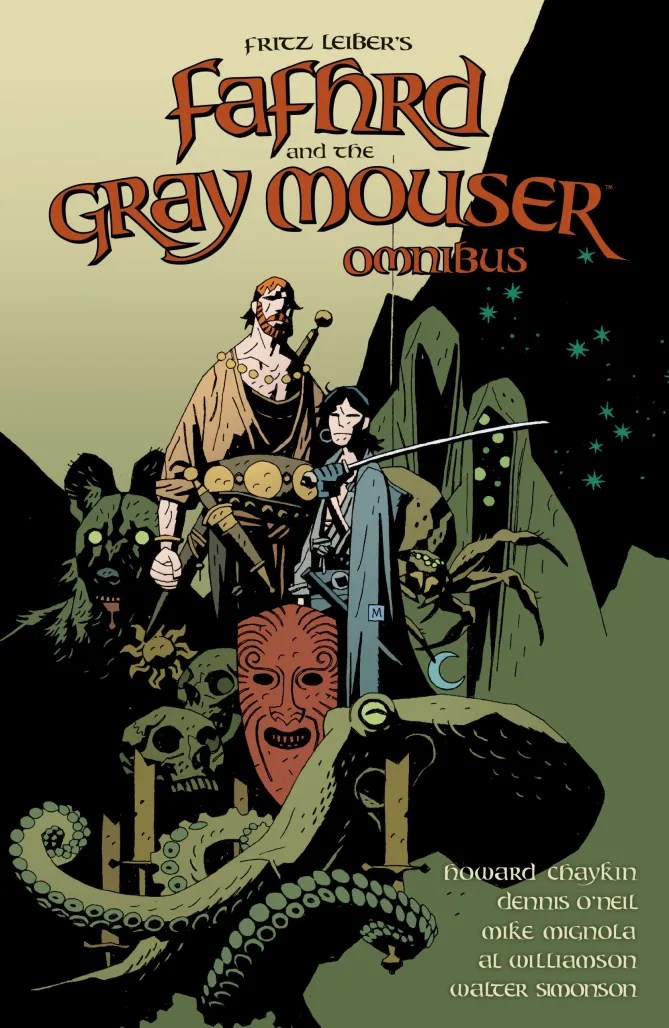
THE FAFHRD AND THE GRAY MOUSER OMNIBUS reprints the Bronze Age DC series Sword of Sorcery by Denny O’Neil and Mike Mignola and Marvel’s series from two decades later with Chaykin writing and Mike Mignola’s art. In the introduction, Chaykin tells how he worked on the DC series with no idea of what he was doing and little familiarity with Fritz Leiber’s characters, whom he later came to love (he describes them as fantasy hardboiled-crime stories and I think there’s some truth to that). For that reason he jumped at the chance to get a second shot.

I remember passing this up at the time, possibly because money was tight, possibly because I didn’t trust Chaykin to do it better. It’s excellent, with a much better sense of character and of the world, and Mignola’s art is perfect in its grotesque style. The only story that doesn’t quite work is “Lean Times in Lankhmar,” an amusing one in which the lack of any adventures or treasure to steal forces the two swashbucklers to get day jobs. It’s one where Leiber’s narration is really needed to carry off the humor.

As the Chaykin/Mignola stories include “The Price of Pain-Ease” a sequel to the heroes first encounter (in “Ill Met in Lankhmar”), I reread the first Sword of Sorcery story, which tackles the same material. In the context of the original series, this is a downbeat one that has the guys dealing with, and overcoming, their grief for their murdered first love. That carries over in the Marvel story but O’Neil’s script for some reason makes it a straight swashbuckler with no emotional heft. And he way overwrites the dialog — Fafhrd and the Gray Mouser can’t seem to do anything without quipping about how amazing what they’re doing is. Still, most of the book is made up of the early series and that’s very good indeed.

MURDERBURG by Carol Lay is a comedy set in Muderburg, a Maine coastal town whose mayor, Leo Scazzi, is a professional hit man and most of the town seems to be underworld adjacent (providing fake IDs, disposing corpses). Over the course of several stories, Leo and his beloved wife Antonia deal with unwanted visitors, rivalries with the neighboring town, people trying to bump one of the Scazzis off and similar trouble. This was a lot of fun; if Lay wasn’t influenced by The Addams Family I’ll be surprised (the lead couple have very much a Gomez/Morticia vibe).

Al Ewing and Steve Lieber do an absolutely amazing job with the six-issue METAMORPHO, THE ELEMENT MAN — not simply reviving the Bob Haney/Ramona Fradon creation from the Silver Age but recreating the madcap style of the original, with some updated details (AI, Sapphire as a social media pop star) and cameos from multiple later iterations such as Element Dog and the New 52’s Element Woman. It’s incredible fun, though as I discuss over at Atomic Junk Shop it’s the fourth version of Metamorpho in the past decade and it bugs me there’s no continuity between them.

ALPHONSE MUCHA: The Artist and His Masterpieces by Terasa Barnard is a coffee table book devoted to the Czech art deco painter/sculptor/glass-worker, lavishly illustrated as such books are and covering his life as well. Mucha was a passionate supporter of the Slavic revival of his day (a movement I’m not familiar with) which explains things like him designing currency for the new nation of Czechoslovakia. As a fan of Mucha’s work I enjoyed this, though some of the Slavic figures and stories he’s working with are unknown to me.

Rights to all images belong to current holders.

Leave a comment

Filed under Comics, Reading

Covers for the last week of January

First, by the great Richard Powers

Ralph Brillhart’s cover here reminds me a little of Powers with that weird figure, though everything’s much more concrete on this cover.

And last, but not least, Margaret Brundage. I’ve read Seabury Quinn often included nudity in his stories because he knew that increased the odds of landing a cover slot.

All rights to images remain with current holders.

Leave a comment

Filed under cover art, Reading

Dress codes and modern fairy tales: books read

DRESS CODES: How the Laws of Fashion Made History by Richard Thompson Ford argues that fashion began when tailoring and sewing made it possible to wear clothes far more elaborate than togas or robes. As soon as that happened, fashion became an issue: what should society do with people who dressed above their station? Dressed to flaunt their sexuality? Dressed as the wrong gender? Dress codes such as sumptuary laws (limiting how fancy your clothes could be, depending on your status) were the response.

Ford follows the law (and the implicit rules on how to dress) down to our own time, looking at recurring themes: the desire to flaunt wealth by wearing clothes; the Puritanical impulse to dress simply; fears that looking good was a cheat code giving people and edge over more qualified rivals. And, of course, the constant efforts of people to defy or overturn the rules, which frequently turned into new and equally exclusionary anti-rules. There are added challenges for women who can’t be taken seriously if they’re too sexy or not sexy enough, and for African Americans dealing with workplace rules that limit their styles (dreadlocks and Afros aren’t something they can put on or off like a blazer so the codes control how they look outside the workplace too). Good job.

ONCE UPON NOW is a collection of short stories published on the Wattpad app built around the perennial trope of modern-day fairytale retellings. In various stories a habitual liar gets himself turned into a wooden puppet (probably the best), what starts out as The Twelve Dancing Princesses turns into a horror story about murderous sirens, college student Rob Hood robs from freshman for their own good (I’m puzzled that the female lead isn’t named something like Marion Mayde) and a friend-zoned girl finally makes it to prom (my least favorite). A mixed bag, like many anthologies.

Leave a comment

Filed under Reading

Women superheroes of WW II, psychic teens of 1970: books

LIBERTY GIRL by Barry Reese was a fun novella based on the same-name indy comic book about the eponymous Wonder Woman-like superhero vanishing in WW II and returning in the present a la Captain America (but with more thought to the gulf between Then and Now). Fun, though hardly groundbreaking; what made it work for me is that the golden-eyed, bronze-skinned protagonist is Doc Savage’s daughter (though as with my own The Savage Year they can’t spell it out). I might take a look at the comic some time, though it appears it’s only available in single issues rather than a trade paperback.

The sixth volume of BOMBSHELLS, War Stories (cover by Ant Lucia) has Amanda Waller’s new Sucide Squad stop Nazi ally Edward Nigma from unleashing the worst of the Tenebrae while large numbers of supernaturals and superhumans gather at the Siege of Leningrad where Kryptonian Faora Hu-Ul reveals her master plan for Earth. As usual this was fun, though it also feels a little too sprawling, with characters we’ve never met (like Faora) showing up at the end and other plotlines apparently vanishing (this is the final volume but perhaps there’s some resolution in the spinoff Bombshells: United).

NINETEEN SEVENTY: The Seven Book One by Sarah M. Cradit is the first in a prequel series to a mythos (the House of Crimson and Clover) that I’ve never read. Here we see the future heads of the witch clan (though like many fictional witches they seem more psionic) as teens in 1970 variously coping with first love, periods of hedonism, Duty Vs. Love, Finishing School vs. Saving the World etc. This was better than most Buy This Book In The Series Cheap offers on Kindle, enough I might pick up more in the series later. However it’s both a prequel and an installment (there are several more 1970s set books) which is a little frustrating, and suffers from repeated anachronisms such as “trophy wife” and “chill pill” as phrases. I still enjoyed it.

All rights to image remain with current holder.

Leave a comment

Filed under Comics, Doc Savage, Reading

Pulp covers for a Tuesday

Earle Bergey. The woman for once is not the center of the image (for comparison, click here).

Frank R. Paul is up next. I must say, that’s an eyecatching one.

Edmond Zwiatek shows us someone sciencing. I suspect it will not work out as planned.

And last, this one by Howard Brown.

All rights to images remain with current holders.

Leave a comment

Filed under cover art, Reading

Kelpies, witches, Frankenstein’s castle and Atlantis: books read

Last month’s Genre Book Club topic was juvenile fiction which prompted me to reread Scots author Mollie Hunter’s THE KELPIE’S PEARLS. The story has an old highlands woman, living quietly in her cottage in modern Scotland (for the time it came out, which is the early 1960s), help out a kelpie. The Kelpie gives her a strand of pearls for a reward (not that she asked for one) and the two of them find common ground in that they’re both old and can both remember the highlands before cars and buses were everywhere.

Unfortunately things go wrong. A local trapper sees the pearls and becomes obsessed with robbing the kelpie (stealing from the fae is, of course, a very bad idea even in kids’ stories), the old woman draws so much attention when she visits Loch Ness (the kelpie arranged for her to see the monster) that she’s swarmed by papparazzi and her life is suddenly turned upside down. Can the kelpie see a way out?

This is a sweet, very low-key story, but it’s gently charming. I intend to (re)read more Hunter eventually.

WITCHCRAFT: A History in Thirteen Trials by Marion Gibson didn’t work for me at all, despite my interest in the topic. Perhaps that’s because where most books portray the trials as driven by personal animosities at the local level, Gibson sees it more a top-down process backed by a consistent theology of demonology, and I’m not sure I buy her take (please note that she’s a historian and I’m a lay reader so my opinion should be taken with a grain of salt). Also her final chapter on witchcraft today and popular perceptions is kind of a mess, dealing with Stormy Daniels (apparently she’s wiccan) and the Felon of the United States whining about how every criticism is a witch-hunt — it really felt like a bad fit for the book.

FRANKENSTEIN SLEPT HERE by Tim Kelly is a Monster Mash stage show in which Baroness Frankenstein has turned her home into a Hotel Transylvania-style refuge for monsters including schizoid Jacqueline Hyde. Uh-oh, though — a wealthy American socialite just bought the castle and is about to evict them! Can the monsters convince her they’re really just the domestic staff? Silly fluff that knows it (“You’re sitting on the Invisible Man!”); I think this would have been fun on stage. “In this place they should mark the towels his, her and its!”

ELAK OF ATLANTIS collects Henry Kuttner’s four sword and sorcery stories of the Atlantean princeling turned sell-sword after slaying his cruel father in self-defense and leaving the kingdom to his brother. Now he and his sidekicks — drunken swordsman Lycon and the druid Dalan — battle various Lovecraftian horrors (I was amused that the Norse gods here are presented as such) and would be conquerors. This isn’t up to Kuttner’s wife CL Moore’s Jirel of Joiry fantasies but they’re certainly entertaining; surprisingly the fourth story brings the series to a reasonable close rather than leaving it open-ended.

All rights to cover images remains with current holders.

Leave a comment

Filed under Reading

It seemed I underperformed at reading as well as writing

I’m on Goodreads and I’m always interested to see the site review my Year in Books at the end of December. I knew I hadn’t been reading a lot this year and I was right: 131 books.

(All images are randomly selected from this year’s reading).

Wait, I said, was that really unusual? I took a look at my bookmarked reports on past years:

2018: 243

2021: 205

2022: 259

2024: 159

So a marked drop off from peak years. But not a continuous drop-off, as last year was the highest. So it’s not just a steady wearying down or a steady increase in distractions from social media. So then what?

Part of it is the increasing demands of dog care. And that a year ago we brought Snowdrop into the house. Two cats demanding food or water in the morning adds up to more distraction than one.

A bigger part, I think, is that our schedules have been a lot more unstable this past year (I’m not quite surewhy). There are small but not insignificant chunks of time where I wind up either with not enough time to sit down and focus, or I’m not sure how much time I have, so I wind up scrolling social media or something equally pointless (I like social media but if I don’t really want to look at it, it’s pointless).

Another factor is the sheer number of little things that keep nagging and distracting me. Friday evening I wanted to concentrate on reading but I kept thinking of all the things I should be dealing with — a bill or two to pay, paperwork to fill out for dog appointments, contractors to contact. I do my best to stay on top of it (it’s part of my contribution to our household operations) but every so often it gets backed up and I feel I have to handle every single aspect of it NOW.

A minor part is that as my novel and nonfiction reading slows down, my comic book reading slows down, and that used to add a lot of books to my list.

I’m not sure what the fix is, but I intend to find one. For starters, not wasting those little chunks of time. We’ll see if that helps (I suspect I waste more than I realize that way).

Back to normal reviews next week. All rights to images remain with current holders.

Leave a comment

Filed under Reading

Three covers for Sunday

Book reviews back next week, once Jekyll and Hyde is done. For now we have Ed Emswhiller —

Earle Bergey —

And last, Roy Krenkl.

All rights to images remain with current holders.

Leave a comment

Filed under cover art, Reading

In lieu of book reviews, how about some Virgil Finlay art?

As finishing Jekyll and Hyde keeps sucking up brainpower, I’m not quite up to writing any reviews. But I’d sooner look at Virgil Finlay’s classic art anyway.

All rights to images remain with current holder.

Leave a comment

Filed under cover art, Reading