Category Archives: TV

“Filled with evil but truly alive. It’s the feeling of being — Edward Hyde.”

My brother Craig, like me, is a fan of Hammer Horror so while he was here I put on DR. JEKYLL AND SISTER HYDE (1971). Despite director Roy Ward Baker coming up with the title as a joke—he was quite surprised Hammer then jumped on it—it’s a good film. I could not, however, kick back and enjoy it without my analytical, writing-a-book-on-this hat coming on.

In contrast to Stevenson and most of the adaptations I’ve seen (e.g., the Barrymore, Fredric March and Spencer Tracy versions) Ralph Bates’ Dr. Jekyll has no interest in splitting good from evil — he starts out wanting to cure all diseases. When a fellow doctor (Gerald Sims) points out it would take several years just to cure cholera and diphtheria, Bates decides to work on eternal life first, because that will be so much easier, right? And then he’ll have time to cure all diseases. It doesn’t occur to either doctor that curing diphtheria and cholera would save thousands of lives by themselves, get his name in the history books and inspire other researchers to follow in his wake.

He’s also unusually low-rent: where March’s Dr. Jekyll is filthy rich and most film Jekylls have servants, Jekyll here lives by himself in rented rooms. By Victorian standards, the lack of a household staff or at least a gentleman’s gentleman makes him slightly disreputable.

Another thing that occurred to me is how much Jekyll and Hyde films use hands. The Stevenson novel makes good use of them as shorthand — when Jekyll starts to lose control of the transformation, one of the first signs is waking up and seeing Hyde’s hands instead of his own. The Johny Barrymore film shows Hyde’s spidery hands—

— and the March film opens with Jekyll’s elegant hands playing piano. Sister Hyde frequently uses close-ups of Bates’ hands changing to Martine Beswick’s as signs of the transformation. A much easier one, I’m sure, than focusing on the face every time.

I’ll have more to say when I watch it purely for the book. “It is I who exist, Dr. Jekyll — not you!”

Earlier this year my brother performed in JEKYLL AND HYDE: The Musical (1997) and as it’s streaming online, I took a look (it’s the source of the title quote on this post). This was much more polished than the version I saw some years back, and (as I now realize) clearly based on the March/Tracy story: a romantic quadrangle with a Madonna (Jekyll’s fiancee) and a Whore (Hyde’s lover/victim), Sir Danvers Carew as Jekyll’s father-in-law (surprisingly he makes it to the end of the show unscathed — Carew isn’t that lucky in most adaptations I’ve seen).

In this version, Jekyll’s inspiration is his own father’s insanity — if he could separate good from evil in our minds, wouldn’t that enable his father to regain normality (an odd rationale as his father isn’t a psycho killer but comatose)? When he tells the hospital board he wants to use one of the patients in the madhouse as a guinea pig, they not unreasonably object; the bishop on the board raises the question not enough people do, after the split where does the evil go? Jekyll denounces them as hypocrites and ultimately decides to test the drug on himself.

I like the detail of Hyde sensing people by animalistic sniffing; I’m less thrilled with his odd, armored carapace, like he was about to turn supervillain. Hyde assaults a young dancer/sex worker who’d attracted Jekyll’s attention then discovers the bishop dropping in on the brothel for some action and settles Jekyll’s score with him. Ignoring the bishop’s hypocrisy, the papers trumpet him as a murdered saint; as the show’s set in 1888, Hyde’s killing spree is obviously meant to parallel Jack the Ripper. While the board members do turn out to be hypocrites there’s no way Jekyll could have known that when he spat the label at them. Jekyll of course struggles to regain control; we all know how that’s going to work out.

This shows the problem with writing about stage shows. Not only are the cast fixed but the show has been tweaked since the original hit the boards and there are other versions out there. In some of the early versions, for instance, one board member was Jekyll’s romantic rival and also the brothel keeper, emphasizing the hypocrisy theme. Splitting them in two gives us two unremarkable characters. For that reason I’ll be watching the David Hasselhoff streaming version which I believe is closer to the original Broadway musical, then comparing the two. “Comments on a lack of style should never be made by those who have none.”

CLIMAX: Dr. Jekyll and Mr. Hyde (1955) was an episode of an early TV anthology show starring Michael Rennie as the gruesome twosome. Unusually this opens near the end of the Stevenson novel, with Utterson leading Jekyll’s household staff to confront Mr. Hyde in Jekyll’s laboratory; after Hyde keels over dead (suicide by poison) Utterson finds Jekyll has left him the journal of the doctor’s experiments.

Here Jekyll’s interest in dividing good from evil is purely scientific: dissection will show us the nature of the soul just as if it were a living organism. There’s no fiancee for Jekyll but his Hyde (a less apelike version of the Fredric March’s evolutionary throwback) does take an interest in a singer at a local pub. When he discovers she has a fiancee he does not take it well.

This is not an A-list version but Gore Vidal’s script does a great job showing Jekyll (pronounced GEEkil as in the March film) slowly sliding into corruption. At first he figures there’s no harm letting Hyde play — in fact it’s rather fun. When things go bad, well you can’t blame him! It was Hyde, and all of us have a Hyde within! Yes, Dr. Lanyon says, but most of us keep him caged. “You talk of innocence but you reek of Hell.”

#SFWApro. All rights to images remain with current holders.

1 Comment

Filed under Movies, TV

She’ll stop a bullet cold, she’ll make the Axis fold: Wonder Woman and other women on TV

While I’ve seen almost the entire Wonder Woman TV series, I’ve never seen THE NEW ORIGINAL WONDER WOMAN (1975) that kicked it off. Until a couple of weeks back. Damn, but it’s good.

After the Batman TV show ran out of steam, TV and movies spent a decade keeping comic books at arms length. The two Captain America TV movies rewrote the mythos, as did the Hulk TV series (though more successfully). Lynda Carter’s debut is a surprisingly faithful adaptation of her debut in Sensation Comics.

We have Steve Trevor (Lyle Trevor) trying to thwart a Nazi bomber attack, crashing on Paradise Island, Princess Diana winning the right to take him home. Then she thwarts a spy conspiracy involving Stella Stevens and Red Buttons (a theatrical agent who puts her on stage — unlike the original story he’s also a Nazi agent). At the end, she’s working with Steve as Yeoman Diana Prince (Yeoman Etta Candy hasn’t shown up yet).

The film doesn’t deal with the Olympian gods at all, nor does it explain how Diana got her gig in military intelligence. I think those are both forgivable. It also establishes Paradise Island as located in the Bermuda Triangle, something the comics subsequently adopted (they also, of course, switched to a WW II setting for a while)

The film’s biggest strength is Carter herself. Like Christopher Reeves a couple of years later she’s completely sincere as Wonder Woman, taking the role seriously while not forgetting the movie isn’t serious drama (in contrast to say, Jared Leto in Morbius). I imagine I’ll start watching the series now — you’ll get my review of the first season at some point. “I have a lot to learn about men — and devious women.”

For another Latina hero (while I didn’t know it when Wonder Woman was on, Lynda Carter is Latina), QUEEN OF SWORDS (2000-2001) stars Tessie Santiago as Tessa Alvarez, AKA the Queen of Swords — Zorro if Zorro were an extremely sexy woman. In the early 19th century, Tessa, having been sent from her father’s California estate back to Spain for education, returns after her father’s murder. She discovers the local governor, Col. Montoya (Valentine Pelka), is behind it as part of his ambitious plans (Montoya’s about one step from a megalomaniac Wild, Wild West villain). Fortunately, Tessa convinced the family fencing master to train her; now she uses her skills with a blade (not to mention a whip) to thwart Montoya’s schemes as the Queen of Swords, helped by her Roma maid Marta (Paulina Galvez).

It’s familiar Zorro-esque stuff but I don’t see that as a disqualifier. And yes, the eye candy factor doesn’t hurt (Peter Wingfield, Methos on Highlander, provides some eye candy if you prefer men, or so I’m told). “We had a bet, remember — double or nothing.”

The second season of THE VICAR OF DIBLEY (first season review here) is only four episodes, dealing with Reverend Geraldine’s (Dawn French) nitwit BFF Alice (Emma Chambers) finally landing her beloved Hugo (James Fleet), then follows them through the wedding episode. Short, but it’s an extremely funny four seasons. “Sex with poodles — is it always wrong?”

The first season of the 2021 Britcom STARSTRUCK has protagonist Jessie (Rose Matafeo) enjoying a drunken hookup New Year’s Eve with Tom (Nikesh Patel). So far so good, then it turns out Tom’s a movie star and he’d like to see her again — sure, he’s sexy and the sex was good, but can an ordinary woman deal with being part of a star’s life? Stock stuff, but I laughed a lot just the same. “I knew you’d be a problem because you wore ballet slippers and don’t think peanut allergies are real.”

Also from 2021, the first season of GIRLS5EVA has the eponymous 1990s girl group (Sara Bareilles plays the lead singer) reunite to see if they can finally become more than a one-hit wonder. Enjoyable and funny, though neither this nor Starstruck have me watching subsequent seasons as avidly as The Vicar of Dibley. “I want to be hand-fed by Gillian Anderson like a complicated rescue horse.”

#SFWApro. All rights to images remain with current holders.

Leave a comment

Filed under TV, Wonder Woman

Jekyll and Hyde walked into a bar …

This month I began the long project of watching Jekyll and Hyde adaptations for my new McFarland book. I also did a bit of research reading —

ROBERT LOUIS STEVENSON: Life, Literature and the Silver Screen by Scott Allen Nollen is an exhaustive look at the many Stevenson works adapted for movies or TV including Treasure Island, Master of Ballantrae, The Wrong Box and of course The Strange Case of Jekyll and Hyde. The latter was my primary interest, of course. While I didn’t find any deep insights into the films, he has useful quotes from directors and several films I didn’t have in my list. Even though I skimmed a lot of the other material — I’ve never been able to get into Stevenson — it was a worthwhile purchase.

Now, the movies. First up, we have the eight-minute silent JEKYLL AND HYDE (1912) the second earliest film version that’s survived (the other film, from 1910, is only available to view at the Munich Film Museum). It’s based on a late 1800s knockoff of the David Bandmann stage version; where the Victorian stage plays followed the novel in having Jekyll’s alter ego already established by the start of the story, this film (like those that followed) goes in chronological order, showing us the moment Jekyll first transforms. It’s quite uninspired.

Universal’s 27-minute DR. JEKYLL AND MR. HYDE (1913) keeps a lot of the story’s plot but without such trivialities as character — we’re given no reason Jekyll (King Baggott) chooses to turn himself into a monster, for instance. And the transformation is accomplished partly by having Baggott crouch down constantly to create the impression he’s smaller (doesn’t work). “Dr. Jekyll is a martyr to science.”


By contrast, Paramount’s 1920 DR. JEKYLL AND MR. HYDE (1920) is a serious production, as witness casting matinee idol John Barrymore in the leading roles (like Richard Mansfield on stage, part of the transformation is carried out by Barrymore’s own facial and muscle control). Barrymore plays an idealist, saintly doctor who unlike Stevenson’s Jekyll has no secret sins to indulge. That, however, annoys Sir George Carew (Brandon Hurst), who sneers that a man with no vices is obviously afraid to confront his passions. When he takes Jekyll out for a night on the town, the doctor is indeed attracted to a sexy dancer (Nita Naldi) — oh, if only it were possible to spin off one’s lustful urges so that one could sin without corrupting one’s soul! Jekyll’s fatal mistake, of course, is that what he does as Hyde will indeed corrupt his soul …

Barrymore gives a solid performance and this film was influential on the Fredric March version, which also gave Hyde a sex interest to parallel Jekyll’s love interest (an element that made it into the more recent Jekyll and Hyde musical). However it’s always felt half-hearted and tame in depicting Hyde’s evil — when he’s done sleeping with the dancer he sends her on her way, which isn’t much beyond what any man might have done. I’m also baffled by an opening scene in which Jekyll’s staring into the microscope and whatever he sees is embodying cutting-edge science. Thanks to my friend Ross for ordering this one for me. “But who is this Hyde, to whom you are leaving everything?”

JEKYLL AND HYDE (1920) strikes me as the first purely Mad Scientist Jekyll — no suggestion of hypocrisy or any problems dealing with his impulses, just that he wants to experiment and split himself in two. This is a definite Z-lister from Hyde (who looks like a brunette Harpo Marx) to an ending revealing It Was All A Dream (I knew one of the silents threw in that twist, but not which)). “No, Bernice, my mind and heart are with a little child who lies deep in the shadow of death.”

Indigo Temple’s music video, Mrs. Jekyll and Mrs. Hyde turned up in a Google search and shows how Stevenson’s novel works as a metaphor: the singer went out with a wonderful woman one night, then she ripped him to shreds (metaphorically) on the second date. More googling showed there’s a number of Jekyll/Hyde themed music videos so perhaps this will become another appendix. “Mrs Jekyll stole my heart/Mrs. Hyde ripped it apart.”

#SFWApro. All rights to images remain with current holders.

7 Comments

Filed under Movies, Reading, TV

Famous names on screen: Godzilla, Nixon, Superman and … Danny Ocean?

GODZILLA MINUS ONE (202 ) lives up to its press clippings as a first rate kaiju film. WW II is over and a failed kamikaze pilot is dealing with his guilt over not dying heroically as well as his obligations as part of a found family with a young woman and an orphan girl. On top of which a large reptilian monster is rising out of the water and it’s very angry …

This works both for the monster stomping Japan and for the personal drama, though the latter makes me curious what Japan made of this — it’s very much a rejection of code of Death Before Dishonor (“I forbid you to die!”) in favor of living for others. I also wonder, given how much recent films emphasize Godzilla as a thing of terror, what younger fans would make of the original series’ wave of friendly, if not cute Godzilla characterization.

As Camestros Felapton says, while Godzilla Minus One acknowledges the horrors of war and warmongering it presents them as something done to well-meaning Japanese soldiers, not reflecting anything they did to others (which would make it a good double-bill with Rambo). Nevertheless, the film works well. “It’s my fault for thinking I could dream again.”

DICK (1999) is the Watergate comedy in which presidential dogwalkers and White House “Secret Youth Advisers” Michelle Williams and Kirsten Dunst end the Vietnam War, bring about the SALT treaty, expose Watergate to Woodward and Bernstein and ultimately bring down Nixon (Dan Hedaya) not to mention causing the 18.5 minute tape gap. With Terri Garr as Williams’ mom, Will Farrell as Bob Woodward, David French as a talking head, Saul Rubinek as Henry Kissinger, Dave Foley as Haldeman and a lot of period detail. TYG enjoyed this one, particularly the lines like “You can’t let Dick rule your life!” — so apparently being too young to remember Watergate doesn’t hurt the movie. “I don’t understand the title of that porn movie.”

Funny, I know I enjoyed OCEAN’S 12 (2004) when I saw it in theaters but rewatching it, it didn’t work at all. For one thing the premise of this sequel is that casino boss Andy Garcia hunts down Danny Ocean (George Clooney) and “Ocean’s Eleven” (“Wait, why do you get top billing?”) and demands they pull off a big enough heist to repay him for the lost money — seriously, what kind of caper film has “repay the guy we robbed” as the motive? Another problem is that the cast spends way too much in supposedly clever conversations to the point the caper gets lost. This does have better women’s roles than Ocean’s Eleven, though, with Julia Roberts participating in the con and cop Catherine Zeta-Jones trying to thwart it. “I want the last check I write … to bounce.”

The second season of My Adventures With Superman is an excellent follow-up to the first season. Superman finally gets to talk with the hologram of Jor-El, learns he has a cousin who survived Krypton’s destruction. He also has to deal with Lois worrying the world’s mightiest man can’t possibly stay interested in her. Less successfully we have Amanda Waller ruthlessly pursuing her agenda of destroying Superman as a threat. I hate Waller as an outright villain (which she’s become in the comics too) and I’m heartily sick of purges against metahumans, mutants or whoever. Overall, though, the good far outweighed the bad. “I’ll be a beautiful widow and you’ll be the bodyguard who loves me but can’t express his feelings.”

#SFWApro. All rights to images remain with current holders.

1 Comment

Filed under Movies, TV

Outsiders in America, India and Markovia: films and TV

EL NORTE (1983) is Gregory Nava’s story of what he describes as the “shadows,” the vast mass of illegal immigrants doing all kinds of blue-collar labor — gardening, busing tables, laundry — throughout California’s cities (and beyond). It’s an amazing movie and as relevant today as 1983.

David Villalpando and Zaide Silvia Gutiérrez play Mayan siblings in Guatemala. When gunmen target their family — dad, a coffee picker, was talking union — they have to flee to El Norte, the United States, where they’ve been told even poor people have cars, refrigerators and flush toilets. After they complete their long odyssey (one horrifying highlight is crawling through an abandoned tunnel filled with rats) they have to find jobs, adjust to the culture and struggle with the pressure to compromise on their own values. It also has some remarkably funny moments, such as when someone teaches them how to pass for Mexico (so they won’t be sent back to their deaths in Guatemala) by cussing more.

It’s not an upbeat movie or a feel-good movie but it’s beautiful to look at and an engrossing drama. I think it’s well worth watching. “No-one fights over bad land.”

SHAKESPEARE WALLAH (1965) was an early Merchant/Ivory film in which a troupe of British Shakespearians struggles to keep performing in post-colonial India despite competition for their audience from cricket matches and Bollywood films. And what will happen when the daughter (Felicity Kendal) gets involved with Bollywood director Shashi Kapoor, who’s also having an affair with film star Madhur Jeffries (yes, the future cookbook author was an actor in her younger years)?

By today’s standards the Shakespearian performances on stage seem extremely mannered, making me curious if that’s a shift in style or that the characters aren’t good actors. Either way, it’s a better film than the same producers’ The Wild Party a decade later. “We are all forced to make cuts in the text written for us by destiny.”

It’s been almost a decade since I watched the YOUNG JUSTICE cartoon, not from lack of interest but not having access to HBO (now AKA Max). That changed and I recently finished up the third season, YOUNG JUSTICE: Outsiders. Restrictions on JLA activity and an investigation into metahuman-trafficking in the European kingdom of Markovia leads to Beast Boy creating a separate team of yes, outsiders (including versions of Halo, Geo-Force and Terra) to protect meta-kids outside the League’s rule-bound set-up. Good stuff. “That break-in at Good’s was a ‘rogue op’ where we were saved by the co-leader of the Justice League and a Batman Family drone!”

#SFWApro. All rights to images remain with current holders.

Leave a comment

Filed under Movies, TV

Doctor Who: Sutekh vs Sutekh

As I mentioned Saturday, Sutekh, the monstrous villain of the classic Doctor Who serial Pyramids of Mars, returns for the final two episodes of the new Disney + season. The first appearance worked; the second appearance did not. I think it’s interesting to look at why.

In Pyramids, the Doctor (Tom Baker) and Sarah Jane (Elisabeth Sladen) arrive at UNIT headquarters only its 1911 and the site is the home of Egyptologist Professor Scarman (Bernard Archard). On his last trip to Egypt, Scarman became the puppet of Sutekh of the Osirins, variously known as Set and Satan. A genocidal figure who would like to end all life on Earth, then the rest of the universe, Sutekh was barely bound by his fellow Osirans. Now, with Scarman has his agent, he will be free at last!

This is very much in the Hammer Horror style with mummies, Egyptian gods and mind-controlled slaves, only all rationalized as science fiction. There’s one truly terrifying moment when Sarah insists that as they’ve come from 1980, obviously the world won’t end if they go back. The Doctor takes her back to 1980 … and Earth is a dead world.

This establishes Sutekh is a terrifyingly powerful opponent. At the same time, because he’s imprisoned,it’s plausible the Doctor and Sarah Jane can win. He’s determined to escape; their goal is to thwart his plan. Even though we know the Doctor’s going to win, it still feels tight, suspenseful and engrossing. The Doctor’s constantly thinking, constantly finding ways to stop the enemy. It helps that while Sarah’s clearly scared, she’s right there with the Doctor every step, and proves herself a crack shot in one scene.

In the Disney + version, by contrast, once Sutekh wipes out all of UNIT, it’s obvious the damage is going to be undone with no permanent harm. It’s not as scary. And because Sutekh is loose and in full possession of his powers, there’s no good way to defeat him. Instead, the Doctor ties him to the TARDIS — what good is omnipotence against a rope? — flies back through time and space until Sutekh encounters himself and being Death Incarnate, destroys himself.

It doesn’t help that Sutekh is CGI. Sutekh was scarier in his first appearance because he was a flesh-and-blood person under the mask. One of the most startling moments was when his Egyptian mask headgear materializes on Scarman as he takes control. By contrast, CGI Sutek, like the CGI Gort in the Day the Earth Stood Still remake, is insubstantial and ineffective. There’s no there there.

#SFWApro. All rights to image remain with current holder.

1 Comment

Filed under TV, Writing

A Disappointing Doctor on Disney: Doctor Who “Season One”

I was pleased with the run of 60th anniversary specials bringing back David Tenant’s Doctor and Donna Noble and introducing the Fifteenth Doctor (Ncuti Gatwa) and Ruby Sunday (Millie Gibson). Though I said at the time that I found the goblins in the final special silly and Ruby “feels like another iteration of Rose, a pretty blonde who’s more than she seems.” Those reactions are a big part of why I’m dissatisfied with the Doctor’s Season One (yes, they’ve rebooted to that) on Disney +. Caution: spoilers ahead so feel free to bookmark this and come back after you’ve watched the season.

The first episode has the Doctor and Ruby arrive on a station crewed by talking Space Babies and threatened by a mysterious monster. It’s cutesy but it worked for me, though not for others. “Once I landed in 1963, when they actually had police boxes.”

The Devil’s Chord didn’t work at all. The Doctor and Ruby arrive in 1963 to meet the Beatles but the Maestro (Jinx Monsoon), another of the Toymaker’s cosmic clan, has wiped out music — and without it, humanity is headed to the apocalypse. I found the Maestro insufferably over-the-top and the Doctor’s completely ineffective against such a demigod; the ending is very deus ex (the Doctor inspires John Lennon to give music one more try, he taps out four notes which is somehow enough to banish the Maestro). “Doctor I know you’re clever but I’ve got news for you — the world did not end in 1963.”

Boom has the Doctor arrive on an alien world, step out and discover he’s on a landmine. It’ll blow up if he steps off but it’s counting down to an explosion if he doesn’t get off. It’s a nail-biter and gives Ruby a chance to be brave (risking her own neck to help him). Coupled with the references to granddaughter Susan in the previous episodes, the Doctor’s rambling about “dad energy” in this episode made me think she was going to appear this season, though that turns out to be a red herring. “I’m getting my Zen on — my landmine zen.”

The next episode is frustrating because it starts so well. In Wales, the Doctor and Ruby disturb what might be a fairy ring, the Doctor disappears, then a strange woman starts standing 73 Yards away from Ruby. Anyone who goes near her — Ruby’s Mum, the Brig — panics and flees, leaving her increasingly isolated. What’s going on?

We never learn. The whole thing is resolved in a vaguely hand-wavy way that doesn’t explain anything — and things were too strange not to explain. Gibson gives her best performance this season; it doesn’t fix the problems (one of which was Gatwa finishing up his obligations on another show so he wasn’t available). “There’s no home to go to, you idiot, not any more.”

The viewpoint character of Dot and Bubble is a young woman in a society where nobody interacts with reality directly — everything’s through the Dot (friendly AI assistant) and the bubble of media it throws around you. Now, though, something’s killing people and two strangers breaking into her feed are telling her they know how to get her and her friends to safety. This one’s okay but comes off too “kids and their cellphones,” though it turns out the point of the episode (which it makes effectively) is something else entirely. “Don’t be silly — not even I would say something like that.”

ROGUE (Jonathan Groff) is a time-traveling bounty hunter who encounters the Doctor and Ruby during a visit to Regency England (or as Ruby puts it, to Bridgerton!). Sparks fly between him and the Doctor but at first he thinks the Doctor’s one of the shapeshifting aliens he’s hunting, then they have to run from the alien Chulder to stay alive. Which is part of my problem with this; as Marvel editor Tom Brevoort says, the Doctor is awfully ineffective this season — he’s running from these B-lister aliens and can’t even save Ruby at the climax (that falls to Rogue). And earlier walks right under Rogue’s Phantom Zone projector (so to speak) before realizing he’s in trouble. It doesn’t help that Groff comes off very stiff here and that there’s little period feel compared with, say, Black Orchid (shown below). “My name is Bond — Molecular Bond!”

Then comes the big finish, the two-part Legend of Ruby Sunday and Empire of Death. In Part One, the Doctor reunites with UNIT to find the secret behind Ruby’s mysterious mother and also the mysterious woman who keeps showing up throughout time, They bring him in on the case of Sue Triad (Susan Twist), a techtrepreneur who’s about to launch a Mysterious Exciting Software (UNIT knows better than to ignore such things) and whom the Doctor recognizes from multiple cameos in other worlds and times this season. Hmm, S. Triad is a TARDIS anagram — is it possible she’s Susan, his granddaughter?

Nope, wrong cover name. The key is not “S. Triad” but “Sue Tech” — Sutekh, the genocidal Osirian of Pyramids of Mars. He’s back, he’s got the TARDIS, and now everyone’s going to die! “Why can’t I see that woman’s face?”

In Empire of Death Sutekh wipes out UNIT and much of the rest of the world but the Doctor’s on it. He can rebuild a new TARDIS out of memories because memories are pieces of time, then he ropes Sutekh behind the TARDIS and drags him through time because Sutekh is death so his touch will obviously destroy himself, right? Then all that’s left is the mystery of Ruby’s mum. It turns out she’s quite ordinary, it’s just everyone obsessing over her that warped reality and made things go strange around her. UNIT finds her, she and Ruby get to know each other and the Doctor prepares to head off alone, all mysteries resolved. Somehow he forgets about Ruby making it snow or was the gibberish about her mum meant to explain that away?

I could accept one hand-wave of logic but that’s way too many in one episode. And Sutekh doesn’t work here as well as in his first appearance (I’ll be blogging about that next week). “I’m an extinction event — why didn’t he kill me?”

Overall, I was disappointed. As Brevoort says, the Doctor’s ineffective in most of the episodes — showrunner Russell Davies isn’t letting him be heroic enough. And Gibson is very much a generic companion in the vein of Rose (or Clara, or Bill) — fun-loving, eager to go with the Doctor, possessing a Mysterious Secret (assuming the ending didn’t wrap that up) and not much personality beyond that. She doesn’t snark at the Doctor like Tegan or Donna, doesn’t have Romana’s brains or Leela’s fighting skills or the presence that Elisabeth Sladen gave to Sarah Jane. Adequate, but no more than that.

I’m not sure I’d rate the season as even adequate.

#SFWApro. All rights to images remain with current holders.

2 Comments

Filed under TV

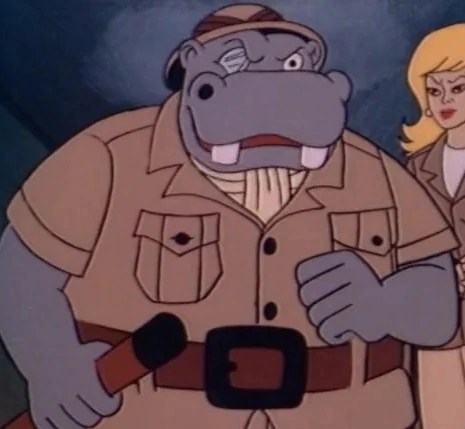
Submit to the power of the Hippotist!

You cannot resist his commands!

The mesmerizing Hippotist was a villain from the late 1970s Plastic Man cartoon. Yes, I know hippopotami are dangerous brutes, but even for Saturday morning cartoons, I find the idea of a mind-controlling anthropomorphic hippo a little bit out there.

#SFWApro.

Leave a comment

Filed under Miscellanea, TV

Women fighting for the good: two movies, two TV shows

Choosing the obscure character MADAME WEB (2024) to headline a superhero movie makes Morbius look high concept by comparison. Dakota Johnson plays EMT Cassandra Webb, who discovers her in utero exposure to mystical spider-venom has endowed her with precog abilities.

Those abilities eventually show her the sinister Ezekiel (Tahar Rahim) who gained spider-powers from the same venom is out to murder three girls he believes will become superheroes and kill him down the road. The girls are understandably freaked by Cass’ interest in them until Ezekiel makes them realize she’s on the level; can her powers help them survive against a guy who’s Evil Spider-Man?

This has gotten trashed as a terrible movie. I don’t think it’s that bad, equivalent to one of the better made-for-TV films in Cyborgs, Santa Claus and Satan. I particularly like Cass’ use of her abilities in the big fight with Ezekiel. But no, it ain’t anywhere near the level of a good MCU film such as Spider-Man: Far From Home. It’s also an odd mish-mash of elements; Madame Web is from Denny O’Neil’s dreadful run on Amazing Spider-Man, Ezekiel comes from J. Michael Straczynski’s run (I wasn’t a fan of that one) and the three girls are assorted spider-heroes (I believe they did work with Madame Web at one point but the ending still feels like a knockoff of DC’s Birds of Prey). If not great, it’s still superior to Morbius. “How would you know if you can climb walls if you’ve never really tried?”

DAMSEL (2024) got good reviews from some friends of mine. Certainly the set-up — a princess in an arranged marriage discovers she’s being set up as sacrifice to a dragon with a score to settle with the local royals. This spent too much time with the princess wandering around the spooky caverns and then wrapped up the plot too fast for me. “It’s not me you should fear — this is the end of your story.”

Moving on to TV, I rewatched the first season of iZOMBIE (2015) in preparation to watching the rest — I don’t know why I didn’t keep going when it aired originally as it’s a good show, based on a DC comic book. Rose McIver plays Liv, a newly turned zombie who controls her craving for brains by working in the morgue as a coroner’s assistant, which gives her easy access to freshly dead gray matter. Eating brains also gives her some of their memories and personality, which leads to her working with a cop (Malcolm Goodwin) to investigate murders, under the ruse she’s a psychic who can sometimes flash on information about the victims (in reality, she samples their brains).

What keeps this from becoming a straight Zombie Detective story is that there are quite a few zombies in town, the result of an experimental energy drink. Blaine (David Anders) is killing people to supply his fellow zombies with their needed food; Liv’s ex Major (Robert Buckley) suspects a kid he knows is one of the victims. Things get increasingly complicated as the season goes along … but throughout, McIver’s performance is top-notch whether she’s playing pure Liv or the personalities assumed after snacking. “Could I twirl like this if I were drunk? Probably but I wouldn’t look half so graceful.”

The first season of the Britcom THE VICAR OF DIBLEY (1994) introduces us to Reverend Geraldine Granger (Dawn French) who shocks a small village when she’s appointed their new Vicar because she’s a — you know — Not A Man! Gwen’s quirky humor and relatively free-spirited outlook rub local bigwig David (Gary Waldhorn) the wrong way so we see them feud over church policy and spending along with dealing with the other local eccentrics. One of the better British sitcoms I’ve seen in recent years. “I believe we’re surrounded by more butter than we realize, sometimes in cunning disguises.”

#SFWApro. All rights to images remain with current holders. Covers by John Romita Jr. (t) and Michael Allred.

Leave a comment

Filed under Movies, TV

Watching Turner Classic Movies in Greenville, SC

As TYG couldn’t attend the March Mensa gathering in Greenvile with me I spent time alone in my hotel room. That was fun—it’s not often I get to sit by myself free of pets—and it also led to me watching a lot of the Turner Classic channel when I was taking breaks from socializing (this is a repost from Atomic Junk Shop as last weekend’s con means I’m short of films to review).

I couldn’t resist tuning in, even knowing I wouldn’t be in the room long enough to finish anything. We don’t have cable at home — TYG cut the cord long before I moved up to join her in Durham — but back in Florida I loved TCM. Even though I have plenty of films available by streaming or my own DVDs, it was oddly cool to watch a film simply because it was on at that exact minute. Which is not to say the watching was always fun …

Case in point: I came in on the first film to find a family in a log cabin confronting a crisis. I had no idea what crisis at first but it turned out I’d tuned in The Yearling (1946) right before the boy protagonist has to shoot the injured deer he’s adopted as a pet. Aaaagh! I hate films and books where pet death, let alone killing your pet, becomes some kind of life lesson for children. But that’s the case here: at the end of the film, a relieved Gregory Peck tells his wife that their boy has grown — he’s no longer a yearling!

FATHER OF THE BRIDE (1950) was a lot more palatable, as witness I watched the whole thing after returning home. This stars Spencer Tracy and Joan Bennett as the parents who realize daughter Elizabeth Taylor is all grown up and in love; what follows is a low-key comedy of manners tackling such questions as whether Taylor’s in-laws will offend if they offer her parents a drink when they meet. Tracy shines as a guy struggling to adjust to the inconvenience of the wedding planning and to his shifting role in his daughter’s world. Some parts show their age — this was an era when marrying at 20 seemed perfectly normal — and Don Taylor as the bridegroom is too bland to match the rest of the cast.

Next up, 1936’s THE GREAT ZIEGFELD starring William Powell as the legendary showman and Broadway producer. I came in just as he’d resorted to some possibly illegal tricks to bring in a quartet of critics who think he’s lost his producing mojo. See any of his four current shows, he tells them, and they’ll change their minds.

After they leave Flo tells a friend it doesn’t matter what they think: he’s invested all his money in stocks bought on margin! When he cashes in, he’ll be so rich he’ll be on easy street! Why yes, the Black Friday crash of 1929 ruins him and he dies broken and penniless, little realizing how much joy his shows have brought to thousands. I might watch all of this sometimes, if only to see 1920s comedienne Fanny Brice (I’ve listened to some of Brice’s “Baby Snooks” radio routines and they’re hilarious).

After that I couldn’t bring myself to rewatch the 1931 tearjerker THE CHAMP with Wallace Beery as a drunken boxer struggling to take care of his kid. In case you’re wondering, this was 31 Days of Oscar month from TCM so naturally that includes a lot of tearjerking, tragedy and death.

Trying to find an alternative to The Champ reminded me not being bound by network schedules has its upside. While I knew the networks were no longer airing cartoons on Saturday morning, I didn’t realize it’s all news — specifically chatter about the Oscars. When I tried Cartoon Network, the channel glitched; SyFy was airing an infomercial.

CIMARRON (1931) did something none of the others did, push me to go online to read TCM’s schedule. I came in on a scene set apparently in an antebellum residence (judging by the faithful black servants) so I assumed it was some drama about the wonderful, nostalgic days of the old South when white men were men and the sheep were nervous. Nope, it turned out the home was just a launching pad for Richard Dix and Irene Dunne to head out west and homestead, accompanied by a goofy black kid servant providing not-aged-well comic relief.

All I knew about Cimarron before catching the piece of it that I did was that it was by Edna Ferber who also wrote Showboat (the online synopsis indicates it has some of the same marital tropes). Oh, and film historian Peter Stanfield cites it as the kind of serious Western like Stagecoach that critics love but did less box office and hit theaters much less frequently than the oft-disdained singing cowboy films of Gene Autry and Roy Rogers.

In any case, I won’t be catching the rest of it. I’m not much of a Western fan and Dix’ Southern accent falls into what for me is the nails-on-a-chalkboard range.

Overall the weekend didn’t leave me missing TCM as much as I’d have expected. But it was still fun.

#SFWApro. All rights to images remain with current holders.

1 Comment

Filed under Movies, TV