
THE GIRLS: An All-American Town, a Predatory Doctor, and the Untold Story of the Gymnasts Who Brought Him Down by Abigail Pesta looks at the case of Larry Nassar, the respected doctor for the US gymnastics team and for gymnasts at Michigan State, who took advantage of his position to molest and sexually assault hundreds of girls. Pesta tells the story through the accounts of a dozen or so of Nassar’s victims, starting with the girl who may have been his first to one of the last before everything crashed down.
The book shows serious competitive gymnastics was often an abusive environment to start with, as coaches pushed their students beyond the limits of safety and verbally abused them for not getting it right, being too heavy, being too stressed, etc. Nassar, however, was a whole ‘nother level of horror, fingering girls in what he claimed was a therapeutic technique; that he was such a prolific predator proved an advantage as obviously if he felt up every girl it had to be a standard technique, nothing weird, right? Pesta shows how Nassar groomed and charmed the gymnasts, and their parents; while some girls did report him, it never led to anything. Infuriatinly, though unsurprisingly, it wasn’t even a coordinated cover-up (that came later, when Michigan State got seriously worried) — dozens of different people independently took no action, either because they didn’t believe the reports or they didn’t want to challenge someone with Nassar’s rep or who knows why. The book is well executed but grim.
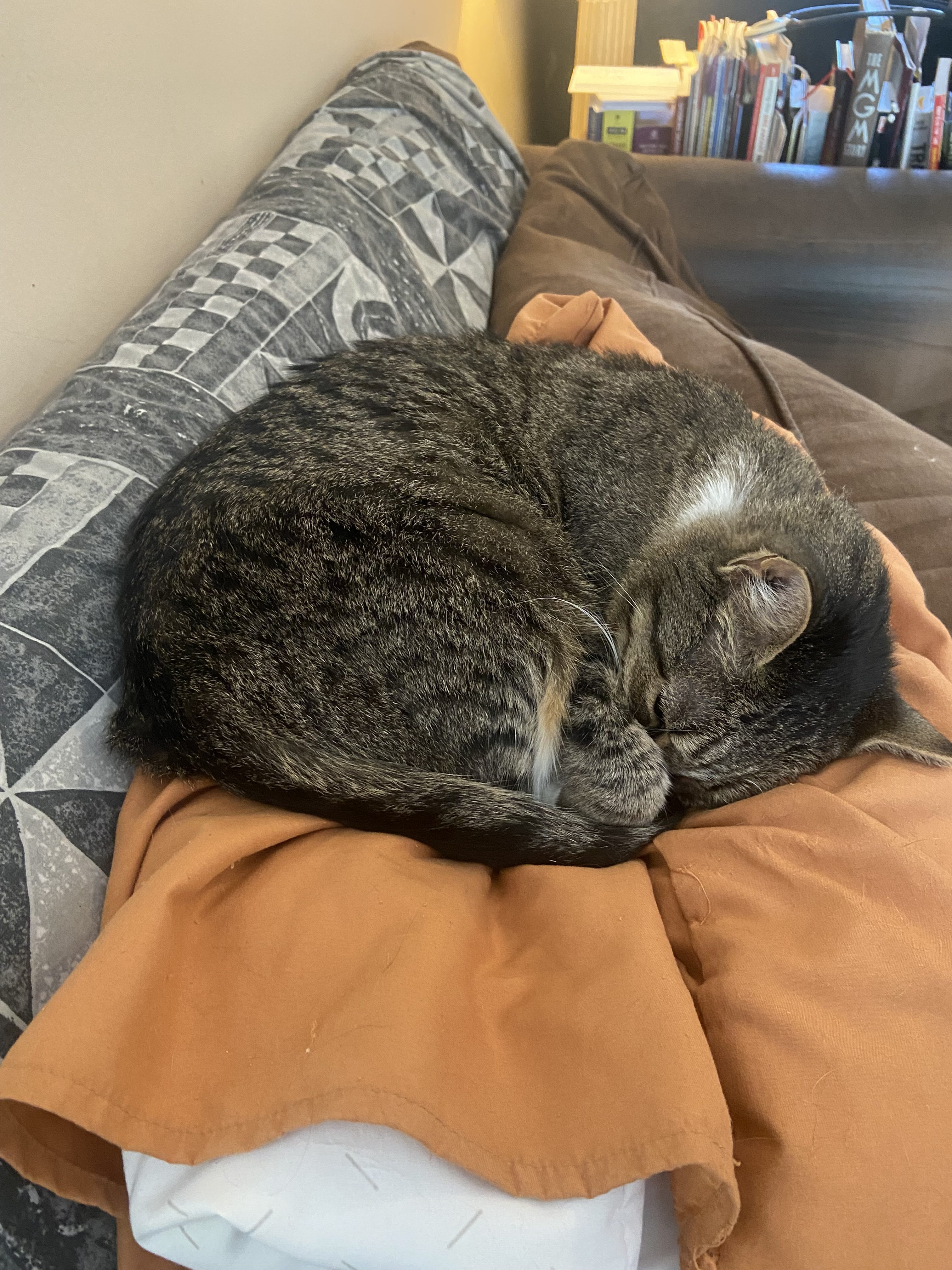
Which may be why I’m going with something more uplifting for my illustration, Wisp asleep:
Leigh Bardugo’s THE FAMILIAR is a romantasy in a similar vein to Lies that Summon the Night and Arcana Academy, with the protagonist forced to wield her magical powers for a sinister, attractive man with everything she needs except her freedom (in the words of the old Flash Gordon serial). In this case, though, Luzia is a scullerymaid in late 1500s Spain and a converso, a Jew who practices the Catholic faith. The Inquisition, though, suspects all such Jews as fake Christians so if anyone ever spots anything suspicious about her, she’s in trouble.
That makes it a major problem when Luzia magically repairs a burned loaf of bread: her employer notices and before long Luzia is swept up by a more powerful noble and placed in a contest to select a holy champion to serve the Spanish king. It’s risky; if anyone suspects her powers don’t come from God, the Inquisition will take her. However it’s a path out of a life where she will never be anything but a kitchen drudge, sleeping on an earth floor. Then there’s Santangel, her new employer’s strange, supernatural agent. Cold, cruel, ruthless, he sees her as nothing but a tool for his master … doesn’t he?
This worked much better than the two earlier books using this set-up. The real-world setting adds punch and making it a done-in-one suited me more than having it launch yet another series. On the downside, the Luzia/Santangel romance feels very perfunctory and the magic needed more explanation. I don’t need an elaborate magic system but I wanted some explanation why Luzia has her powers (Christian god? Jewish god? Satan?). As is, she might as well be a mutant. Despite those flaws, I really enjoyed this.


