

Al Plastino, the definitive Silver Age Supergirl artist (that close-up from this post is his work—all rights with current holder) passed away this week. So I’m going to indulge my comics love and talk Supergirl.
DC had done a couple of stories with one-shot Supergirls before the definitive version debuted in 1959’s Action 252. Superman arrives at the sight of a spaceship crash and discovers his sunny cousin flying out of the ship. She explains that her home on Krypton, Argo City, was hurled away from Krypton intact, surviving under a protective dome created by Superman’s uncle, Kara’s father, Zor-El. Kara Zor-El grew up to a teen there, but then the ground turned into kryptonite so her father, having observed Superman on Earth through a telescope, built a rocket to send her to safety before the kryptonite poisoning became lethal.
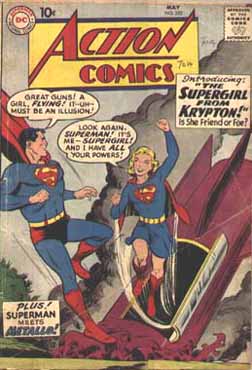
(Cover art by Curt Swan, rights with current holder)
Superman sets her up in an orphanage while training her to use her powers as his “secret weapon.” Over the next few years in her series (a backup to Superman in Action) she eventually got adopted (becoming “Linda Danvers’), went public as a super-heroine, went to college and around the end of the 1960s, acquired an arch-enemy (Luthor’s niece Nasthalthia) and went to work as a TV camerawoman. She also jumped from Action to the star of Adventure Comics.
As I’ve mentioned before, DC has a tendency to reinvent super-heroines over and over in a way it doesn’t do as often with male heroes. Leaping from Adventure to Supergirl to Superman Family (sharing the spotlight with Lois Lane and Jimmy Olsen), Linda Danvers was at various points an acting student, then a guidance counselor at a school for the gifted, then a soap opera actress, with a complete change in supporting cast every time.
Then in the Crisis on Infinite Earths, she died. For real. For good, or so it seemed. DC wanted Superman to be unique, no other Kryptonian survivors, and in the post-Crisis reboot she never existed, but Crisis let her go out in one blaze of glory.
Post-Crisis a new Supergirl did emerge, a lab-created shapeshifter whose physical powers, IIRC, were telekinetic rather than strength. She was a fun character for a while. Then Peter David—an admitted huge fan of the pre-Crisis Supergirl—had her merge with a suicidal woman named Linda Danvers. This kicked off a Supergirl book that didn’t really resurrect the pre-Crisis version but used a lot of its characters and concepts in new ways.
By the time the David book folded (he strongly implied the protagonist of a later series, Fallen Angel, was Supergirl, though), it was almost 20 years since Crisis and the commitment that all the changes were permanent had unsurprisingly worn off. So a couple of years later, a version of the original Supergirl, a fellow Kryptonian, made her appearance.
And she’s been an ungodly mess. We’ve had multiple different origins, constant shifting as to what she’s doing or who she works with and the few times that I’ve read an issue she comes off well, unpleasant. In Supergirl: Candor, she comes off as somewhere between Bad Girl and Self-Destructive Girl. In the reboot DC Universe, DC’s announced she’s going to become a Red Lantern, destructive counterparts of Green Lanterns, fueled by rage. She seems to have nothing in common with Superman’s heroic cousin from the pre-Crisis universe. Which wouldn’t be so bad, if she was, well, interesting, but it feels more like a dead end: they’re determined to use her (current Editor in Chief Dan Didio is obsessive about regressing as much of DC to the Silver Age as possible) but they really can’t think how. So they just fling stuff at the wall and hope it sticks (much like Hawk and Dove)
Sigh. Kara Zor-El deserves better.


If you like my blog …

Pingback: Comic Crush: Supergirl (Kara Zor-El) | Heroine Junkies
Republicou isso em Curiosidades na internete comentado:
Add your thoughts here… (optional)
Pingback: Everything You Ever Wanted to Know About Superman (But We’re Afraid to Ask) | Fraser Sherman's Blog