
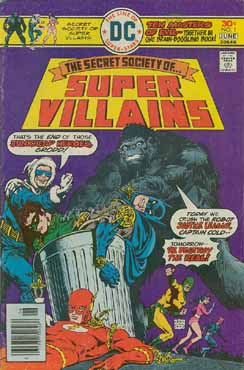
 DC’s 1970s Secret Society of Super-Villains is an interesting book to reread. It stumbles right out of the gate, but makes up for that by having, however unintentionally, an improvisational feel where you never know what’s coming next.
The original first issue had Darkseid contacting Clayface, Star Sapphire, Captain Cold Gorilla Grodd and Manhunter (a clone of the super-hero killed a few years earlier in Detective Comics) and recruiting them to steal an experimental military nerve gas. The villains realize he intends to use the gas as a tool for conquering Earth, double-cross Darkseid and vow to work against him (one of the staples of super-villain centered comics is to pit the bad guys against an even worse guy).
If this seems odd behavior for Darkseid——as if humanity can come up with better weapons than Apokalips——I’ll get to that below.
In any case, writer/editor Gerry Conway eventually reworked the whole concept and gave us a markedly different first issue (DC reprinted the original later in The Amazing World of DC Comics #11). Messages go out bringing a gaggle of super-villains to a San Francisco tower where Manhunter offers them the benefits of working for the Secret Society’s mysterious director, if they pass their initiation tests. At the end of the issue, Grodd passes his, while another villain, Copperhead flunks.
Reading this first-run, I loved it. There’d been super-villain teams before, and super-villain-centered books, but combining the two seemed to offer all kinds of potential for characterization and different stories. And the end of the first book announced next issue would see the return of Captain Comet, a super-hero not seen (at the time) since the mid-fifties.
Unfortunately, the gradual development of the secrets behind the society went out the window in #2.Captan Comet returns to Earth from 20 years traveling the stars and not knowing who the players are, winds up siding with the Society against Green Lantern (rereading, Comet’s assumption the Society are good guys is incredibly forced, based on things such as one villain telling GL “I won’t let you kill me”—because yeah, Green Lantern’s notorious for that).
Almost immediately, Manhunter reveals to him that Darkseid is behind the Society (as a more powerful version of his crime cartel Intergang) and that Manhunter is hoping to turn the villains against him. We then plunge into several issues of the villains going mano-a-mano with the Apokalips forces. The villains who choose to sit out (Wizard and Sinestro) meanwhile encounter Funky Flashman, a PR guy (another, very minor Kirby creation) who tries to convince them that what they need is most is PR slanted to give them a better image (“Why doesn’t anyone ever blame the heroes for the property damage? Why is it always the villains?”).
Shifts in the production team then brought this to an abrupt end: Manhunter reveals his clone body comes with built-in bombs so he throws himself on Darkseid and apparently blows him up. The letter column explains the production team want to build a series that doesn’t depend on failed older strips such as New Gods and Manhunter for its material.
The idea of Darkseid as a misfire sounds strange today, when the characters have been mined and recycled over and over, but at the time DC management saw New Gods as a low-rated, unsuccessful flop. When Darkseid showed up after the book’s cancellation,he was little indistinguishable from any other alien conqueror. The days when, as Keith Giffen put it, “DC editors pass Darkseid around like a bong” were far in the future.
(Part Two to follow).


If you like my blog …

Pingback: Secret Society of Super-Villains: Part Two « Fraser Sherman's Blog