
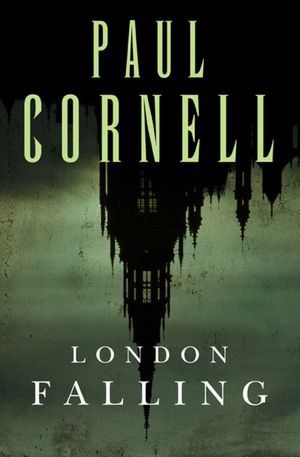
My April book for this series is Paul Cornell’s new urban fantasy, in which a London police squad tackling organized crime runs up against something much nastier.
The Story: The squad, led by DI Quill, is about to close the trap on Toshack, a slick gangster who’s slipped out of Scotland Yard’s grasp time and again. He goes looking for the mysterious “freelancers” who fix his problems, fails to find them, gets taken into custody—and then his head explodes in a shower of blood. Trying to figure it out, the cops get exposed to a jolt of magical energy that gives them second sight.
This, unfortunately, draws the attention of Toshack’s freelancer, a centuries old witch who’s also the ultimate soccer hooligan, murdering anyone who scores too many goals against her favorite team (this makes sense in context, trust me). Can they stop her before she kills again?
What did I learn?
•Newbies are interesting. As I’ve mentioned before, urban fantasies with rookie heroes who don’t know the magic work better for me than ones where the protagonists are already in on the game. Here the cops have no idea what they’re getting in for; the story proceeds smoothly from a straight police procedural to a supernatural cops vs. sorcery tale.
At the end, of course, the cops are in the know and become the familiar kind of ghost-busting protagonists I’ve seen before. I’m curious if that’s going to work against the second novel, though I’m still looking forward to it.
•Rapid-fire scene changes can work. I’ve mentioned before that I tend to have multiple-POV casts and I seem to lose everyone with the scene shifts.
Cornell gives his squad members a POV each, and a lot of times each protagonist gets only a few paragraphs before Cornell jumps to another viewpoint. It works when he does that, I think, because it happens when they’re all in the same scene and character one’s section follows almost immediately on character two’s. I’m much more likely to switch scenes as well as POV, which may be why it’s more confusing.
•What makes this interesting. There’s a line in one of G.K. Chesterton’s Father Brown stories (a Catholic priest who solves mysteries) that while the cops may lack Sherlock Holmes’ deductive skills, they have the advantage of being in the system: Holmes may deduce someone is a dangerous foreign spy, Lestrade may know it simply because the Yard tracks suspicious foreigners.
That’s pretty much how things work in London Falling. The cops approach this like any other case: Analyze motive, track the perp’s movements, predict her next move, talk to witnesses. Murphy in the Dresden Files doesn’t seem to do much police work beyond shooting people. These guys are cops through and through. It’s a distinctive approach (of course I don’t read a lot of urban fantasy so it may be quite common for all I know) and it helps keep the book grounded.
This one was both entertaining and instructive.
Is Our Writers Learning? London Falling by Paul Cornell (#SFWApro)
Filed under Is Our Writers Learning?, Reading


Pingback: Is Our Writers Learning: Severed Streets (#SFWApro) | Fraser Sherman's Blog