
This week I’ve been working my way through The Krypton Companion, a look at Superman from the 1950s through the 1980s. While I’ll go into it in more detail another time, one thing that leaped out at me—because it’s a relevant question for any writer—was one several writers and artists brought up: How do you challenge Superman? How do you give him a story problem he just can’t smash his way through? Of course, there’s kryptonite to even the playing field, but you can’t use that every time—so what do you do?
•The Puzzle Story.
Writer Len Wein described this (accurately I think) as the standard solution under Mort Weisinger’s tenure: Present an obstacle that can’t be solved by brute force. How can Superman prove that he isn’t really Clark Kent despite Lois getting conclusive proof? What is Luthor’s latest big and evil plan? Can Superman protect Jimmy Olsen from killers without revealing he’s around and spooking the killers off (several 1950s stories used this trick)?
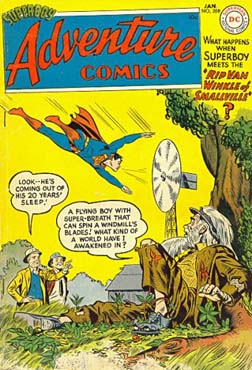
Or consider “The Rip Van Winkle of Smallville”: A man wakes up after 20 years in a coma, unaware how much time has passed. Superboy has to hide the truth until the man is stronger, for fear the shock will put him back in a coma, which requires thwarting the schemes of the man’s financial manager (who wants Rip back in a coma in order to retain full control of his finances). It’s not a problem he can solve by raw muscle.
•Find someone who can punch back.
Wein said that he created both the 1970s foe the Galactic Golem and the later alien conqueror Mongul (the book confirms it was Wein who created Mongul, even though he debuted in a Jim Starlin story) because most of Superman’s foes, like Luthor, were brainy types or technicians and he wanted someone who could actually slug it out with Superman.
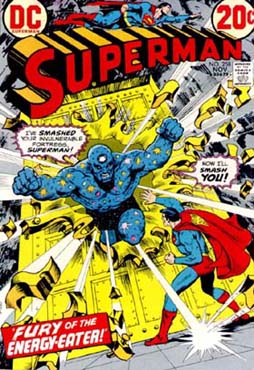 Interestingly, Dan Jurgens gave exactly the same reason for creating Doomsday in the 1990s.
The drawback to this approach is that it’s easy to go over the top as characters get more and more formidable: If you want to make a new character impressive, just make him more powerful than the last super-powerful villain and presto! (for example, the debut of Marvel’s Onslaught has him knocking the nigh-invincible Juggernaut around). And in some cases, the audience may not buy that the villain’s really that tough: I never bought that the Batman villain Bane could do as well as he did against Batman, for instance.
•Ethical Challenges
Writer Elliott Maggin took the novel stance that chopping Superman’s powers down to make him more vulnerable (something that’s been done multiple times over the years, though it doesn’t last) is a mistake: Part of what makes Superman intriguing, for Maggin, is having all that power and deciding how to use it. Confront him with an ethical conundrum—can even Superman decide the right thing to do?
That’s not an easy one to do on a regular basis, particularly in an action-oriented series, but it is a good tactic. Martin Pasko, in another interview, references one story he did in which Superman has to decide whether to rescue someone who (for good reason) wishes only to die. A story many years later (“What’s So Funny About Truth, Justice and the American Way”) has Superman forced to prove his humane, no-kill approach is a better choice than the murderous, take-no-prisoners super-team, the Elite (coming soon to a cartoon DVD, I note). Watchmen and Kingdom Come, in different ways, also deal with tough choices.
I don’t think there’s one right answer, for Superman or any character, but it’s interesting to look at the tools available.


If you like my blog …

Pingback: The (super)man and the Challenge | Fraser Sherman's Blog
Pingback: Movies and a Play | Fraser Sherman's Blog
Pingback: Slacktivist and Superman (#SFWApro) | Fraser Sherman's Blog