
SWORDS AND AGAINST DARKNESS III mercifully didn’t have any of the attempted rape-humor in the first two collections in the series. It does, however, have a depressing number of typos—having had friends publish with Zebra Books, I’m not terribly surprised, but given editor Andrew J. Offutt’s comments herein about the importance of professionalism, he must have been cringing. The best stories in this issue are Ramsey Campbell’s “Pit of Wings,” which once again merges horror with sword-and-sorcery well, and the first of Darrell Schweitzer’s tales of the damned medieval knight, Sir Julian. We also get Manley Wade Wellman, Tanith Lee and David Drake so it’s a good collect.
 Ah, optimism—WEIRD HEROES VOL. 3: Quest of the Gypsy by Ron Goulart (cover and interior illustrations by Alex Nino; all rights to current holder) was planned as the first of a six-book series, but we only got one more. Spinning off from a short story in the first volume, this has the amnesiac psi Gypsy battling bioweapon terrorists, robot sans-culottes, Tunisian pirates and a talking vulture in a chaotic, 21st-century Europe while trying to figure out who he really is and what this “game” he’s enmeshed in involves. Unfortunately, we never did get the answers.
Based on reader feedback, WEIRD HEROES VOL. 6 ran to SF rather than the action/adventure of the first collection. Unfortunately the switch doesn’t lead to a boost in quality: the only standout was Ben Bova’s time-traveling amnesiac superman Orion (who would go on to appear in novels outside the WH format). Ron Goulart’s ET detective Shinbet is fun but Philip Jose Farmer’s Greatheart Silver entry is tedious and Arthur Byron Cover’s Galacticu Gumshoe is way too self-conscious of being a hardboiled detective in a space adventure (that story makes me understand why some writers I know flinch from metafiction).
I’m idly curious if THE BEST OF JACK VANCE was his own selection as he admits tgat several of the stories are indeed personal favorites. While I didn’t care at all for “Sails” (the kind of obsess-over-tech set-up that kills my interest), the strangely convoluted societies of “The Last Castle” and “The Moon Moth” deserve to be here, as does the whimsical “Ullward’s Retreat” and the parallel-world story “Rumfuddle.” (“The waiter is Genghis Khan.”).
ON THE MAP: A Mind-Expanding Exploration of the Way the World Looks by Simon Garfield is an entertaining but scattershot look at maps ranging from the legendary British Mappa Mundi through Marco Polo, Mercator, the Silver Map (a medallion chronicling Drake’s round-the-world voyage), Britain’s Ordnance Survey, Churchill’s wartime map room and the modern debates over Google maps and what they do to our sense of the world (“Unlike a written map, digital mapping moves with you—so you really are always at the center of the universe.”). Unfortunately while almost all the bits are good (I could have done without the discussions of brain mapping and evolutionary psychology), Garfield’s breezy bouncing from topic to topic wore out its welcome much faster than in his Just My Type. This may be because the new book is 100 pages longer, or because I’d have liked a more serious touch at times. For example, while Garfield acknowledges in passing that maps are often a form of propaganda (how they present contested borders, for instance) he never devotes any space to that topic. And the fluffiest chapter, on mapping in videogames and D&D felt equally lacking: why not deal with fiction as well (L. Frank Baum had Oz mapped out more than a century ago). Interesting, but not satisfying.
Tag Archives: Jack Vance
And now, book reviews! (#SFWApro)
Filed under Reading
Books (#SFWApro)
No movies due to last week’s schedule madness
UN-AMERICAN WOMANHOOD: Antiradicalism, Antifeminism and the First Red Scare by Kim E. Nielsen looks at how anti-communist paranoia of the 1920s convinced large numbers of conservatives that suffragettes and feminists were at best dupes of the Bolshevik Menace, at worst willing co-conspirators, as their opposition to male dominance posed a threat to the manliness and family structure that America’s strength depended on. It was widely believed that along with abolishing private property, the Russian Revolution had deprived husbands of their property rights in their spouses—which meant not female independence but all women becoming state-owned (and supposedly ending up in state brothels as sex slaves). Likewise, left-wing opposition to child labor was seen as directly undercutting a father’s right to control his children. As someone who blogs about feminist issues, it’s really fascinating to see how the property rights of the husband were taken as a given by so many people back then; a good book.
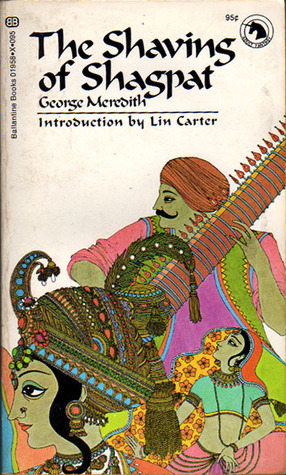
THE SHAVING OF SHAGPAT by George Meredith (cover by Ray Cruz, arts by current holder) is another of Ballantine Books Adult Fantasy series, a 19th century Arabian Nights tale in which hapless barber Shibli Bagarag discovers the reason barbers have become pariahs is the Ultimate McGuffin hidden in the hirsute face of the merchant Shagpat, bringing the entire world under his influence (so barbers becoming outcasts shields Shagpat from any risk of being shaved). However Shibli learns that if he can gather the right mystic talismans and a powerful blade, he can be the one to accomplish the title feat. Lush and entertaining, with some nice poetic touches (“His eyes were like two hollow pits dug by the shepherd for the wolf, and the wolf in them.”), though a bit too much poetry (Meredith’s initial publication came as a poet). And if you dislike fantasy versions of the East written by Europeans (I know some people hate that), this definitely isn’t for you.
THE WORLDS OF JACK VANCE is a short story collection by the recently deceased writer, the best of which is probably “The Moon Moth,” for its bizarre honor-bound alien culture. Close behind it is “The Brains of Earth,” a novella in which a scientist discovers Earth is trapped between two different alien mind-parasites (amusingly, when the protagonist gains psychic powers to fight them, his decision is not to go public until his powers help America win the Cold War!). In other stories, reality goes haywire, we learn what it takes to lead the Milky Way galaxy and ecoterrorists battle to take over an alien world. Vance’s flair for oddball cultures and his distinctive writing style are well displayed here.
Filed under Reading


